Search interesting materials

Showing posts with label urban reforms. Show all posts

Sunday, October 24, 2021

Resolving municipal distress in India

by Adam Feibelman and Bhargavi Zaveri-Shah.

In recent years, municipal bodies in India have been increasingly accessing the public debt markets. In the four year period beginning 2017 to August 2021, nine municipal corporations made bond issuances aggregating to Rs. 30 billion. In contrast, in the immediately preceding two decades, ten municipal bodies had issued bonds aggregating to less than half this amount. This is generally a positive development. Tapping financial markets expands the resources available to cities for critical services and development. Like firms that access the public markets, municipal bodies that subject themselves to market discipline are held up to higher standards of transparency and local governance. A key missing element in this story, however, is the lack of clarity about municipal creditors' rights in the event of a default by a borrowing municipal body. In a chapter published in the 2021 annual publication of the Insolvency and Bankruptcy Board of India titled Quinquennial of Insolvency and Bankruptcy Code, 2016, we argue that the time is ripe for policymakers in India to develop a re-organisation framework for financially distressed municipal bodies. We evaluate the potential of a formal bankruptcy regime as the model for such a framework.

The case for a municipal re-organisation framework

We make three arguments. We begin by demonstrating the weak state of municipal finances in India. For example, in the decade beginning 2007-08, municipal revenues stagnated at 1% of the GDP, significantly lower than comparable countries. Municipal bodies (urban local bodies or ULBs) are disproportionately reliant on state governments for grants in aid and loans. They are shown to have consistently under-invested in capital infrastructure. The pandemic has exacerbated the weak state of municipal finances in India. The size of the municipal debt market is, therefore, likely to grow as municipalities seek additional resources.

Second, we argue that the current legal regime in India provides neither opportunities for collective action against municipal debt default nor clarity on the treatment of creditors (bond holders, banks and financial institutions, state lending agencies, employees and vendors) in the event of the borrowing municipal body's insolvency. Very few municipal bonds are guaranteed by the state government. At one end of the spectrum, this creates the possibility of aggressive sale of public assets, owned and operated by the ULB for the benefit of the public, by 'powerful' creditors of the ULB. On the other end of the spectrum, this deprives the system of the benefits of early recognition of financial distress in ULBs. It minimizes the possibility of salvaging a ULB's operations through a mutually negotiated and court-supervised re-organisation exercise. The growing levels of municipal borrowing from the public markets and the impact of the COVID-19 pandemic reinforce these concerns.

Third, the standard re-organisation framework applicable to private borrowers does not apply to ULBs as they provide public goods, and most of their assets are presumably for public use. Several countries have enacted differently designed re-organisation frameworks for resolving distressed municipal bodies. We highlight the key features of one such framework, namely, Chapter 9 of the US Bankruptcy Code. To be sure, Chapter 9 has its critics. However, with more than 100 municipal entities having used Chapter 9 for their resolution, it has proven to be a viable municipal bankruptcy regime. It is a rule-bound process, but one that is flexible enough to be able to address the complex problems of government financial distress, which inevitably combine important commercial concerns with essential necessities of social well being. At the least, it helps frame a number of threshold and critical questions that should be part of any discussion on the reorganization of distressed municipal entities.

Key legal and institutional challenges

We conclude by underscoring some key legal and institutional challenges to the idea of a municipal bankruptcy law in India. First, while bankruptcy and insolvency is in the concurrent list of the Constitution, municipal governance is an intrinsically State subject. A union municipal bankruptcy legislation will raise complex questions of federalism and will require provisions that allow states to retain their autonomy in applying a union legislated bankruptcy law to their ULBs. What might be the institutional tools for preserving such autonomy?

Second, experience from the US suggests a pro-active role for courts in administering a municipal bankruptcy. Any framework in India will need to determine whether the court or administrator heading the process will have the power to supervise the functioning of public services during the ULB's insolvency proceedings. If so, this would be a fundamental departure from the design of the Insolvency and Bankruptcy Code, 2016, which seeks to minimise court intervention in the insolvency proceedings and provides for the appointment of Insolvency Professionals for running the debtor's operations. Similarly, the scope of relief that the process can legitimately provide in a ULB's bankruptcy proceeding will need to be considered. Can a resolution plan for a ULB contemplate an increase in taxes? Can it provide for the sale of the ULB-owned public property? How can it do so without impinging upon decisions that are the prerogative of a city level legislature or the state's power?

Enacting a municipal bankruptcy law will require the resolution of these questions and prolonged negotiations with states much like the enactment of the GST framework. However, this should not deter policymakers from beginning the process. The gains of a clear municipal bankruptcy framework, in the face of the severe impacts of the COVID-19 pandemic and the deteriorating state of India's cities, should provide a motivation for doing so. The fact that municipal bonds are set to become an important asset held by Indian households adds an additional imperative and responsibility to ensure that there is a framework in place for addressing municipal financial distress in India.


Adam Feibelman is a Professor of Law and Director of the Center on Law and the Economy at Tulane Law School. Bhargavi Zaveri-Shah is a doctoral candidate at the National University of Singapore.

Thursday, April 08, 2021

Measuring institutional capacity in property tax systems: A case study of ten cities in India

by Diya Uday.

Property tax is ubiquitous with municipal finance. It provides local governments with the means to execute development strategies. In theory, property tax is an ideal candidate for supporting fiscal strategies in decentralised economies because the tax base is immobile making base identification and enforcement relatively easy (Kelly 2013). There are indications, however, that in India, we have not succeeded in doing property taxation well.

A national-level indicator of the performance of property taxes is the percentage of revenue generated from property taxes to the national GDP. Studies indicate that the proportion of revenues from property tax to GDP in India is low when compared with other countries. At the state-level, where property tax is a major source of revenue, there is evidence of revenue shortfalls, indicating the need for reforms. The policy responses for increasing revenues from property taxation, include increasing tax rates, revising taxation criteria and suggesting floor tax rates. But will these interventions be successful in improving the performance of the property tax system in cities?

A key factor in determining the success or failure of any policy intervention is institutional capacity. Policy interventions such as increases in property tax rates assume that ULBs are operating at optimal levels of institutional capacity and therefore increases in tax rates, property values or even improvements in tech infrastructure will optimise revenues from property taxes. In particular, these policies are founded on two main assumptions:

  • that ULBs have adequate human resources and the technical capacity to assess and demand taxes correctly;
  • having assessed taxes correctly, ULBs have the enforcement capacity to collect the entire tax demanded.

To achieve revenue optimisation from property tax it is important to first get tax administration right. Without this, it is unlikely that local governments will be able to capture the full extent of the property tax potential even with tax rate increases or technological interventions. This raises the important question: what is the current capacity of ULBs in property taxation?

In the literature we see indications of deficiencies in the institutional capacity of ULBs in performing some major tax functions like tax collections (World Bank 2004; Mathur et. al 2009; Bandyopadhyay 2014). While these studies give us valuable insights, this literature is not recent. Institutional capacity may have improved over time given the recent concentration of schemes to improve local governance such as the Smart Cities Mission and the Jawaharlal Nehru National Urban Renewal Mission (JNNURM). There is a need for new studies that will give us insights into the current state of institutional capacity.

In this article, we therefore measure the institutional capacity of some property tax functions in a sample set of cities in India. Our aim in doing so is two fold:

  • to gain insights on the current level of institutional capacity in some property tax functions in a sample set of cities.
  • in doing so we attempt to demonstrate that policy interventions must not presume the existence of adequate institutional capacity.

Our findings contribute to the existing literature on the state of property tax administration in India. In addition to this, we question the current approach to measuring administrative functions in the property tax system. We suggest an alternative approach for a more accurate diagnosis of the problems in administration.

A case study of ULB capacity in ten cities

We undertake two levels of analysis. We first examine the institutional capacity of ULBs in property tax collections in a sample set of cities. We then analyse the human resource allocation in the property tax departments in some ULBs. We use our findings to gain insights on institutional capacity in ULBs in a set of sample cities.

Sample selection: Our selection of the cities was driven by the location of the city and the availability of data. Our final selection includes a list of metropolitan and tier-2 cities located across ten different states in India. The selected cities are Chennai, Pune, Indore, Vishakapatnam, Shivamoga, Varanasi, Surat, Warangal, Kota and Bilaspur.

1. Measuring collection capacity

Methodology: We measure collections by calculating the Tax Collection Ratio (TCR), a commonly used method for measuring tax collections. Applying this method, we calculate the TCR as the difference between the tax demand made and the actual tax collected across each of the five years for which the data was available in each of the sample cities (2013-2018). We then calculate the TCR as a percentage value. We use this percentage value as a proxy to demonstrate the level of administrative capacity of a given city by taking 100 per cent as the benchmark. For instance, if the TCR percentage of a given city is 90 per cent, we interpret this to mean that the city has 90 per cent institutional capacity. Such a city has a higher level of institutional capacity when compared with a city in which the TCR percentage is 80 per cent, indicating a higher deficit in tax collections.

Table 1 sets out (i) the average property tax collected in ten cities across five years and (ii) the minimum and the maximum property tax collection across years in the period of study.

Table 1: City-wise average property tax collections (2013-2018)
CityStateAverage TCR (%)Minimum tax collection (as a % of tax demanded in that year)Maximum collection (as a % of tax demanded in that year)
ChennaiTamil Nadu9074 (2013-14)106.60 (2017-18)
PuneMaharashtra96.3687 (2017-18)109.77 (2015-16)
IndoreMadhya Pradesh80.2572.16 (2014-15)106.48 (2016-17)
VishakapatnamAndhra Pradesh114.2924.42 (2017-18)265.52 (2015-16)
ShivamogaKarnataka98.3697.86 (2014-15)99.30 (2016-17)
VaranasiUttar Pradesh9692 (2013-14)98.97 (2017-18)
SuratGujarat84.6576.65 (2015-16)84.21 (2014-15)
WarangalTelangana79.8775.12 (2013-14)82.75 (2016-17)
KotaRajasthan58.8637.04 (2013-14)96.14 (2016-17)
BilaspurChattisgarh90.275.52 (2017-18)122.95 (2013-14)

Source: Author's calculations from Smart Cities Mission data

Findings: We find that no city in the sample has achieved 100 per cent TCR. Only one city i.e. Shivamoga has close to 100 per cent of tax collections. There is a deficit in property tax collection across all the cities in the sample (distance from 100 per cent collection of tax demanded). We do find, however, that half the ULBs in the samples have achieved the goal of 90 per cent efficiency as set by the JNNURM. We also find that there are variations in property tax collection across cities. While in some cities the collections are below sixty per cent (Kota), others have a much higher percentage of collection (Shivamoga and Pune).

We also see a variation in the TCR within the same city. For instance, Kota has a maximum TCR of 96.14 per cent in one year (2016-17) but a low TCR of 37.04 per cent in another (2013-14). Similarly, Vishakpatnam has an over collection of 265.52 per cent in the year 2015-16 but under collection of 24.42 per cent in 2017-18. Even in cities like Pune or Chennai, which have a high average TCR across five years (column 3), the minimum TCR (column 4) and maximum TCR (column 5) vary. In half of the cities in the sample, we also see tax collection exceeding the maximum tax demand in a single year (column 4) for Chennai, Pune, Indore, Vishakapatnam and Bilaspur.

2. Examining human resource allocation

Our second level of analysis examines the human resource capacity in the property tax departments in a set of sample cities. The human resources could affect the TCR in two ways: First, the technical capacity of the human resources to apply the rules correctly. For instance, the ability to correctly identify taxable properties, ascertain property values, apply the assessment formula to a given assessee and determine amounts due. Second, the number of personnel in the department could potentially affect the level of accuracy in tax functions. For instance, an inadequate number of resources could increase inaccuracies. In this analysis, we focus on the second aspect of human resources, the number the personnel to examine whether a higher number officers alone leads to a better TCR.

Methodology: We collected data on the number of officers in the property tax department in the sample cities for which this data was readily available. The cities for which this data was readily available were Chennai, Pune, Vishakapatnam, Shivamoga, Varanasi, Warangal and Bilaspur.

Given the paucity of data on the number of taxable properties in the city, we device an indicator to estimate the number of taxable properties in the city using proxies. For this, we first collect Census 2011 data on the number of households living in permanent structures within the municipal area. We then calculated the number of officers per 10,000 households. We also collect data on the total area (sq. km) of the city and compare this to the administrative strength.

Table 2 sets out the administrative strength of the property tax department, the number of households living in permanent structures within the municipal area, the estimated officer to households ratio (per 10,000 households) and the city area in the sample cities for which this data was available.

Table 2: Comparing city-wise human resource allocation and TCR
CityStateAverage TCR (%)Adminis-trative strength (no. of officers)No. of households in permanent structuresAllocation of officers (per 10,000 households)City area (sq. km)
ChennaiTamil Nadu9027610,40,94831,189
PuneMaharashtra96.36416,83,26717,256.46
VishakapatnamAndhra Pradesh114.29564,25,40916,501
ShivamogaKarnataka98.3612558,826218,477.84
VaranasiUttar Pradesh963211,64,014191,535
WarangalTelangana79.87681,41,7505406
BilaspurChattisgarh90.28057,292146,377

Source: City municipal websites and Census 2011

Findings: We find that some cities with higher a TCR, also have a higher officer to households ratio. For instance, Shivamoga has the highest TCR and the highest level of administrative strength. However, we see that cities with a low TCR, do not have the lowest administrative strength. For instance, Warangal is has the lowest TCR in the sample, but not the lowest officer to households ratio.

We observe that cities with similar TCR scores do not have similar personnel to households ratios. For instance, the officer to household ratios for similar TCR cities such as Varanasi and Pune or Chennai and Bilaspur are false, demonstrating a variation in human resource allocation even across cities with the same TCR levels. Further, cities with a larger area also do not always have a higher allocation of officers. For instance, Varanasi has a smaller area than Vishakapatnam, but a higher number of officers. Chennai has a smaller area than Shivamoga, but a higher number of officers than Shivamogga. We find not consistent pattern in the manner in which human resource allocation is done across cities.

Limitations: (i) We use the number of households living in permanent structures within the municipal limit as a proxy for the number of taxable properties in a city. This does not take into account the commercial property coverage of a city. (ii) Another proxy for the number of properties in a city is the area of a city, however, a larger city may be less dense and have fewer properties than a smaller and more dense city which may have a larger number of properties (iii) The estimates are only as accurate as the data available on government websites.

Learnings for property tax reforms

The findings from our case study offer insights for property tax policy reforms in ULBs:

Presumption of adequate capacity: Our study finds deficiencies in institutional capacity in tax collections across ULBs. From a reforms perspective, even if tax rates are increased, unless the present institutional capacity is improved, revenues from property taxes might continue to be affected. Further, while our study examines the institutional capacity in one tax function - tax collections, it is likely that there are deficiencies even across other functions. This may affect the outcomes from the current set of policy interventions which focus on increasing revenues by changing the design of the tax system rather than fixing the problems in the administration.

Effect of variation across ULBs: Our findings demonstrate a variation in the capacity of ULBs to carry out property taxation. We are therefore likely to see varying levels of success even for the same set of reforms across ULBs because of the different levels of institutional capacity.

Inconsistencies within ULBs: We not only see a variation in the TCR across ULBs, we also see variation in the TCR within the same ULB across different years. This is demonstrated by the variation in the minimum and maximum collection ratios of cities in our sample. This means that even cities with an overall higher average capacity might have low or high collections in a given year. For instance, the minimum TCR in Vishakapatnam is 24.42 per cent across five years and the maximum is 265.52 per cent. Similarly, the minimum TCR in Kota across five years is 37.04 and the maximum is 96.14 indicating a wide variation in the tax collections even by the same authority. While it is unclear why this is the case, this indicates some inconsistencies in capacity levels.

Management of human resources: Our findings indicate that the institutional capacity in property tax systems is not only a function of administrative capacity in terms of the number of personnel. For instance, while we see that Shivamoga has the highest officer to households ratio and the highest TCR, Pune had a lower officer to households ratio but has the second highest TCR. Similarly, despite having a similar TCR, Chennai and Bilaspur have very different human resource allocations. Therefore, increasing the strength of the administration alone may not yield better outcomes in the assessment and collection of property taxes. Instead, improving the technical capabilities of the administration or effective utilisation of the existing human resource capacity by ULBs might yield results. For instance, Bahl et. al 2013, suggest that tax authorities in developing countries are unable to capture economies of scale.

A new approach to measurement

In the course of this study, we found that the existing approach to the measurement of tax functions in the literature has two main problems. First, studies examine tax collections as an isolated administrative function and not as a product of the preceding tax functions. Second, because of this, these studies tacitly assume that the administrative processes that precede tax collections, such as the tax assessment and all the processes that make up tax assessment are accurately done. This in turn affects the diagnosis of the problems in administration.

We posit instead, that the property tax system comprises of a series of interconnected administrative processes that determine the overall outcome of revenue generation from property tax. Each process determines the success of the next. Errors in administering one process will have repercussions for the accuracy and success of the processes and functions that follow. For instance, tax collection is not just a product of the enforcement function of the ULBs. It is also a function of accurately assessing taxes due. Similarly, the accuracy of the tax assessment function is determined by (i) the maintenance of a database of all taxable properties in the city (ii) regular updation of this database, (iii) correct valuation of the properties in the database, (iv) correct application of the tax formula for these valued properties and (v) determining permitted exemptions. Table 3 set outs an indicative list of the functions that work to together form a chain of administrative processes which ultimately determine tax collections.

Table 3: Indicative list of processes involved in tax assessment and collection
FunctionProcesses
A. Accurate tax assessment i. Maintaining a property records database of all taxable properties
ii. Updating the property records database
iii. Correct valuation of properties in the database
iv. Correct application of the tax formula
v. Correct determination of exemptions and concessions
B. Accurate tax collectioni. Making a correct tax demand (= Ai+Aii+Aii+Aiv+Av)
ii. Enforcement to collect tax demanded

When we break down administrative functions into smaller processes and view each function as being linked to the next, the result of measuring of any one administrative function will provide us with insights on the accuracy of not just the function being measured but also the previous functions in the chain of administration. For instance, the TCR of a ULB is an indication of the institutional capacity of not only tax collection but also of assessing tax correctly and getting the processes associated with the functions of assessment and then collection right. In this view, a TCR of 90 per cent potentially indicates not only a failure by the ULB to recover 10 per cent of the tax demanded but also potential inaccuracies in assessment for 10 per cent of the tax demanded, leading to appeals and pending cases on account of which payment might not have been done by assesses.

Our learnings from the case study, therefore, are not indicative of capacity issues just in tax collection, but could also be on account of inaccurate tax assessments. This analysis, in line with reports on poor tax assessments in ULBs.

This approach has two advantages over the traditional approach. It breaks down and highlights all the processes involved in property tax administration. In doing so, it allows us to more accurately diagnose the specific function at which the process fails.

Conclusion

We carried out this case study to demonstrate the importance of institutional capacity in the property tax system of ULBs. We have two main findings which are as follows:

First, we demonstrate that the problems in institutional capacity exist across a majority of our sample cities. This signals that there are potential capacity problems in many if not all cities across India. It is unclear therefore whether the present set of interventions to increase property tax revenues will yield optimum outcomes. Our findings demonstrate that it is important to precede policy interventions with the measurement of institutional capacity in the property tax system. We cannot presume the existence of adequate institutional capacity. This is in line with the literature that suggests that infrastructure and institutions are the foundation for achieving effective policy outcomes (Kelkar and Shah 2019, Pritchett et al 2012, Subramaniam and Felman 2021).

Second, deficits in the TCR are not just signals for improving capacity in tax collections and enforcement but also in tax assessment and all allied administrative processes. It is therefore difficult to diagnose which part of the property tax administration requires reform. A failure at any one point of the system has repercussions for the remaining functions. We, therefore, need a comprehensive framework for measuring institutional capacity at the level of each process of the property tax system, some of which are illustrated in Table 3.

Our study also demonstrates that while most cities have some way to go, some cities have achieved higher levels of TCR than others, indicating that they have perhaps learnt to do assessments and collections better than others. We also see that some cities appear to have achieved better utilisation of administrative strength than others. There are perhaps lessons in tax assessment and collection in these cities that other ULBs in India can learn from. A case study of the good practices in collection and assessment in these cities might offer insights for better property tax administration in other cities in India.

References

Arvind Subramaniam and Josh Felman, The Economy and Budget: Diagnosis and Suggestions, January 2021.

Matt Andrews, Lant Pritchett, Michael Woolcock, Looking Like a State: Techniques of Persistent Failure in State Capability for Implementation, CID Working Paper No. 239 June 2012.

O. P Mathur, Debdulal Thakur and Nilesh Rajyadhyaksha, Urban Property Tax Potential in India, National Institute of Public Finance and Policy, 2009.

Roy W. Bahl, Johannes F. Linn and Deborah L. Wetzel, Governing and Financing Metropolitan Areas in the Developing World, Lincoln Institute of Land Policy, Pages 1-30, 2013.

Simanti Bandyopadhyay, Municipal Finance in India: Some Critical Issues, ICPP Working Papers 14-21. May 2014.

Roy Kelly, Making the Property Tax Work, ICEPP Working Papers. 42, 2013.

Vijay Kelkar, Ajay Shah, In Service of the Republic: The Art and Science of Economic Policy, 2019.

World Bank, India: Urban Property Taxes in Selected States, 2004.

Diya Uday is a senior researcher at the Finance Research Group, Mumbai. The author would like to thank Ajay Shah, Susan Thomas and the anonymous referee for their valuable insights, comments and guidance for this work.

Saturday, May 23, 2020

Do stamp duties affect transaction volumes? A study of real estate transactions in Mumbai

by Diya Uday.

The real estate market in India has many factors that cause price inefficiencies. The outcome is that investors will stay away from real estate markets as long as these inefficiencies exist. So how can market efficiency and thereby participation be increased? The Coasian answer is that a market will yield efficient outcomes in the absence of transaction costs.

What constitutes real estate transaction costs in India? Transaction costs are of two kinds: manifest and hidden. Manifest costs are apparent. They are borne by the parties to the transaction and not the market as a whole. They are quantifiable and therefore lend themselves well to observation and possibly measurement. Hidden costs are not statutorily imposed by the government but they increase the cost of conducting transactions. They may be identified but are difficult to quantify and therefore do not lend themselves well to measurement. Some of these are borne by the parties to the transaction while others hidden costs such as price distortions are borne by the market as a whole. In a previous article we argued that price distortions are the unseen consequences of restrictive land market regulations (Uday, 2019). The table summarises this typology of transaction costs with some examples.

Typology of land market transaction costs in India
Manifest transaction costsHidden transaction costs
Stamp duties Title searches
Registration chargesIntermediary charges
Cost of updating government recordsPrice distortions

Having identified some transaction costs, we attempted to determine the effect of stamp duties on transaction volumes, using Mumbai as the environment under examination. We ask the question: Do transaction volumes change after an increase in stamp duty?

Our motivation for conducting this study is to gain some insights on the relationship between stamp duties as a transaction cost and transaction volumes in the Indian real estate market.

In the literature we see that stamp duties are considered as taxes that cause market inefficiencies (Maatanen and Tervio, 2019). They discourage mutually beneficial transactions and ensure that properties are not held by the people who value them the most (Mirrles et al., 2011). An increase in stamp duty leads to a decline in the number of sales (Dachis et al., 2012). This decline is attributable to a reduction in property prices (Davidoff and Leigh, 2013; Dachis et al., 2012). Similarly, elimination of stamp duties, increases transaction volumes (Best and Kleven, 2018). The literature that examines the effect of stamp duty interventions on transactions uniformly finds that transaction volumes react to stamp duty interventions.

Methodology and findings

For this study, we selected three types of transactions: conveyance, lease and mortgage. We first extracted transaction volumes data for these transaction types in Mumbai, from the website of the Department of Registration and Stamps in Maharashtra. We then calculated the total yearly transaction volumes for each of the three transaction types across all the years for which the data was available (July 2012 onwards). We extracted all notifications which amended stamp duty rates for the relevant period of the study (July 2012 - February 2020). From these, we selected the notifications applicable to conveyances, leases and mortgages only. The selected notifications were then sorted by month and year.The following interventions were studied:

  • Maharashtra Tax Laws (Levy, Amendment and Validation) Act, 2012 notified on 15 April, 2012
  • Maharashtra Stamp (Amendment) Act, 2015 notified on 24 April, 2015
  • Maharashtra Stamp (Second Amendment) Act, 2017 notified on 7 September, 2017
  • Mumbai Municipal Corporation (Second Amendment) Act, 2018 notified on 17 December, 2019

These interventions were overlaid on the transaction volumes data in the appropriate point in time. A cross-sectional observation of the effect of the increases in stamp duty on each transaction type was done.

This analysis yields the following observations:

  • Conveyance transactions: There are three relevant interventions in the form of amendments to the law on stamp duty rates for conveyances for the period under examination. The first amendment was notified on April 25, 2012 by Maharashtra Tax Laws (Levy, Amendment and Validation) Act, 2012. Under this amendment the stamp duty on conveyances within the limits of the Municipal Corporation was increased from 4 per cent to 5 per cent of the market value of the property. The stamp duty for conveyances within the Municipal Council and cantonment areas was increased from 3 per cent to 4 per cent of the market value of the property. In both cases, there was an increase of 1 per cent. The second amendment was notified on September 7, 2017 by Maharashtra Stamp (Second Amendment) Act, 2017. Under this amendment the stamp duty payable on transactions in Municipal Council and Cantonment areas was increased from 4 per cent to 5 per cent of the market value. The third intervention was the Mumbai Municipal Corporation (Second Amendment) Act, 2019 notified on December 17, 2019. Under this amendment a surcharge of 1 per cent is charged on conveyances in the certain areas. In these places, the stamp duty payable on conveyance transactions is effectively increased to from 5 per cent to 6 per cent of the market value.

    For the first stamp duty intervention in 2012 we do not observe a drop in the transaction volumes. In fact we see a steady increase in the year 2012 despite an increase in the rate of stamp duty until 2013. After 2013, the transaction volumes are on an upward trend until 2018. We do not observe an immediate drop in transaction volumes after the second intervention. We see that the upward trend from 2016 continues despite an intervening increase in stamp duty. From the year 2018 we observe a drop in the number of registered conveyance transactions. At its lowest point, the number of registrations were the lowest since the later half of 2012. The downward trend from the year 2018 continues into 2019.

    One might theorise that the drop in transaction volumes from 2018 and into 2019 are the effect of the stamp duty interventions in 2017 and 2019. However, a look at the trends in transaction volumes of leases and mortgages also reveals a fall in the number of registered transactions from the year 2018. This indicates that the reduction in transaction volumes is likely to be on account of some other variable that affected the real estate market as a whole rather than on account of the increase in stamp duty rates. Figure 1 depicts conveyance transaction volumes in Mumbai for the period from July 2012 to February 2020. The dotted lines represent relevant stamp duty interventions in the month and year of the intervention.

  • Lease transactions: There are two relevant interventions on stamp duty rates for lease transactions in the period under examination. The first intervention was the Maharashtra Tax Laws (Levy, Amendment and Validation) Act, 2012 notified on 15 April, 2012. This amendment applied to conveyances and not leases directly. However, we are considering this a relevant intervention for leases because the stamp duty for lease transactions is a percentage of the stamp duty for conveyance transactions. Therefore, any change in the stamp duty for conveyances will cause a consequent change to the stamp duty for lease transactions. Since the 2012 amendment increased the stamp duty for conveyances, it consequently increased the stamp duty for lease transactions. The second intervention for lease transactions was the Maharashtra Stamp (Second Amendment) Act, 2017 notified on September 7, 2017. Again, this amendment did not directly apply to lease transactions however, given the linkage between the stamp duty payable on conveyances and leases as explained above, we have included this amendment as a relevant intervention for lease transactions. Under this amendment, the stamp duty for conveyances was increased, thereby increasing the stamp duty for lease transactions.

    We observe no immediate effect of the increase in stamp duty on lease transaction volumes for both interventions. However, as observed with conveyance transactions we see a continuing upward trend in transaction volumes in the period immediately after the increases in the stamp duty rates by both interventions. After 2018, we observe a downward trend in transaction volumes. This continues into 2019. This trend has been observed with conveyance and mortgage transactions as well and is therefore, likely on account of some other variable affecting the real estate market as a whole rather than the increase in stamp duty. Figure 2 depicts lease transaction volumes in Mumbai for the period from July 2012 to February 2020. The dotted lines represent relevant stamp duty interventions in the month and year of the intervention.

  • Mortgage transactions: There are four relevant interventions on stamp duty rates in the period under examination. The first intervention was the Maharashtra Tax Laws (Levy, Amendment and Validation) Act, 2012 notified on 15 April, 2012. While this amendment was for conveyances and not directly for mortgages, we consider this a relevant intervention because the stamp duty for mortgage transactions is a percentage of the stamp duty for conveyance transactions. Therefore, any amendment to the stamp duty for conveyances is a relevant intervention for mortgage transactions. Since the 2012 amendment increased the stamp duty for conveyances, it consequently increased the stamp duty for mortgage transactions as well. The second intervention was the Maharashtra Stamp (Amendment) Act, 2015 notified on April 24, 2015. Under this amendment, the stamp duty payable on a mortgage was increased from five hundred rupees to 0.5 per cent of the amount secured by the mortgage subject to a maximum of ten lakhs. The third intervention was notified on September 7, 2017 by the Maharashtra Stamp (Second Amendment) Act, 2017 whereby the stamp duty for some conveyances was increased to 5 per cent of the market value. Given the linkage between stamp duties for conveyances and mortgages, we have considered this a relevant intervention. The fourth intervention, is the Mumbai Municipal Corporation (Second Amendment) Act, 2019 notified on December 17, 2019. Under this amendment a surcharge of 1 per cent is charged on mortgages in the certain areas, increasing the overall stamp duty payable on mortgage transactions.

    As observed in case of lease and conveyance transactions, we observe no immediate reduction in the transaction volumes after increase in stamp duty by the 2012 intervention. We do observe a fall in the transaction volumes immediately after the 2015 amendment either.This appears to be a continuation of a downward trend in mortgage transaction volumes from the beginning of 2015. While we cannot say for certain, perhaps the sharpness of the downward trend could be affected by the increase in stamp duty. One may have observed a more gradual decline in the downward trend if the stamp duty has remained unchanged. We cannot however, verify this. After the short-term reduction, transaction volumes for mortgages increase until 2018 when a a sharp decrease in the transaction volume is observable. This downturn is consistent with the downturn we observe in respect of the transaction volumes of conveyances and leases and we therefore, cannot attribute this to increased stamp duties alone. Figure 3 depicts mortgage transaction volumes in Mumbai for the period from July 2012 to February 2020. The dotted lines represent relevant stamp duty interventions in the month and year of the intervention.

Limitations:

  • The study has been done for the period from July 2012 upto February 2020. This is on account of the lack of published transactions volume data for the period prior to July 2012 from the website of the Department of Registration and Stamps in Maharashtra.
  • This study observes the effects of stamp duty interventions on three types of real estate transactions only.
  • The increases in stamp duties have not been significant.
  • We have not controlled for the effects of other events in the real estate market on transaction volumes. However, we proceed on the assumption that a change in the market as a whole will affect all three types of major transactions. For example, an increase in interest rates for home loans will affect not just conveyances but also mortgage transactions and possibly leases. The observations for 2018 are in-line with this reasoning.
  • The represented data is year-on-year and does not report month-on-month changes to transaction volumes.
  • The sharpness of the increase in transactions in the year 2012 maybe smaller than what is being observed as we only have data from July 2012.
  • The data does not distinguish between primary and secondary market transactions or residential and commercial transactions.

Conclusion

We undertook this study to determine the effect of stamp duties on transaction volumes by attempting to answer the question: Do transaction volumes change after an increase in stamp duty? Our motivation for doing so was to gain insights on the relationship between stamp duty as a transaction cost and transaction volumes in the Indian real estate market.

We did not observe any immediate decreases in transaction volumes in Mumbai pursuant to increases in stamp duties. This is a departure from global literature which suggests that transaction volumes decline with increases in stamp duties. However, our data offers some insights which are as follows:

First, while we may not observe immediate changes in any transaction volumes pursuant to stamp duty interventions, we observe that all three types of transactions follow some common trends. For example, there is an increase in transaction volumes across all transactions types in 2017 and a significant drop in transactions across all transaction types from the year 2018. This decline continues into 2019. This is significant because it indicates the existence of market variables that affect all transactions regardless of the type of transaction. These variables appear to have a possibly greater impact on transaction volumes than changes in stamp duties do.

Further, given that stamp duties are among the larger manifest costs, it is likely that we will not be able to observe any changes in transaction volumes if smaller manifest costs are changed. The variables affecting all transactions types in common are therefore perhaps hidden costs.

Second, the lack of volatility in the period immediately following an intervention may be indicative of a thin market where only the bare minimum on-market transactions are taking place. Transaction volumes are therefore not likely to be affected by rises in stamp duty rates. This confirms our view that despite the high market value of real estate assets in Mumbai, transactions are likely to be taking place out of necessity rather than for investment purposes, unlike in other countries where such studies have been conducted.

Third, we know that real estate transactions in India have a cash component. Given this, transactions are unlikely to be significantly affected by small increases in stamp duty.

Does this also mean that the converse is true? Will reductions in stamp duties increase transaction volumes in the real estate market in India? Literature indicates that significant changes such as tax holidays have more sizeable effects on transactions (Besley et al., 2014). For instance, a temporary elimination of transaction taxes was found to increase real estate market activity by twenty per cent in the UK (Best and Kleven, 2018). Less significant reductions in stamp duties are unlikely to have a sustained and significant effect on market participation, given the state of the Indian real estate market. While small reductions in stamp duty rates may seem like low hanging fruit with which to fix the problems of a thin market, this study indicates that without addressing the other variables that appear to be affecting transaction volumes, it is likely to be a blunt policy intervention. However, governments tend to lean towards offering stamp duty concessions to boost market participation. This is not the shot in the arm that the real estate market needs.

Since the Indian real estate market appears to present a unique case, the answer to increasing participation perhaps lies in a bundle of interventions aimed at addressing and reducing both hidden and manifest transaction costs. Some of these could be the removal of land market restrictions that have distortionary effects on the market (Uday, 2019), increasing information symmetry by creating more comprehensive land records (Shaikh and Uday, 2018) and the creation of streamlined market places which allow easy trading of real estate assets.

References

Besley et al., 2014, The Incidence of Transaction Taxes: Evidence from a Stamp Duty Holiday, Timothy Besley, Neil Meads and Paolo Surico, Journal of Public Economics, Volume 119, November 2014.

Best and Kleven, 2018, Housing Market Responses to Transaction Taxes: Evidence From Notches and Stimulus in the UK, Michael Carlos Best and Henrick Jacobsen Kleven, The Review of Economic Studies, Volume 85, Issue 1, January 2018.

Dachis et al., 2012, The Effects of Land Transfer Taxes on Real Estate Markets: Evidence from the Natural Experiment in Toronto, Ben Dachis, Giles Duranton
and Mathew A. Turner, Journal of Economic Geography, Volume 12,
November 27, 2012.

Davidoff and Leigh, 2013, How Do Stamp Duties Affect the Housing Market?, Ian Davidoff and Andrew Leigh, Economic Society of Australia, Volume 89 No. 286, September 2013.

Maatanen and Tervio, 2019, Welfare Effects of Housing Transaction Taxes: A Quantitative Analysis with an Assignment Model, Niku Maattanen and Marko Tervio, European Research Council, 2011.

Mirrlees et al., 2011, Tax by design, James Mirrlees, Stuart Adam, Tim Besley, Richard Blundell, Stephen Bond, Robert Chote, Malcolm Gammie, Paul Johnson, Gareth Myles and James M. Poterba, Institute for Fiscal Studies, Economic and Social Research Council, September 2011.

Shaikh and Uday, 2018, Rethinking urban land records: A case study of Mumbai, Gausia Shaikh and Diya Uday, The Leap Blog, November 1, 2018.

Uday, 2019, How land laws create dead capital, Diya Uday, The Leap Blog, July 15, 2019.


Diya Uday is a senior researcher at the Finance Research Group, Mumbai and visiting faculty at the Tata Institute of Social Science, Mumbai. The author would like to thank Ajay Shah and the two anonymous referees for their comments and suggestions.

Friday, December 14, 2018

Concerns with Delhi Metro

by Shubho Roy and Ajay Shah.

The primary input that goes into an infrastructure project is money. In the case of the Delhi Metro, cost estimates run to Rs.5.52 Billion per km for the underground stretches and Rs.2 Billion per km for the over-ground stretches. The construction cost does not include the cost of land, which the government provides at a subsidised rate.

Turning to the revenues, the arithmetic is clear. The revenue of Delhi Metro comes from the price per ride and the number of rides. To fix intuition, suppose we spend Rs.100 on an asset. Suppose the capital requires annual payments of Rs.10 per year. The infrastructure asset has to then generate at least Rs.10 of cash per year, after paying for the (small) running costs. This cash can come about in many ways, e.g. sell 1 ticket at Rs.10 or sell 10 tickets at Rs.1, and so on.

The cost of capital in India is relatively high, given the presence of high macro/financial risk and a closed capital account. The annual cost of servicing the debt and equity capital, that goes into such projects, will be higher than is the case elsewhere in the world. The costs of building an urban metro system in India are similar to those seen elsewhere in the world. But the same infrastructure asset has to generate a higher revenue stream in India given a higher cost of capital. This means that the user charge or the intensity of use, or both, have to be higher in India.

Hence, to think about the viability of the Delhi Metro, we have to examine the extent to which it beats global benchmarks in user charges or intensity of use or both.

User Charges

User Charges for Metro
PriceMetro

As the graph above shows, Delhi Metro has one of the lowest user charges in the world, when compared with other large metro systems. So we're not getting through on this one.

Intensity of use

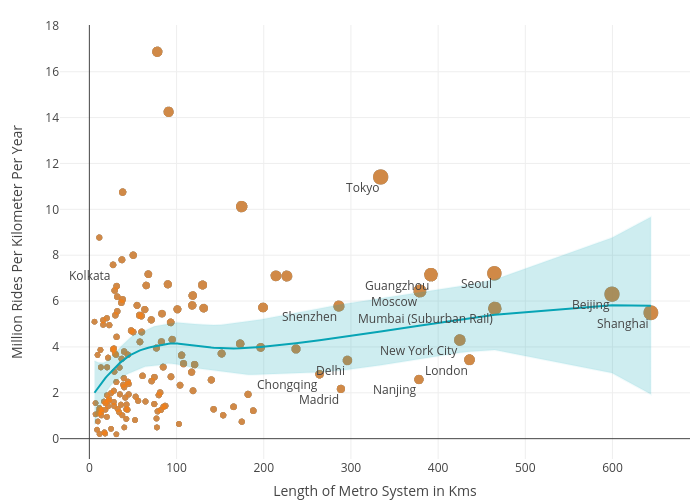
We could just look at the number of rides in the Delhi Metro. Matters become a little more complicated for international comparisons, as the number of rides varies (slightly) with the length of the metro system. Bigger metro systems get somewhat more rides. To compare apples with apples, we look at how Delhi Metro should have fared in the context of these relationships, as observed worldwide.

Rides per Km
ridership

As the graph above shows, on this metric also, the Delhi Metro fares poorly. Delhi Metro is out of line when compared with the relationship seen worldwide. In this graph, the size of the bubble is proportional to total annual rides. Mumbai's ancient train system is faring well in translating kilometres of track into rides. The old Kolkata Metro also does a pretty good job in generating rides per km of track. But Delhi is not.

Thus there is a financial problem

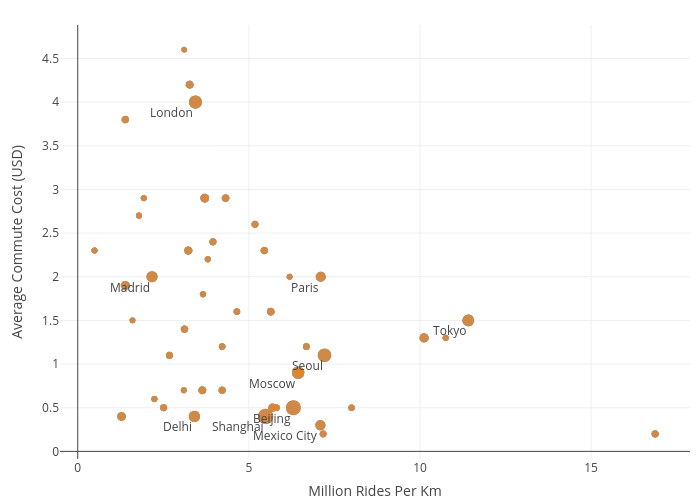
The cost of a metro system in many big cities of the world is similar. The dominant element of this cost is the cost of capital. This is a more significant barrier in India, as the cost of capital is higher in India when compared with most large countries. To make ends meet, a metro system has to achieve the required cash flow by having an adequate user charge multiplied by the number of rides. In Delhi Metro, we are faring poorly on both counts: We don't have an adequate user charge, and we don't have the required number of rides.

Rides and User Charges
rdkmPricePlot

As the graph above shows, Delhi fares poorly on both Rides per Km per Year and the average price charged for a commute. The size of the bubble represents the size of the metro system.

Suppose we treat Shanghai as a benchmark. Their charge is similar to that in Delhi, but they get 5.49 million rides per km of track against Delhi's 3.41. There is a gap of about 60%.

How could this gap be closed by holding prices intact? Last year, Delhi's metro system was 296 km long. Delhi would need to get 615.68 million more rides per year without increasing track length, to catch up with Shanghai. That is a 60% rise from Delhi's 2017 ridership of 1007.9 million rides.

Conversely, to obtain the same revenue per km of track, Delhi needs to charge 60% more per ticket. This seems far more feasible.

As Delhi adds more lines next year, the denominator will grow. This will translate into a bigger challenge in terms of obtaining the requisite number of rides.

Positive externalities

We could argue that Delhi Metro is all about positive externalities and that we should not be so worried about the lack of revenues. We can then use other means like taxes to pay for the system. In this vision, the essence of urban infrastructure lies in promoting dense interactions between residents. This is measured by counting the rides per capita. A metro system is inducing large positive externalities if it achieves high values of rides per capita per year.

Rides per Capita riderpercapita

As the evidence above shows, Delhi Metro fares poorly on the rides per capita per year. Delhi is not a small metro system. It now ranks on amongst the top ten metro systems. As the graph shows, in such large systems, the rides per capita should be higher, as the metro network covers the city better.

For an example, Delhi and Madrid are both at about 200 kilometres of line. But in Delhi, there are 25 rides per person per year, while Madrid is at about 100. We are about 4 times worse than we ought to be.

Conclusions

To justify infrastructure assets such as Delhi Metro, we in India have to find exceptionally large user charges, given the difficulties of macro/finance policy which impose an elevated cost of capital. Or, to the extent that the direct revenues are inadequate, we have to justify the expenditure based on an externalities argument.

Delhi Metro is faring poorly on all three fronts. The cost per ride is low, i.e. the user charge is inadequate. The number of rides per year is low. The intensity of usage is low. We have a problem.

We conjecture that part of the problem may lie not in Delhi Metro but in Delhi's urban planning. Delhi is a vertically challenged city, with severe restrictions on the number of floors a person can build. This FSI restriction creates large areas of low-density housing. For example, the IIT Delhi Metro Station is bound by IIT Delhi on one side and the Green Belt on the other. IIT Delhi has a student population of less than 8,000 and the Green Belt is entirely uninhabited for a few kilometres. In effect, the IIT Metro Station does not have a catchment area of an adequate number of potential customers.

The authors would like to thank Vimal Balasubramaniam, Devendra Damle, Ashim Kapoor, and Shalini Mittal for valuable contributions.

Tuesday, March 13, 2018

Analysing The Odisha Land Rights to Slum Dwellers Act, 2017

by Jai Vipra.

Slum rehabilitation in India is plagued with issues of dispossession, illegal subletting, corruption and exclusion. In a previous post, I had described the concept of 'working titles', or titles to slum land that provided some, but not all, property rights to slum dwellers, usually tied to provision of municipal services, infrastructure, housing upgradation or credit. Such working titles could avoid the political economy and institutional problems encountered in slum rehabilitation policies in India.

In a welcome move, a working title was created in Odisha, a state where roughly 23% of the urban population (5,00,000 households) lives in slums. The Odisha Land Rights to Slum Dwellers Act was passed in September 2017. The Act has two interlinked objectives: one, to provide tenure security to slum dwellers against the constant threat of eviction or demolition, and two, to create a legal base for improving the liveability of slum dwellings. The Act provides for in-situ rehabilitation in general, and offsite rehabilitation in case of land important for the public interest, land unfit for human habitation, ecologically sensitive land, or heritage land.

The Act creates a working title through the instrument of a Certificate of Land Right, which grants the right to occupy a particular piece of land. This right is heritable but not transferable - the right holder cannot sell, lease or gift it to someone else. It is, however, mortgageable for housing finance, and can be transferred to the relevant financial institution in case of default.

The Act prevents transfer or ownership of more than one such certificate by one person. In the event of a transfer, it is declared null and void, no compensation is paid to the transferee, and the transferer can be fined up to Rs. 20,000 or subjected to one year imprisonment, or both.

Issues

(1) The Act seems to define slums only to include slums on state government land, which would make the provisioning of land rights practical. However, the drafting on this is unclear and the Act could benefit from a rewording of the following provision:

2 (r) slum or slum area means a compact settlement of at least twenty households with a collection of poorly built tenements, mostly of temporary nature, crowded together usually with inadequate sanitary nd drinking water facilities in unhygienic conditions, which may be on the State Government land in an urban area.

If the Act does not intend to exclude privately owned land, it ought to contain provisions to compensate the current legal owners of such land while granting property rights to slum dwellers.

(2) There is a trade-off that the Act implicitly identifies between providing transferability and protecting slum dwellers from dispossession. The procedure for surrendering a certificate in case a family wants to move to another dwelling outside the slum is not outlined in either the Act or its corresponding Rules. Only the procedure for surrendering a title in case a household owns more than one Certificate of Land Right is outlined. The rationale appears to be that if an option to surrender the rights were to be available, it would create incentives to force slum dwellers to surrender those rights, particularly as the government owns land left over after survey and settlement. While the choice made is fair, it is helpful to underline its consequences - families do not have a way of moving out of the settlement legally and easily.

(3) The Act sets up an Urban Area Slum Redevelopment and
Rehabilitation Committee under the Collector to survey the land, approve a list of residents, and provide certificates. It also creates an Appellate Authority to whom appeals against the decisions of the Committee can be made. Neither the Act nor the Rules prescribe any criteria or manner of selection for this appellate authority, short of stating that the State Government will appoint him or her.

(4) While the pilot in Ganjam focused on community participation, the Act and Rules do not emphasise it as much. The Rules state that the Chairperson of the Committee must serve a notice to slum dwellers to 'appear before him' to point out boundaries, and that even if people do not turn up, they will be bound by the results of the survey. This provision, while in consonance with the Orissa Survey and Settlement Rules, 1962, might be inadequate given the supreme importance of community participation that emerges from examples of working titles from other countries.

The above-mentioned Committee, after the survey process, approves a list of households to whom land rights will be accorded. Land rights are only to be given to landless persons, defined as persons who do not own land and whose families do not own land in that urban area. This provision can possibly be exploited by both slum dwellers and authorities, as it is a difficult claim to prove. Thus community participation at the survey stage becomes doubly important: to control both exclusion and inclusion errors.

Further, communication about what the title means is vital. People can experience decreased tenure security if the nature of the title is not conveyed well. Particularly as this Act requires slum dwellers who are not from economically weaker sections to pay a certain amount for land, there is a risk of long-term slum residents perceiving it as a threat to ownership rights rather than a strengthening of land tenure. The fact that the money collected is credited to a fund only to be used for slum improvement needs to be made clear to the community.

A government media briefing talks about the creation of Slum Dwellers' Associations, but this is not institutionalised policy. In general, whether it is through the Act, the Rules or government record-keeping and institutional learning, the role of community participation needs to be emphasised more.

The government is now looking to implement the Act in all districts of the state, and has conducted training programs for the same. There are certainly questions about the incentives the Act creates to squat on public land, but these have to be answered by other urban as well as rural policy initiatives to manage migration better. Overall, the Act is an encouraging step as it ties slum policy to slum dwellers' issues rather than ideals of a 'slum free city' or practices such as large-scale resettlement. Given the potential working titles have to avoid issues faced by regularisation carried out in the normal manner, it will be worth examining the implementation of this Act so that other states can draw lessons.


Jai Vipra is a reasearcher at National Institute of Public Finance an Policy. The author thanks Anirudh Burman for useful discussions.

Friday, February 09, 2018

Working Titles: Property Rights for Slum Policy in India

by Jai Vipra.

This post argues that slum rehabilitation programs in India need to ask fundamental questions about which specific arrangement of property rights would be the most beneficial for all stakeholders, including the government, residents of slums, potential residents, and the rest of the city. It examines the option of providing less-than-complete titles to property as a slum rehabilitation strategy.

Urban informal settlements, largely slums, are a problem because they are squatter settlements, which means that the tenure is insecure and residents can be evicted at any time. The lack of legal tenure also affects access to services like water and electricity, and impedes the development of infrastructure such as roads and sewerage systems. Without proof of ownership of land, residents cannot mortgage or otherwise capitalise it. The lack of legality of land occupation is, of course, a problem in itself.

Slums sometimes crop up on public land, and can frustrate city planning objectives. This post does not examine the policy options for controlling the growth of new slums, which will include rural growth policy, job creation, public transport, overall land use management, etc. Here, I only focus on formalising existing slums.

Existing slum rehabilitation strategies

Sometimes, slum residents are relocated to city outskirts. This strategy has obvious problems, given that the main value proposition of slums is their location, and that relocation disrupts valuable social networks.

Mahadevia has classified slum rehabilitation strategies (other than relocation) in India into three buckets:

1. Basic Services Programs: for example, the Urban Community Development program that involved communities to reduce costs, the Slum Networking Program and the Urban Basic Services for the Poor program that integrated slum upgradation with social infrastructure.

2. Shelter and Services Programs: for example, the Slum Upgradation Program that provided land titles - leasehold or freehold - along with an optional housing loan. Another example is the Rajiv Awas Yojana, now discontinued, that provided for community participation at every stage and covered all slums, whether notified or not.

3. Special Programs: includes programs that aim to provide infrastructure and housing to cities and include slums in their strategy, for example, the Mega Cities Project.

Most of these schemes have included a provision to 'regularise' slums, and have excluded slums that could not be regularised, for example, those present on land owned by the Central government. Regularisation means that complete, or near-complete, legal tenure security is provided through full titles. Full legal tenure security means a title that grants the right to use, exclude from, inherit and alienate land through sale or transfer.

Such full titles create two kinds of problems:

1. Political economy problems: These include likely dispossession of land because of increased transaction value of property, and illegal subletting, among other issues. Dispossession occurs because full titles raise the commercial value of land, creating incentives to capture it, and thus decrease tenure security.

By some accounts, at least half of the people granted full titles in slum rehabilitation programs sublet their houses illegally.

Subletting or transfer of property rights is not an issue in itself. The issues arise either when titles are granted to non-residents pretending to be residents, or when residents, after acquiring titles, rent their properties out and move to another slum, simply shifting the issues with slums to another part of the city.

The first issue is one of monitoring and design. If community organisations play a role in determining who gets titles, their membership and conditions of membership must be rethought.

The second issue of title-holders moving to different slums indicates that a full title and a modern flat were not being demanded. Evidently some slum residents do not want these 'better' dwellings, and are using the titles to access capital. Perhaps our focus ought to be on increasing access to capital through other ways, while not losing sight of the need to improve living conditions in slums.

2. Public administration problems: Regularisation involves ascertaining original land ownership, resident status, identities, resolving disputes, etc. This process adds time and financial strain to already-strained state capacity. For example, the Slum Upgradation Program in Mumbai in the 1980s ran into problems even with a lease, because the private land would have to be acquired by the government first.

Property rights framework

We can already see that thinking of slum rehabilitation in terms of the kinds of property rights granted through titles helps us disaggregate issues. Some of the problems we saw above are caused by the peculiarities of full titling. They could presumably be solved by using less-than-full titles. Let us call such titles working titles. Working titles provide less-than-full tenure security. That means that they guarantee some, but not all, property rights. For example, a working title may guarantee the right to cultivate or occupy land, but not to alienate it. It may guarantee the right to construct non-permanent structures but not permanent structures. Working titles can avoid the need to amend the main state registry for every property transaction; they can be based on general demarcation of plots on makeshift maps; they can maintain ultimate state ownership of land when required.

They provide some tenure security, and because they do not give full ownership rights, they often skirt the need for the government to acquire private, encroached-upon land. Theoretically, they may reduce the moral hazard of encroaching on a property that will eventually be fully regularised. For this to be true, the property rights included in the working title have to be enough to provide tenure security to the urban poor but not enough for encroachment to become attractive.

There are many examples of programs providing working titles. The following table, derived from secondary literature, examines the objectives, effects, administrative design and issues of four such programs:


Working titles: Analysis of Case Studies
Area Purpose Instrument Rights Administrative design Coupled with Effects
Cape Town, South Africa | Source Violence Prevention Occupancy certificates Use Community register A project to upgrade infrastructure and state service provision Unclear effects on violence
Access to services Access to services Regular but voluntary updating of registry Improved access to services
Upgradation of infrastructure Social consultation process Upgradation delayed because of relocation requirement
High-level informal settlements working group Electrification
Dedicated, full time on site registration office
Brazil | Source Keeping public land public Concession of Real Rights to Use Use for a limited period of time, renewable Registration required in some areas Project to upgrade infrastructure and dwellings Public land remains public
Reducing disputes Transfer with municipal approval Monthly fee in some areas Services such as rubbish collection, water and electricity Unclear effects on dispute levels
Tenure security Decreased tenure security because it is perceived as a rental
contract due to program design and inadequate communication
Namibia | Source Less strain on state capacity Starter title Use Parallel registry Only been piloted, but legal framework important
Poverty reduction Sell, transfer Para professionals
Inherit Community involvement
Landhold title Use
Sell, transfer
Inherit
Mortgage
Botswana | Source Reducing strain on state capacity Certificate of Rights Use General plans for demarcating boundaries Services such as earth roads, water, toilets Did not reduce strain on state capacity
Access to services Inherit Similar to customary system Housing loan Improved access to services
Too much urban land state-owned because of historical reasons; need to transfer rights to squatters Transfer with municipal approval Monthly service charge Effectively transferred rights in public land to residents
Mortgage Dispute resolution system High level of disputes
No registration at deeds registry Unauthorised structures

Conclusion

We can draw some preliminary inferences from these case studies of working titles. Working titles seem to improve access to services by formalising rights. They also avoid the legal issues of registration in the main registry of a country, by using parallel processes and structures. They help with identifying actual residents because communities are heavily engaged in mapping processes. They can provide tenure security if their purpose and characteristics are communicated well.

While programs that provide working titles aim to also improve infrastructure, in reality, it seems as if the infrastructure provision increases community involvement and may end up making the working titles easier to implement, and an attractive option for the poor. The hypothesis is that when coupled with infrastructure provision, services and housing loans, working titles seem to have increased take-up and easier implementation.

While working titles reduce the need for state capacity in some ways, they increase it in others, particularly with the need to involve communities intensively. They require high commitment from the administration and the community towards solving issues of tenure insecurity. They may not reduce the strain on the state's dispute resolution system. The pilots have been small, and their effects in larger contexts are unclear. They also uniformly do not increase the mortgage-ability of land; however, as the same case studies and other sources show, neither do stronger titles in these and other countries.

While there is some research on such titles, more research is required on the optimal administrative design for such programs, so as to reduce the strain on state capacity and disputability among the community. It would also be beneficial to undertake systematic research on the suitability of working titles for India.


Jai Vipra is reasearcher at National Institute of Public Finance an Policy. The author thanks Anirudh Burman, Suyash Rai and Devendra Damle for useful discussions. The two anonymous reviewers also contributed very helpful insights.

Wednesday, May 03, 2017

Why are so many houses vacant?

by Sahil Gandhi and Meenaz Munshi.

Urban India has a severe shortage of housing, yet Indian cities have many vacant houses. According to the census of India 2011, out of the 90 million residential census units, 11 million units are vacant; that is about 12% of the total urban housing stock consists of vacant houses. To put these numbers in perspective, consider the houses constructed by the central government under its three largest programmes related to urban housing: Jawahar Lal Nehru National Urban Renewal Mission (JNNURM) (2005-Extended till March 2017), Rajiv Awas Yojana (2011-2015) and Pradhan Mantri Awas Yojana (urban), altogether only provided 1.1 million units. The total vacant housing stock may not exactly match - in terms of quantity and type - the requirements of the households crowded out of the housing market. But this paradox of vacant houses and a shortage of housing, is a symptom of the distortions in the functioning of land and housing markets.

To put the gravity of the vacant housing situation in perspective, let us compare the situation in Indian cities with a few international cases. Gurgaon and Pune have more than 20% and Mumbai has around 15% of their residential stock vacant (see IDFC Institute forthcoming). Internationally, such levels of vacant housing would trigger aggressive public policy interventions. For example, when vacant stock in Paris reached around 7.5% of the residential stock (see Better Dwelling 2017, Planetizen 2017 , Telegraph 2017), the city council proposed to increase council tax rates from 20% to 60% on rentable values on vacant properties. In Vancouver when vacancy rates reached 6.5% of the total housing stock it introduced a vacant house tax (The Globe and Mail 2017).

The housing shortage would be much less severe if the existing housing stock could be used more efficiently. Robert Buckley, former managing director of Rockefeller foundation, asks a similar question in his co-authored piece, "How can the existing urban capital stock help address housing affordability?" (Buckley et al 2016, p. 127). Bringing say 15% of the total (both private and central government funded units) vacant housing stock into the market, could in effect do much more for affordable housing than what PMAY(urban) will be able to provide in the future. Any policy proposals for enabling efficient use of vacant housing stock must be preceded by an understanding of the causes of vacant housing. We look into a few possible causes in a forthcoming IDFC Institute report on making housing affordable by addressing supply side constraints in housing markets. This piece draws from our work for the report.

Vacant housing in Indian states

The census of India 2011 provides numbers on vacant houses in urban India. In the instruction manual for the Census House listing, the instructions for categorising vacant housing are, If a Census house is found vacant at the time of House listing i.e. no person is living in it and it is not being used for any other non-residential purpose(s) write 'Vacant'. Since it is very unlikely that slums will have vacant houses, we can assume that all vacant houses are in the formal sector.

Figure 1 shows the number and share of vacant census houses in urban parts of major states. These 18 states (shown in the figure) together constitute around 95% of the total 11 million vacant houses in urban India. Maharashtra has the highest number of vacant houses (slightly greater than 2 million) followed by Gujarat (around 1.2 million) while Gujarat has the highest share of vacant houses to the total residental stock (around 19%).

Figure 1. Vacant Houses in major States (Urban)

These vacant houses are both government provided and privately owned and have different reasons for being unutilised.

Centrally sponsored housing

Since the launch of JNNURM in 2005, the central government has endeavoured to address the issues of urban housing in India. Under the Basic Services for Urban Poor and Integrated Housing and Slum Development Programme components of the mission and later, with the introduction of Rajiv Awas Yojana (RAY), the government attempted to create housing stock for the urban poor. The UPA government by launching the Pradhan Mantri Awas Yojana (Urban) showed continued commitment to housing for poor in urban areas. However, the success of these schemes can be deemed to be limited if we consider the quantity of houses constructed and the number of those that remain vacant.

In response to questions raised in Parliament in May 2016 and March 2017, the Ministry of Housing and Urban Poverty Alleviation furnished information about the number of houses constructed under the various Centrally Sponsored Schemes that were lying vacant. In 2016, around 23% of total houses constructed were vacant while in 2017, the share of total constructed houses that were vacant was around 17%. It is important to note here that out of the 11 million units vacant in 2011 we do not know the exact number of units built under centrally sponsored schemes. JNNURM was the only urban housing related scheme functioning in 2011. In 2016, 2,24,000 JNNURM sponsored dwelling units were vacant. Assuming the same number of vacant units in 2011 - and this assumption likely overestimates the number - the central sponsored housing formed only around 2% of total vacant housing stock.

Table 1. Status of centrally sponsored housing under JNNURM, RAY and PMAY(U) in urban India
As of May 2016 As of March 2017

Occupied 793,995 964,577
Vacant 238,448 200,677
Total constructed 1,032,443 1,165,254
% vacant 23.1 17.22
Source: Lok Sabha Starred Question No. 256 Answered On May 11, 2016; Rajya Sabha Unstarred Question No. 991 Answered On March 09, 2017

The May 2016 response by the Ministry also provides information on the state-wise break down of vacant houses constructed under the three schemes.

Table 2. State-wise status of Centrally Sponsored Housing
Name Constructed Vacant % Vacant of constructed in state % Vacant in state of India

Maharashtra 128,386 54,282 42.3 22.8
Delhi UT 27,344 26,228 95.9 11.0
Andhra Pradesh 64,942 24,611 37.9 10.3
Gujarat 123,232 23,124 18.8 9.7
Telangana 73,795 17,982 24.4 7.5
Uttar Pradesh 66,169 15,972 24.1 6.7
Madhya Pradesh 34,540 15,737 45.6 6.6
Tamil Nadu 115,713 12,745 11 5.3
Rajasthan 39,924 11,084 27.8 4.6
Chhattisgarh 21,788 10,373 47.6 4.4
Karnataka 48,877 9,431 19.3 4.0
Other States 287,733 16,879 5.9 7.1
Total 1,032,443 238,448 23 100

As one can see in table 2, 10 states and Delhi contribute around 93% of total vacant houses. Maharashtra has the largest number of vacant houses, which forms around 42% of total houses constructed under the three central schemes in the state.

Some rationale for this vacant housing that is meant for the urban poor has been put forth in the policy discourse. Rohini Pande (2017) argues that one of the reasons for high vacancy rates of government built housing is that the poor reject the new housing because of absence of social networks in this type of housing.

On at least two separate occasions (11 May 2016 and 6 April 2017) in the Lok Sabha the Minister and Minister of State of Housing and Urban Poverty Alleviation (Venkaiah Naidu in 2016 and Rao Inderjit Singh in 2017) when asked on the reason behind the vacancy of units have said the exact same thing:

Construction and allotment of houses under these schemes is the responsibility of the State/UT Governments concerned. Due to reluctance of slum dwellers / beneficiaries to shift in cases of relocation projects, lack of / incomplete basic infrastructure and livelihood sources etc., these vacant houses are yet to be allotted by the concerned States/UTs

One crucial takeaway is the importance of location in informing housing decisions. Unless government schemes target creation of houses in sites close to labour markets or areas with access to public transport, public housing schemes will fail in their objective.

Vacant Private Housing: Returns and Risks of Renting

Rental housing can be a significant proportion of housing supply. Rental yields (rent as a share of property price) are the returns a property owner can get on her investment and hence play an important part in deciding the economic viability of investing in rental housing. Rental yields in India are typically very low. For comparing rental yields in Indian cities we make use of user contributed self-reported data available on Numbeo. Figure 2. shows that rental yields, defined as “the total yearly gross rent divided by the house price (expressed in percentages)” for representative Indian cities do not exceed 5% and mostly range between 2 to 4%. Much of the investments in housing stock are done not to earn rental incomes but to gain from capital appreciation or to hide unaccounted money.

Figure 2. Rental yields in Indian cities 2017

Source: Numbeo (as seen on 27 Feb 2017).

For comparing yields in Indian cities with other cities around the world, Figure 2 shows the relationship between rental yields and price to income ratio for cities. The figure allows us to compare rental yields for cities with similar levels of affordability defined as the ratio of income to price. Note that Indian cities have lower rental yields when compared to other cities with similar price to income ratios (See figure 3). Interestingly, all Indian cities (marked in red) in the graph can be seen forming the lower bound.

Figure 3. Relationship of rental yields and price to income ratio (2017)

Note: Indian cities (#16) shown in red, other cities in the world are in blue, a few other international cities are identified in yellow. Data source: Numbeo

The returns from renting out an apartment are low in Indian cities when compared to other cities and other prevailing market investments and they certainly do not reflect the risks involved. Renting out a property is a risky affair in India due to perceived (often, correctly) difficulties of evicting tenants, particularly under the onerous regulatory framework of the various rent control laws that are still applicable across states in India.

Since housing is a subject on the state list, different states have different rent control laws. These laws fix rent for properties at much below the prevailing market rates and make eviction of tenants difficult. As a result, they increase perception of risk and distort incentives for renting. To get around this, leave and licence agreements are being used as an alternate legal mechanism to rent properties. Despite this, the legacy of rent control and policy uncertainty creates reluctance to rent. To provide an example of policy uncertainty, in 1973 the Maharashtra government brought the then existing leave and licensees contracts under rent control (Gandhi et al 2014). Instances like this have had an adverse impact on the confidence of investors and landlords. Further, rent control laws have proved to be very tenacious and difficult to rollback. In 2016, the Maharashtra government tried to amend the Rent Control Act such that residential properties above 847 square feet would no longer be protected under rent control (Tandel 2016). This would have allowed landlords of these properties to increase rents to market rates. However, coming under pressure from the tenants’ associations the government did not amend the law.

The problem is further exacerbated by the slow pace with which disputes are redressed by the judicial system. An account of a High Court case between a tenant and a landlord in Mumbai in Tabarrok (2017) attests to this. The pendency of cases and increase in litigation, even prompted the Supreme court to frame guidelines regarding tenancy agreements (Mohammad Ahmad & Anr v. Atma Ram Chauhan S.L.P. (C) No.6319 of 2007), so as to reduce the number of cases filed by landlords for recovery of rent. It is important to note here that these guidelines are non-binding, and may not lead to any significant change in the situation of the vacant housing stock.

Conclusion

Over the years, rental housing as proportion of total housing has fallen from 54% in 1961 to 28% in 2011 in Urban India (Gandhi et al. 2014). Without a vibrant rental housing market labour markets cannot function efficiently (see Shah 2013). Bringing the private vacant housing stock into the rental market and understanding and resolving the reasons for vacancy in the government provided stock could significantly improve efficiency in utilising available stock of housing. We have the following recommendations and scope for research:

  • Central schemes or missions have provided flexibility to states in order to meet the objective of providing housing for all. However, there is a need to monitor their quality in terms of services provided, accessibility, and links of the dwelling units to the broader labour markets in the urban region. Without these aspects, the units will be rejected by low-income households. There is a need to study state-wise reasons for government sponsored vacant housing. The reasons may differ across states and may require a state specific interventions.

  • More research is required on the reasons behind low rental yields in Indian cities and the possible role of rent control laws.

  • Special fast track courts in states could be set up to handle eviction disputes and guarantee efficient, time bound and predictable settlement of rental disputes.

References

Better Dwelling (2017). Vacant homes are a global epidemic, and Paris is fighting it with a 60% tax. 2nd March.

Buckley, R. M., Kallergis, A., & Wainer, L. (2016). Addressing the housing challenge: avoiding the Ozymandias syndrome. Environment and Urbanization, 28(1), 119-138.

Gandhi, S., Tandel, V., Patel, S., Pethe, A., Agarwal, K., & Libeiro, S. J. (2014). . Marron Institute of Urban Managient Working Paper, 10, New York University.

IDFC Institute (forthcoming). Losing the plot: the supply-side roadblocks for achieving housing for all in urban India.

Pande, R. (2017). Constructing housing for the poor without destroying their communities, Ideas for India, 24th March.

Planetizen (2017). Paris Targets Vacant Second Homes With 60% Tax, 31st March.

Shah, A. (2013). Should policy makers favour home ownership?. Ajay Shah's blog, 3rd June.

Tabarrok, A (2017). A twisted tale of rent control in the maximum city. Marginal Revolution blog, April 2017.

Tandel, V (2016). Why repealing the Maharashtra Rent Control Act is good politics, Firstpost, 13th June.

Telegraph (2017). Britons with property in Paris to be hit with new tax hike. 27th January.

The Globe and Mail (2017). Ontario’s rent and housing reform: 16 big changes, explained in charts. 22nd April.


Sahil Gandhi, is assistant professor, School of Habitat Studies, Tata Institute of Social Sciences, Mumbai and Meenaz Munshi is Senior Associate, IDFC Institute, Mumbai. The authors would like to thank Ajay Shah, Alex Tabarrok, Vaidehi Tandel, and four anonymous referees for their comments and suggestions.