Search interesting materials

Showing posts with label author: Josh Felman. Show all posts

Friday, February 11, 2022

Review of "The Rise of the BJP: The Making of the World's Largest Political Party" by Bhupender Yadav and Ila Patnaik

by Josh Felman.

In 2014, the BJP secured a remarkable victory. They won an absolute majority in the Lok Sabha elections, the first time any political party had done so in three decades. Then, five years later, they repeated this feat, increasing their majority. Now, they dominate the national landscape in a way not seen since the heyday of the Congress party, half a century ago.

How did this happen? Most analysts give a one-word answer: Modi. Others give a two-word answer: Modi-Shah. Without doubt, Narendra Modi and Amit Shah are exceptional politicians and strategists. But life is complicated, and great men cannot entirely determine the course of history.

One reason why the BJP won in a landslide in 2014 is that Congress completely mismanaged the economy. The party proved unable to deal with the fundamental problems that emerged after the Global Financial Crisis, such as the sizeable non-performing loans at the banks. Instead, they tried to resuscitate the economy through lax fiscal and monetary policy, a strategy which failed to revive growth, producing only double-digit inflation. Then came a spate of scandals, and the government became paralyzed, unable to do anything at all.

Even so, it is wrong think that the BJP was merely the accidental beneficiary of Congress' collapse. As this book stresses, the BJP has been rising for a long time.

Sometimes a picture is worth a thousand words. So consider the following chart. It shows that despite a notable dip in the 2000s, there has been a clear trend to the BJP's representation in the Lok Sabha. And that trend is upward. The BJP was formed in the 1980s, initially earning just a few seats. By the mid-1990s, it had become the largest party in Parliament.

How can we possibly explain this development? This book provides an answer. Not "the" answer, of course, but a particularly valuable answer, for the explanation comes from a BJP insider. Unlike most books written by politicians, this work avoids the intricacies of long-forgotten debates and refuses to engage in score-settling. Instead, this is a serious work, covering the entire sweep of independent India's history, documented with extensive footnotes -- exactly as one would expect from the co-author, who is a noted, non-political academic. (Full disclosure: I have also been a co-author with Ila Patnaik.)

The aim of the book is to explain how we have arrived at the current political pass. Of course, it does so from a BJP perspective. But that is exactly the need of the moment: we need to understand what the BJP believes, as these beliefs will translate into actions that affect all of us.

So, what explanation does the book provide? Essentially, it argues that the rise of the BJP stems from two factors: its organizational ability and its message. Of the first, the book makes a convincing case. Indeed, no reader – no matter what his or her political view – can finish this book without a sense of awe. It’s not just that the party has come up with one brilliant idea after another, such as "multiplying" their Prime Ministerial candidate by projecting 10-foot holograms of Modi in 200 cities across the country. Even more astounding is the BJP's ground game.

Consider the BJP's strategy for the 2014 election. The party developed a booth management strategy, under which leaders were assigned to every single one of the 1 million voting booths in the country. Each leader supervised around 50 individuals, whose job it was to meet with around 30 voters and convince 15 of them to vote for the BJP.

This arrangement required an incredible amount of effort, coordination – and manpower. Simple arithmetic shows that 50 leaders for 1 million booths required no less than 50 million party workers. For the 2019 election, the party mobilized 110 million members. How on earth did the BJP manage to convince so many people to work so hard for the party?

One strategy has been to convince members that they are part of a family. They even have a slogan for this: Mera Parivar, Bhajpa Parivar (My family is the BJP family.) In practice, this means that the life of a party worker is dominated by an endless calendar of events: campaigns, followed by political activities, interspersed with visits from seniors. Particularly strenuous efforts are made to nourish connexions amongst members from all strata of the party, with seniors being asked to share meals with workers on their visits to the regions.

Another strategy is to employ the highly motivated swayamsevaks (volunteers) of the RSS. The authors are unequivocal about the links between the RSS and the BJP. They emphasize that the predecessor of the BJP, the Jana Sangh, was founded with the explicit purpose of giving a political voice to the RSS' vision for India. And they note that the BJP was born when the leaders of the Jana Sangh were forced to choose between their commitment to the RSS philosophy and their political career in the Janata Party. They chose to stay true to their ideology.

The devotion to this ideology remains strong to this day. Prime Minister Modi has said, 'I am connected to the mission and not ambition. In my life, mission is everything, not ambition'.

So, what exactly is this mission? Put another way, if the second reason for the BJP’s success is that it has developed an attractive message, what exactly is that message?

In some areas, the book gives a clear answer. It says that right from the start the BJP has focused on the fight against corruption. Its first major success came in 1987 when it was able to pin the Bofors scandal on the Congress Party, accusing their senior officials of taking bribes in return for granting a large defence contract. In 2002, Venkaiah Naidu became BJP President partly on the strength of his credentials as convener of an anti-corruption movement in Andhra Pradesh. And of course corruption was a major theme of the 2014 election.

Another key element of the BJP mission, according to the book, is improving the standard of living of the poor, the people whom the Jana Sangh used to call the 'last man in line'. The Modi government came up with a particularly effective way of doing this, by providing the poor with tangible benefits such as LPG gas cylinders and toilets – and cash transfers, paid directly to newly created Jan Dhan bank accounts. These programs created a direct link between the party and the poor, earning in particular the loyalty of female voters.

In other areas, however, the book is much less precise. For example, we are told repeatedly that the BJP believes in "nationalism". But it is not clear what this means. After all, Congress is also a nationalist party; indeed, they led the independence movement against the British.

Some commentators claim that the BJP's nationalism is different because it is a communitarian vision, focusing on building a Hindu nation-state. The BJP strenuously denies this charge. Indeed, the word Hindutva is not to be found anywhere in this book. Instead, the BJP views itself as the party of true secularism, devoted to the principle that no group should be treated differently by the state. Accordingly, they oppose triple talak divorce and special status for Kashmir – because these policies treat different groups differently.

But this argument sits uneasily with the claim that the BJP believes in 'cultural nationalism'. The book takes great pains to stress that this phrase refers to an all-Indian culture, coming out of many traditions: Hindu, Muslim, even Western. But the only traditions the BJP has mobilized to defend – at least the only ones mentioned in the book are Hindu traditions.

Particularly striking is the framing of the dispute over whether to build a Ram temple on land where a mosque was standing. As the book puts it, for the BJP, Ayodhya was not a land dispute; "it was a mission to unite India with the thread of cultural nationalism". The argument seems to be that the country should have united behind this plan, since it honoured an important tradition, the place where Lord Ram was reputed to be born. But many people did not see things this way, and the dispute proved enormously divisive.

That said, the BJP's message of cultural nationalism does resonate with a significant section of the population, giving it a compelling message to go with its superb organization and millions of devoted members. That makes the BJP a formidable vote-getting machine. No wonder it has just risen and risen.

But history teaches that a relentless rise is often followed by a disastrous fall. Indeed, one doesn't have to look very far to see an example of this process at work. Right after independence the Congress Party bestrode the political landscape like a colossus, winning 364 out of the 489 contested seats in the first parliamentary election. But since the 1970s it has gradually decayed, to the point where it holds only 52 seats in the current Lok Sabha.

The BJP has thought long and hard about this example, concluding that Congress declined because it failed to nourish its roots during its long period in power. To make sure this doesn’t happen to them, the BJP not only pays considerable attention to sustaining morale amongst its party members (as already mentioned); it also takes great care to avoid the perils of dynastic leadership. The BJP offers a clear path for ambitious young supporters, who can start with party work, progress to a role in government, and then take up role of an elder statesman. To ensure that this career ladder is not blocked by elderly seniors, members are expected to step aside from active operational roles once they reach the age of 75. It will be interesting to see whether this practice continues, now that the party has a firm hold on power.

Beyond the constant need to replenish the party with new energy, the BJP faces another challenge, one that will be even more difficult to manage: it must meet the needs of the nation. Without doubt, the BJP has found a way to satisfy what we could call 'Cultural India'. But meeting the needs of Aspirational India, the hundreds of millions of young people looking to find good jobs and raise their living standards, will be a far more difficult task.

The current government is fully aware of this problem, having inherited an economy that was in shambles. Accordingly, it has implemented reform after reform, including Inflation Targeting, the Insolvency and Bankruptcy Code, and the Goods and Services Tax. But the economy has still failed to take off, as investment has remained stubbornly low.

So far, there have been no political consequences, as the public has accepted that it will take time to restore an economy that was in such bad shape when the current government arrived. But the BJP knows that at some point, the public will demand results.

Accordingly in 2020, the government decided to change tack, abandoning the post-1991 policy of opening up the economy in favour of a new approach, Atmanirbhar Bharat ('Self-Reliant India'), whereby tariffs are being increased to encourage import substitution while production subsidies are being given to firms selected by the government. It is still early days, but there is little in India’s history or that of Asia more generally that suggests this strategy is likely to work. In that case, trouble for the BJP may lie ahead.

For far too long, the nature of the BJP has remained a mystery to the English-reading public. Finally, we have an authoritative presentation of their point of view, one that allows us to understand better how the BJP has risen and what it believes. For anyone who wants to understand how India arrived at the current juncture – and where it is likely to go in the future – this book is a must read. Buy it and read it carefully.


Josh Felman is the principal at JH Consulting.

Monday, January 10, 2022

A cooperative liquidity window for mutual funds: A debate

by Harsh Vardhan vs. Josh Felman and Ajay Shah.


Problem statement

There is a mismatch between the growth of the mutual fund industry versus the maturation of the financial markets (Shah, 2018). This generated trouble after the IL&FS default of August 2018, and will likely make trouble in the future also. Mutual funds are in an awkward place, promising liquidity to their customers but lacking a liquid bond market. Some years ago, the exchanges were getting better, and there was a path to building the Bond-Currency-Derivatives Nexus, so we could hope that progress on both paths would come along and solve the problem of the mutual funds. Now, both elements (exchanges and bond market reform) have a weak outlook. Is there a way out of this conundrum? Can a liquidity window for mutual funds be created, through which the problem of the mutual funds can be solved?

Why we need this and how it can work, by Harsh Vardhan

Indian debt mutual funds have grown rapidly over the past few years. Debt funds got a strong push after demonetisation. Currently the total assets under management (AuM) of debt funds are ~ Rs 15 Trn. There are individual debt fund schemes with AuMs of over Rs 1 Trn.

Debt funds invest their corpus in debt securities. In India there are two main classes of debt securities – those issued by the government including central and state governments and those issued by companies. Both have very poor liquidity. In the case of government bonds, while there is a somewhat liquid interbank market, a large part of the liquidity is in a single ‘benchmark’ paper which is typically a 10 year bond. When a new 10 year bond is issued, the old one ceases to be the benchmark and its liquidity drops sharply. The lack of liquidity is even worse with corporate bonds.

Most debt mutual funds promise high liquidity to their investors. For liquid and short duration funds, redemption proceeds are credited to the investor on T+1 while for most other debt funds it is T+2. MFs suffer the agony of liquid liabilities and illiquid assets. They manage this challenge through two pathways: (a) holding cash (typically less than 5% of AuM) and (b) having credit lines from banks.

There is considerable systemic risk in the Indian financial system, and situations where these two pathways prove to be inadequate. As an example, Franklin Templeton shut down six debt schemes when redemptions were unusually large and the bond market was unusually illiquid. The redemption pressure that they faced had nothing to do with their money management; it was induced by an episode of systemic risk.

In the anatomy of these recurrent debt market crises, one interesting feature is market failure in the form of a negative externality. Purely at random, when large redemptions show up at any one door, the selling that this induces drives down prices (as the overall market is illiquid and impact cost is high), which adversely impacts the NAV of all other funds. For any rational economic agent that sees the first inkling of higher outflows (either by watching flows or by looking at NAV changes), it is rational to yank all debt investments. This creates a channel through which selling by one fund induces redemptions for others.

Another way to locate these problems in the framework of market failure is to see that market liquidity is a public good. As an example, the liquidity of Nifty futures is non-rival (your consumption of liquidity does not adversely impinge on my access to liquidity) and non-excludable (everyone can access the Nifty futures market). When we build liquid markets, we are creating a public good.

All market failure is ultimately a problem of coordination between economic agents. We should look for collective action through which some of the problems of debt mutual funds can be addressed.

There are two solutions going around, for this problem of bond market illiquidity, which just don’t make sense. One strategy is for regulators to demand that mutual funds hold more capital. Mutual funds are not balance-sheet based entities and the journey of trying to amplify their equity capital requirements is conceptually wrong. Another strategy is for the central bank or the government through any other agency, to run a liquidity window for mutual funds. When the full consequences of this play out for mutual funds, it is likely to leave them worse off.

Is there a way out of this jam? I believe we can establish a Cooperative Liquidity Window (CLW), built by mutual funds for mutual funds -- with a small involvement of the state -- which can help solve this problem. For the people who are too used to state leadership in such things, we should point out that the Bank of England played this kind of function -- liquidity support for distressed banks -- for centuries as a purely private organisation; it was only nationalised in 1946. During the great depression in the US in the 1930s, J P Morgan, founder owner of the eponymous bank, orchestrated a bail-out of the American banking system through co-operative efforts of larger, stronger banks. These experiences are food for thought, and the design proposed here draws on this history.

For such an emergency liquidity support mechanism, we should establish five conceptual objectives:

  • It should use no public money.
  • There should be an extremely low amount of state coercion involved, in getting some MFs to participate in the CLW, and no role for the state in terms of regulation, management, appointments, or rule-making of the CLW.
  • The governance of the mechanism should be within the AMCs that participate in it; it should operate as a self regulatory organisation.
  • The capital to set up and operate the mechanism should be provided by the participants; it should operate as a mutual co-operative; rules of access to the mechanism should be defined by the participants.
  • It should be only an emergency liquidity support system. The criteria for defining an emergency, and the extent of support that can be provided to individual entities, should be defined by members as the by-laws of the mechanism.

How would the proposed CLW work?

  1. The participating AMCs would create a vehicle by contributing to the equity of the vehicle. The vehicle could be set up as a trust or any other legal form that minimizes transaction costs.
  2. Some members would be coerced by SEBI (the largest firms adding up to perhaps 75% of the category AUM) and others would be voluntary participants (those who would like to benefit from its services even if not forced by SEBI). Apart from this, there would be no role for the state power in the CLW, in any fashion.
  3. The equity contribution of each MF should be determined by its debt fund corpus. For example, all MFs with debt fund AuM of over Rs 1 Trn might contribute Rs.5 Billion, those with an AuM of Rs 0.5 Trn to 1 Trn might contribute Rs. 3 Billion, and so on. The CLW governance must write the specific rules of equity contributions.
  4. The CLW would leverage up and create a corpus that supports a securities repurchase (repo) operation in the event of stress.
  5. When a member AMC faces severe redemption pressure (way beyond what is deemed normal by the members collectively as defined by the governance rule of the CLW) it would pledge its eligible debt securities to raise short term liquidity. This would be akin to a bank accessing the repo window in the event of a run.
  6. This window would also accept liquidity from members like a normal repo window.
  7. The rules regarding the extent of liquidity support provided, the tenure, the bid-ask spread, acceptable securities as collateral and hair cuts, etc. would all be defined by the members collectively.
  8. The CLW would operate as a not for profit entity or provide a modest return on equity to the member shareholders.

Currently there are ~45 AMCs in India. If we assume that 40 of them participate, each contributing an average of Rs 1 billion of equity capital, we would have Rs.40 billion of equity capital in hand. Assuming 4x leverage, the resources of the organisation would be Rs.160 billion. It is easy to go to much higher values.

The CLW should support participating MFs only in dealing with liquidity issues and not credit risk issues. This should be enshrined in the governance and operating rules of the CLW. Considering that the CLW will be managed by the AMCs themselves, who are all deeply informed players, it is reasonable to assume that they will be able to differentiate between liquidity and credit issues, Further, at a security level, the CLW will determine eligibility of securities and haircuts applicable. This will ensure that even in providing liquidity support, credit issues are not ignored. The rules of operation of the CLW should be well known, ex ante, so all the participating MFs face a predictable environment.

Let us simulate how the Franklin Templeton crisis might have played out, if this CLW was in place. The issues faced by Franklin Templeton’s shuttered debt funds schemes were purely liquidity issues: Over the last 18 months or so, they have returned upwards of 90% of the AUM at the time of shutting the schemes. Further, the return on these funds during the time was comparable with other funds in the same asset class. As the Franklin Templeton crisis was a liquidity crisis and not a credit crisis, the CLW would have been in play to support the liquidity crisis at Franklin Templeton. With illustrative assets of Rs.160 billion, it would have had the financial depth to deal with this situation, where all six affected funds put together had a total AUM of about Rs. 250 billion.

This design is not a substitute for a deep and developed bond market. A liquid market for securities is always the best solution to deal with any liquidity issues. But we face a problem today: We have a situation where the debt mutual funds corpus has grown very significantly and yet the bond market, especially the corporate bond market, remains very illiquid. The CLW is a mechanism where enlightened self interest can create a cooperative which helps the sector deal with a dangerous liquidity challenge.

In my proposal, there is only one use of state power: I feel SEBI should force large debt funds adding up to (say) 75% of the industry AUM to be members of the CLW, and force non-members to communicate this lack of membership in their customer-facing communications. The justification for this use of state power lies in the extent to which this would help reduce systemic risk (innocent bystanders being adversely affected in the next mutual fund crisis). This coercion addresses the free rider problem, where any one MF may derive benefits from the more stable mutual fund / bond market system, but try to be stingy in not paying for this stabilisation. Apart from this, I propose there should be no state involvement / control / regulation of the analysis, design, staffing, rule-making or operation of the CLW.

All members would have the self interest of making the facility work well -- as they are both owners and customers -- and they would thus exert governance. This is a problem where a cooperative solution works well. There is no market failure in the working of the CLW, and thus no role for regulation or any other involvement of the state.

There is one limitation in this design. The CLW will not be adequate if there is a full fledged financial crisis, such as what was experienced in 2008. In that case, the CLW would become one more element of the financial system that would have to be analysed in the crisis management at MOF.

There is no solution which can cover up for the lack of a bond market, by Josh Felman and Ajay Shah

Bond mutual funds are facing a serious dilemma. On the one hand, they promise investors liquidity, the ability to withdraw money at short notice. But on the other hand, they hold assets that are largely illiquid and difficult to sell. As a result, they face a mismatch between what they promise and what they can actually deliver.

Investors typically pay little attention to this mismatch, because most of the time it isn’t apparent. That’s because on most normal days, the investors who want to withdraw their money are more than counterbalanced by the many investors who are putting their money into the funds. It is only when this balance is disrupted, when a large proportion of investors “run” to take their money out, that mutual funds must sell their assets and the liquidity mismatch is revealed (Sane, Shah, Zaveri 2018).

Of course, banks face a similar mismatch problem. They, too, promise that depositors can withdraw funds easily, even as they hold assets (loans) that are even more illiquid than bonds. But in the case of banks there is a firewall against runs, namely the deposit insurance provided by the Deposit Insurance and Credit Guarantee Corporation. With this insurance, depositors know that their deposits are always safe. Accordingly, they have no incentive to rush to banks to withdraw their money, even if they find out that their bank’s loans have turned bad.

Could a Cooperative Liquidity Window (CLW) provide a similar firewall for debt mutual funds? At first blush, it seems like it would. After all, if the problem is that bonds are illiquid, then it seems logical to create a window that would allow funds to exchange bonds for cash. Moreover, the CLW proposal has some particularly attractive features. It would be a private initiative, involving no public money; and it would be employed only in emergencies, reducing the risk that it would distort financial markets. It avoids state failure by having no state involvement, apart from coercing large mutual funds (MFs) to become members.

But we see difficulties in translating this concept into a working liquidity facility. Consider the following problems with the proposal:

  • The illustrative corpus – Rs 160 billion – is relatively small, about the size of a single mutual fund group (such as Franklin Templeton). So, if several groups get into trouble at once, there won’t be enough liquidity to go around. In our thinking about the CLW proposal, we should think of something more like Rs.0.5 trillion of dry powder.
  • The proposal envisages that lenders will be willing to purchase Rs 120 billion of CLW debt. Would they really be willing to lend so much money to an unknown institution engaged in the risky activity of buying illiquid debt? And even if they did, what interest rate would they charge?
  • Assuming that lenders charge a relatively high rate of interest, how will the economics of every day operation of the CLW work out? In most years, its assets will simply be sitting in safe but low-yielding government securities, so it will suffer from a negative cost of carry. That means it will need to make compensating large profits on its occasional liquidity activities, by buying debt at very low prices and selling at high prices.

Let’s assume optimistically that these problems can somehow be overcome. We think the proposal still won’t work, because it has an important flaw: it is based on the premise that mutual funds facing runs are merely suffering from liquidity problems. But things are usually not this simple. Most runs involve credit risk issues, which means that there is a danger of defaults, which could saddle the CLW with large losses. And this makes all the difference. To be concrete: we don’t agree with Harsh’s relatively sanguine assessment of the Franklin Templeton story.

Runs on mutual funds follow a standard sequence. Initially, investors find out that a large bond-issuing firm is in serious trouble. In response, they start examining the portfolios of their mutual funds. And when they find the funds that are heavily exposed to the teetering firm, they run. This is precisely what happened in the case of Franklin Templeton. This firm invested aggressively in risky assets: even its “safe” Ultra Short mutual fund invested more than one quarter of its portfolio in assets rated A or below, rather than the AAA assets that such funds would normally hold. In addition, Templeton invested heavily in zero coupon bonds issued by Yes Bank. So when financial markets turned risk averse and Yes Bank ran into trouble, investors fled the Templeton funds.

In restrospect, it turns out these investors were correct: there was indeed credit risk. It is now almost two years since Templeton shut six of its funds, and the 300,000 investors in these funds still haven’t received all of their money back. Even if investors are reimbursed eventually for their full nominal amounts, they have suffered an opportunity cost. Inflation will have eaten away at the real value of their money, and they will have lost the opportunity to use the funds to meet last year’s expenses (such as Covid hospital bills) or make other investments. In particular, they were unable to place this money in the stock market, which has nearly doubled since withdrawals were frozen in April 2020.

The complexity of correlations and asymmetric information about credit and liquidity risk means that the proposed CLW will run into three problems:

  1. It could distort the incentives of mutual funds. Right now, mutual funds face market discipline. They know that if they invest in risky, illiquid bonds, they will get into trouble if investors panic and demand their money back. So most mutual funds – unlike Franklin Templeton – try to confine their purchases to safe, relatively liquid bonds. Precisely for this reason, most funds were able to survive the runs on Templeton largely unscathed.

  2. This discipline could disappear if a liquidity window is established. In this case, mutual funds will feel more free to buy risky, illiquid bonds. In fact, they might try to buy as many such bonds as possible. After all, risky bonds carry higher interest rates, so mutual funds that buy them will be able to advertise higher returns. And if things go wrong, these funds will always be able to pass the problem onto the CLW.

    Of course, they will not be able to transfer all their risk, since they have contributed to the equity capital of the CLW. For example, if they own 10 percent of the CLW, they would have to bear 10 percent of any losses faced by the CLW. Still, they might be able to pass on 90 percent of any potential losses. And this is enough to distort incentives.

    So, the CLW will try to stop such behavior, by limiting the types of debt they will buy. But this will not be easy.

  3. The CLW will find it difficult to use rules or discretion to determine what types of debt are eligible for the facility. If the CLW tries to use rules, that is to define the types of debt that they will buy, firms will employ ‘financial engineering’ to create debt that nominally conforms to the rules but in fact remains highly risky. This was how the US wound up in a financial crisis in the mid-2000s: because firms created synthetic bonds that were rated AAA but were actually highly risky. Closer to home, there are also examples of bonds that were deemed safe – like the AAA-rated bonds issued by ILFS – that nonetheless ended up defaulting.

  4. If the CLW consequently eschews rules and says instead that it will handle episodes using case-by-case discretion, users will fear that they cannot rely on the CLW, since such an approach would mean that other members could veto their attempt to unload their bonds to the facility.

    We request the reader to not envision peaceful times, when some trades are taking place and spreads are fine, but instead to think of times when spreads are high, recent trades have stale prices, and a pall of fear hangs over the market. Consider a situation like late 2008, when bond prices were plummeting. At that time, buying bonds was considered a foolhardy act, comparable to ‘catching a falling knife’. Would a consortium of mutual funds really have the courage to intervene in this situation?

    It is important to recall that the shareholders of the CLW are, themselves, bond market traders. They are the ones refusing to buy the bonds at any price on their own books – that is why the bonds are illiquid! So why would they allow their agent (the CLW) to do this? Consider the calculation of the other firms. If the CLW purchases the bonds, and the bonds default, the cost will have to be borne by the members of the cooperative. In contrast, if the CLW doesn’t purchase the bonds and the mutual fund is forced to shut down, the other firms might even benefit. Recall how the rest of the financial system `ganged up’ against LTCM in 1998, as they stood to gain from declining prices of LTCM’s positions.

  5. Even when the CLW is willing to purchase bonds, it will not be easy to agree on a price. When bonds are illiquid, their price is not known to anyone. The distressed mutual fund will plead for a high price – and it will have a say in the running of the CLW. But other shareholders would object, as they would not want to suffer losses. So the Board of the CLW will work themselves into a tizzy trying to agree on a sale price.

  6. Let’s assume the majority on the Board gets to decide the price.They will face an inherently difficult problem. Because the bonds are illiquid, the Board will need to guess the true value of the bonds on offer. And because the CLW would be running with an elevated leverage ratio, the consequences of guessing too high would be disastrous. At a 3:1 debt-equity ratio, a 30 percent fall in the price of the CLW’s assets would wipe out the entire equity capital. So, the CLW will need to offer a low price.

These three problems would haunt the CLW. It might freeze up with decision-making paralysis precisely at the times when decisive action is most required. Alternatively, it might proceed, but with excessive caution. It might purchase only select assets, meaning that many mutual funds facing runs would find the liquidity window closed. And even where the CLW was willing to purchase their assets, it is likely to offer a low price, which would prove ruinous to already-stressed MFs. These features interfere with the stated function of the CLW.

Many people remember stories from the Panic of 1907, where one person -- J.P. Morgan -- was the buyer of the last resort. This mechanism worked because Morgan was a self-interested profit-maximising individual who made a decision to use dry powder. He drove a hard bargain and purchased assets very cheaply, and turned a tremendous profit. He took enormous risk in the process, for he could have gone bankrupt himself. And, it could easily have been that the demand for liquidity insurance was bigger than his balance sheet, in which case his intervention would have gone badly wrong. For each J.P. Morgan who is celebrated for a 1907 event, there are many others who failed at various moments in history. We dream that a CLW will be able to think and act like J.P. Morgan, but its shareholders + board + management would find it impossible to have the entrepreneurial and risk-taking acumen of an individual. This is perhaps why we don’t see such a co-operative liquidity window in the world today.

A final point. We have stayed within the construct of no state intervention other than forcing MFs adding up to 75 percent of category AUM to become members. We fear, however, that when faced with the difficulties described above, the Indian state will not hold back even though there is no market failure. Once this happens, the familiar litany of state failure would commence.

We see this debate as a special case of a general principle. An economic policy strategy that addresses the surface symptoms is unlikely to work; the scope for financial engineering in public policy is very small. For a policy to succeed, it needs to engage in a root cause analysis, to address the underlying economic problem. If the problem is that investors are running from bond funds because they are inherently illiquid, then the only way to solve this problem is by reducing the mismatch between what these funds promise and what they can actually deliver. And that requires some fundamental financial reforms.

Hence, we would argue that the future of Indian finance remains along the strategy of the Financial Sector Legislative Reforms Commission (FSLRC). Once this is done, the need for a liquidity window will gradually fade away.

Bibliography

Mutual funds with feet of clay. Ajay Shah, Business Standard, 22 January 2018.

Runs on mutual funds. Renuka Sane, Ajay Shah, Bhargavi Zaveri. The Leap Blog, 12 October 2018.

Tuesday, April 07, 2020

RBI vs. Covid-19: Understanding the announcements of March 27

by Rajeswari Sengupta and Josh Felman.

When the first cases of Covid-19 started getting reported in India, the economy was already in a precarious situation and the space for a macroeconomic policy response was limited. Even so, the Reserve Bank of India has come up with a number of initiatives to combat the crisis. In this article, we consider the broad principles that should guide the macro policy response, summarise the RBI announcements of March 27, and assess the announcements against the principles.

Background


The "corona crisis" consists of three interlinked problems: a health shock, an economic shock following from the lockdown, and a global economic downturn. Each one of these shocks on its own is significant. Put together, they have created considerable pressure upon policy makers to act quickly and decisively.

Coming up with an effective policy response is not an easy task. For one thing, the corona crisis poses some exceptional difficulties. It is clear that the human and economic toll will be serious, but it is unclear how long the crisis will last or how deep the damage will be. And without a clear understanding of the size and duration of the problem, it is difficult to know how to calibrate the policy response. For example, monetary easing could take a year to have a significant effect. By then the problem might be over, and inflation might have re-emerged, at which point painful measures would be required to bring it down. This is not just a theoretical possibility, it is precisely what happened in the aftermath of the Global Financial Crisis in 2009-13.

Principles of policy response


Policy making is difficult in the best of times. It is harder in exceptional times, when there is pressure for quick actions, grounded in reduced analysis. It is in exceptional times that the toolkit of good governance becomes even more important:

  • The lowest cost actions are those which are grounded in root cause analysis.
  • Each action needs to be carefully weighed in terms of the costs and benefits imposed upon society.
  • As much as possible, policy responses should be fitted into existing rules and frameworks.
  • All state actions should be preceded by public debate and consultation.

This toolkit is a valuable discipline, an institutionalised application of mind. Why is root cause analysis important? Consider the problem of weak banks lending to firms in recent years. From 2018 onwards, RBI has been trying to address this problem by injecting more and more liquidity into the banking system, in the hope that banks would deploy these resources and lend more (link, link, link). But liquidity issues were not at the root of the problem, the twin balance sheet (TBS) stresses at firms and banks were the real issue. Bank lending has also been discouraged by the government’s measures to investigate and prosecute bank officials for their lending decisions. As a result of these factors, banks have remained reluctant to lend to the private corporate sector, curtailing credit to industry to a year-on-year growth rate of just 0.67 percent in February 2020.

As an example of poor cost-benefit analysis, consider the regulatory decisions after the Global Financial Crisis. At the time, it was felt that exceptional times called for exceptional deviation from prudent financial regulation. A series of restructuring schemes followed, allowing banks to postpone NPA recognition and hide bad news. With the benefit of hindsight, we know that this restructuring worked poorly, and helped prepare the ground for the twin balance sheet crisis of 2011-2020.

As for respecting frameworks, there is a temptation during crises to abandon rules and resort to discretion. But recent experience warns us that "temporary measures" are often difficult to reverse (consider the 2010 fiscal stimulus), while inadvertent consequences (such as NPAs) are difficult to resolve. More fundamentally, temporary measures disrupt the stable configuration of expectations of economic agents, which hamper the recovery. It takes many decades of consistent behaviour in a rules-based framework to shape the rhythm of the working of state institutions, to build up policy credibility. This credibility can be rapidly dissipated.

Hence, policy makers need to proceed cautiously.

The March 27 announcements


It is in this context that we need to examine the March 27 announcements. Four bold actions were taken, following an "out of cycle" i.e., unscheduled Monetary Policy Committee (MPC) meeting:

  • The repo/reverse repo rates were cut by sizeable amounts, to 4.40/4.00 percent from 5.15/4.90 percent. The 91-day treasury bill rate, which measures the de facto stance of monetary policy, dropped to 4.31 percent from 5.09 percent on 26 March.

  • Ordinarily, banks can borrow on a short-term basis from the RBI using the repo window. To supplement this facility, a new `targeted long-term repo operations' (T-LTRO) mechanism, with a limit of Rs.1 trillion, was announced. Banks may find this attractive because they do not have to mark to market the investments made with these borrowed funds for the next three years. However, there is a condition: the money that is borrowed here must be deployed in investment-grade corporate bonds, commercial paper, and non-convertible debentures, over and above the outstanding level of their investments in these bonds as on March 27, 2020.

  • The cash reserve ratio (CRR) was reduced by 1 percentage point, bringing it down to 3% of deposits ("net demand and time liabilities"). This is the first time the CRR has been changed in the last 8 years. RBI's initiatives appear to be motivated by the desire to increase liquidity, as their statement highlights that these measures will free up Rs 3.74 trillion in banks' funds.

  • Banking regulation requires banks to recognise and provide for a loan when there is a delay in payment. According to the Prudential Framework for Resolution of Stressed Assets, banks are required to classify loan accounts in special mention categories in the event of a default. The account is to be classified as SMA-0, SMA-1 and SMA-2, depending on whether the payment is overdue for 1-30 days, 31-60 days or 61-90 days, respectively. RBI has now modified this regulation, so that banks can offer a moratorium of 90days for term loans and working capital facilities for payments falling due between March 1, 2020 and May 31, 2020. However interest on the term loans will continue to accrue during this period. If a firm applies for and receives a moratorium, the loan account in consideration will continue to be recognised as a standard asset and the SMA classifications will no longer apply. Interest on term loans will continue to accrue during this period. 

Analysing the monetary policy announcements


Monetary policy is most effective when economic agents understand and can anticipate the behaviour of the MPC. This process of learning and understanding is still underway, given that India is in the early years of building up the credibility of the inflation targeting framework and the MPC process. So, one would have expected that the MPC statement would go into great details and spell out its macroeconomic forecast, explaining why it believed the 75 basis points rate cut was consistent with its commitment to the 4 percent inflation target.

However, tt did not explain the rate decision in the context of a revised inflation forecast, or any other element of a macroeconomic forecast. It did not offer a justification for the magnitude of rate cut chosen.

Since the rate cut announcement was not couched in the standard IT framework, the public does not have the assurance that the rate cuts will be reversed when inflation begins to rise again. To remedy this problem, monetary policy actions could henceforth be couched in terms of this framework, as a way of assuring the public that the RBI is keeping its eye on this critical objective, and that the mistakes of the past will not be repeated.

Analysing the banking regulation announcements


We know that the corona crisis is a temporary shock. Standard economic theory tells us that the optimal response to a temporary shock is for (viable) firms and households to obtain financing, so that they can tide over the difficult period. Over the next few months, three categories of firms will emerge: a) firms that are able to pay their dues throughout the crisis period, b) firms that are fundamentally viable and can survive provided they are given adequate credit support, and c) firms whose business is faulty and who should become bankrupt as a result of this shock.

It will be important for the banks to distinguish among these firms. Banks should ideally do nothing with firms in category (a), extend credit support to firms in category (b), and take the firms in category (c) to the insolvency and bankruptcy courts as and when that process resumes.

Under the 27 March package, the RBI has given regulatory approval to banks and other lending institutions to decide which of their customers needs a 90-day deferral. This decision, to allow banks but not require them, to grant moratoria is a good one, as it allows banks to distinguish among the three types of firms.

However, the plan is not without drawbacks.

  • No mechanism has been created to classify the loans that will be rescheduled, so transparency has been lost. Investors – already nervous because of accounting surprises at Yes Bank and other financial institutions – will consequently provide capital only at a cost marked up to reflect this information risk premium. And this increase in banks’ costs will be passed on to the borrowing corporate sector.
  • Moratoria will create problems for pass-through certificates, i.e. loans that have been bundled as bonds and sold to mutual funds, because there are no provisions in these certificates for loan rescheduling.
  • Finally, and most importantly, there is no clarity on what happens once the moratorium period is over. How will banks clean up the mess that will be created later, as many of the firms which benefited from the moratorium end up defaulting? There will be a new wave of NPAs, which we know from experience will be difficult to resolve.

There is also a risk: now that a "temporary" moratorium has been introduced, there will be pressure for it to be extended again and again. If the RBI is unable to resist, we will quickly find ourselves back in the 'extend and pretend' era of post-2008. Banks, investors, the RBI, will all be navigating in a fog, since no one will know – and hence, be able to deal with -- the true size of the bad loan problem.

In other words, under the current design, there are risks that the costs of the moratoria could end up exceeding the benefits. Is there an alternative? In fact, two supplementary actions could reduce potential costs, while preserving the benefits.

First, RBI could announce that firms seeking a moratorium would be marked in a separate category. This would give transparency regarding the true financial situation of the banks. There will also have been a bit of a stigma for borrowers, helping to preserve debtor discipline. If a firm has no choice, it will still postpone repayment. But if a firm can afford to pay, it will do so, in order to escape the stigma.

Second, forward planning could help deal with the consequences of the inevitable surge in defaults. Even before the corona crisis, bankruptcy cases were taking far longer than what the law stipulates. Large cases were taking several years to resolve. If this situation is not addressed, there is a risk that large sections of the economy will be tied up in bankruptcy courts, making it impossible for the economy to return to normal, even after the virus abates. To make sure this does not happen, the Insolvency and Bankruptcy Code (IBC) needs to be reformed urgently in order to ensure faster and effective resolution. Such reforms would also have an immediate benefit: banks would be more confident in lending now if they knew the IBC would not be overwhelmed by cases after the crisis is over.

Reviving credit growth


The need of the hour is to revive credit to the private corporate sector. But the marginal benefit of the RBI adding more liquidity to a system that is already in a surplus mode is not clear. This strategy has already been tried, without success. It is unclear why it would work now, especially now that uncertainty about firms' prospects has only increased.

For a proper root cause analysis, let’s go back to economic fundamentals. Consider a loan decision. When a bank decides to approve a loan, it is performing two functions simultaneously: it is assuming risk, and it is allocating capital. In the current circumstances, it is still possible for banks to allocate capital. They can assess which firms are more likely to be hit badly by the crisis and which firms are going to be less affected. That is, banks can figure out the relative risk. The problem for the banks is that right now they cannot assess the absolute level of risk, because they do not have any idea about how long the crisis is going to last, or how deep the crisis is going to be. And this shock has come at a time when banks have already become risk-averse given the last few years of balance sheet problems. Hence, it is difficult for them to lend, especially to new customers.

In these circumstances, giving them liquidity, exhorting them, coming up with any number of subsidy schemes, will not work. But there is a possible solution. The government-- not the RBI -- could relieve the banks of the burden that they cannot manage: the burden of risk.

This can be done through a mechanism as follows. The government can capitalise a fund which will then give loan guarantees. The scheme would have some selection criteria, say MSMEs that have been current on their bank loans. It would also specify the maximum rupee amounts per firm, pegged say to the annual revenues of the company. Once the eligibility criteria are specified by the government, the actual selection of the firms would be done by the banks. They would identify the best firms, originate the loans, and then apply to the fund for guarantee coverage. The banks should be charged a fee for this, to discourage them from using the fund unnecessarily.

In this way, we could use the law of comparative advantage to obtain better economic outcomes: the government would do what it does best in crises, namely bearing risk, while the banks would continue to do what they do best, namely allocating capital.

Conclusion


The RBI’s March 27 announcements were bold and decisive. In particular, the reduction in the repo rate by 75 basis points will provide significant debt service relief to firms and households. This is a welcome measure, at a time when their cash flows are going to be seriously strained. The announcement that banks will be allowed to grant temporary debt moratoria to firms and households could also prove a major help, for exactly the same reasons.

That said, the announcements could have been better grounded in basic principles. The root causes of the banks’ reluctance to lend have not been addressed. At the same time, the way the policy actions were designed and announced run the risks of damaging confidence in the existing frameworks. The public may not be so sure that the authorities remain committed to preserving low inflation or financial stability. Nor is it clear that there is an "exit strategy", to ensure that the defaults will be resolved expeditiously, allowing the economy to return quickly to normal, once the health crisis is over.

There is still time to clear up these ambiguities, and remove any doubts. Initial actions can be followed by supplementary steps, and initial problems can always be remedied. This will take careful root cause analysis, cost-benefit calculations, and a determination to reinforce existing policy frameworks.


Josh Felman is a researcher specialising on India. Rajeswari Sengupta is a researcher at IGIDR.

Monday, April 06, 2020

Release of v2.0 of the Exchange Market Pressure dataset associated with PFM 2017.

by Josh Felman, Madhur Mehta, Ila Patnaik, Ajay Shah, Bhavyaa Sharma.

The idea of Exchange market pressure (EMP) was introduced by Girton and Roper (1977). It suggests measurement of the total pressure on the exchange rate, some part of which is visible as the change in the exchange rate, and the remainder is resisted by currency trading of the central bank. Many researchers have worked on devising EMP estimators, the most prominent of which are Eichengreen et al. (1996), Sachs et al. (1996), and Kaminsky et al. (1998). EMP measures have been utilised in thousands of papers in international finance and macroeconomics.

In Patnaik et al. (2017) we proposed a new method for calculating EMP which attempts to overcome the well known problems of conventional EMP measures. Alongside this paper, a cross-country dataset was released, which ran from January 1996 to May 2017.

We have done a second release of this dataset, which carries these series forward to November 2018. In this dataset, which is numbered as v2.0, we have 135 countries. On the web page, we have a CSV file of the dataset, and also the few lines of R code that get you going on using it. The URL of this web page will be stable, and the next release will come out with further updation of the dataset in a few months.

In the v1.1 dataset, due to lack of annual macroeconomic data for some countries, the rho values were computed with erroneous confidence bands, which consequently affected the EMP values. We have corrected this error.

In the following paragraphs we compare version 2.0 of the new measure of EMP further for four countries, namely, India, China, Russia, and Brazil against the conventional EMP measure of Eichengreen et al. (1996). This helps give intuition about the gains from the new measure.

Example: EMP for China


In the figure above, the two grey rectangles in the conventional EMP measure plot for China are periods where the value of the EMP measure are near infinity. The new EMP measure does not have this problem.

The new EMP measure shows that in years prior to the Lehmann Brother's collapse, there was persistent appreciation pressure on the RMB. After the Lehman default, a sudden shift in the exchange market pressure can be seen. These phenomena are not present in the conventional measure.

A significant event for China occured on 12 June 2015, when a financial crisis began. The new EMP measure shows this depreciation pressure better than the conventional measure.

Example: EMP for India


In India's case, the Lehman default in 2008 brought about a sharp depreciation in the value of indian rupee. This story is nicely told in the new EMP measure. The conventional measure suggests that there was a switch from depreciation to appreciation pressure at that point.

Prior to the taper tantrum of 2013, the entire year of 2012 had high volatility in the rupee exchange rate. In the tantrum, there was high pressure on the rupee value to depreciate. These facts are well-represented in our measure of EMP, and consistent with a detailed understanding of that period, as opposed to the conventional one.

Example: EMP for Russia


In the case of Russia, the conventional measure fails to show the magnitude of the effect of the Lehman default, the taper tantrum and the Russian invasion of Ukraine in 2014. The new EMP measure has the correct features: that these events imposed depreciation pressure on the rouble.

Example: EMP for Brazil


In the case of Brazil, the Lehman default and the taper tantrum of 2013 imposed high depreciation pressure on the Brazilian real, in the new EMP measure, but not in the conventional measure.

References


Eichengreen, B., Rose, A., Wyplosz, C., 1996. Contagious Currency Crises, Technical Report. National Bureau of Economic Research.

Patnaik, I., Felman, J. and Shah, A., 2017. An exchange market pressure measure for cross country analysis. Journal of International Money and Finance, 73, pp.62-77.

Desai, M., Patnaik, I., Felman, J. and Shah, A., 2017. A cross-country Exchange Market Pressure (EMP) Dataset. Data in Brief.

Girton, L., and Roper, D., 1977. A monetary model of exchange market pressure applied to the postwar Canadian experience. American Economic Review, vol. 67, pp.537-538

Sachs, J., Tornell, A., Velasco, A., 1996. Financial crises in emerging markets: The lessons from 1995. National Bureau of Economic Research.

Kaminsky, G.A., Lizondo, S. and Reinhart, C.M., 1998. Leading indicators of currency crises. Staff Papers-Int. Monet. Fund (1998), pp. 1-48.


We thank Shekhar Hari Kumar and Namita Goel for their work on this release.

Saturday, May 27, 2017

Improved measurement of Exchange Market Pressure (EMP)

by Ila Patnaik, Josh Felman, Ajay Shah.

Exchange rates vs. exchange market pressure


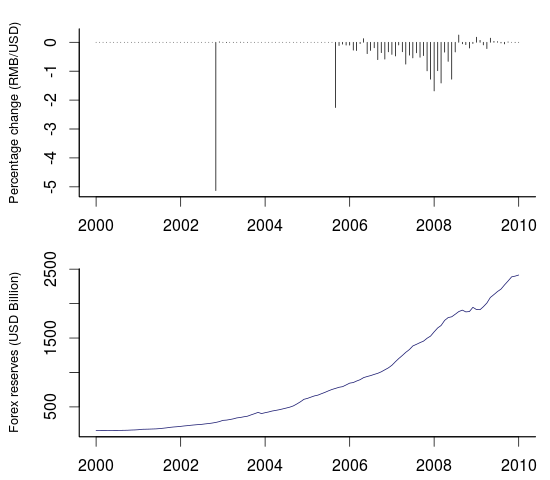
Changes in the exchange rate are very visible. But is the apparent change in the exchange rate a fair depiction of the pressure on the currency market? As an example, consider China's story with the exchange rate:

Figure 1: China's monthly exchange rate returns (upper) and foreign exchange reserves (lower)

The upper panel is monthly returns on the CNY/USD. Positive returns are depreciations and vice versa.  We see large periods of zero change separated by a few months in which there was an appreciation. Does this mean that in the long periods of zero change in the exchange rate, the currency market was quiescent? No. This is a period in which the Chinese central bank was trading in the currency market on a large scale. As the graph of their foreign exchange reserves shows, they went from \$0.4T in 2004 to \$1.9T in 2009. There was a lot of pressure on the currency to appreciate. What we see, as zero or small negative returns, understates the true story.

In order to address this problem, economists aspire to construct a measure of `exchange market pressure' (EMP), which would show the true conditions on the currency market in each month. To borrow a phrase from Amit Varma's podcast, there's an important difference here between the seen and the unseen. The apparent exchange rate change is what we see. What's really going on, in terms of the macroeconomic situation on the currency market, is the exchange rate pressure.

Conventional thinking in EMP measurement


Attempts at EMP measurement have been in progress since Girton and Roper, 1977. There are many EMP measures in the literature. An important one, which expresses the mainstream strategy, is by Eichengreen et. al., 1996 . They propose an EMP index for a country is given by:

\[
\textrm{EMP}_{t} = \frac{1}{\sigma_{e}} \frac{\Delta e_{t}}{e_{t}} - \frac{1}{\sigma_{\bar r}} \left ( \frac{\Delta \bar r_{t}}{\bar r_{t}} - \frac{\Delta \bar r_{US_t}}{\bar r_{US_t}} \right) + \frac{1}{\sigma_i} \left (\Delta \left (i_{t} - i_{US_t} \right) \right)
\]

Where the exchange rate is denoted by $e_t$, reserves divided by base money is $\bar r_t$ and intervention of the central bank at time $t$ is $i_t$. The change in $e_t$ is denoted by $\Delta e_t$; the change in $\frac{r_t}{m_0}$ is denoted by $\Delta \bar r_t$. The three sigmas, $\sigma_e$, $\sigma_{\bar r_t}$, and $\sigma_i$, denote the standard deviations of the relative change in the exchange rate, difference between relative changes in the ratio of foreign reserves and base money in the home country against the reference country (US), and the nominal interest rate differential.

This EMP measure is essentially a weighted average of changes in exchange rate, foreign exchange reserves, and interest rates. To prevent the most volatile component of the index from dominating (usually the forex reserves), each component is weighted by its standard deviations. The resulting EMP index is dimensionless. There is a literature (Pentecost et. al., 2001, IMF.,2007) which finds that these kinds of measures are useful in forecasting currency crises.

Problems with conventional EMP measurement


This approach to measurement has several problems. When there is a fixed exchange rate, the standard deviation in the denominator goes to zero. When a country with an inflexible rate (low $\sigma_e$) experiences a modest change in the exchange rate, this shows up as a large value of EMP. As an example, consider the Chinese experience in the time period covered in Figure 1:

Figure 2: Conventional EMP measure for China

In some months, it is not possible to compute the EMP as we get a divide by zero. In other months also, the graph above does not square with our understanding of what was going on. As an example, consider the period after the Lehman collapse. The EMP measure seems to suggest that this is where the highest pressure to appreciate was seen, which seems incorrect.

A better EMP measure


A recent paper, Patnaik et al., 2017 introduces a new method for measurement of EMP. This new approach seeks to measure EMP in the units of percentage change of the exchange rate of the month. The EMP reported for a month is an estimate of the unseen - the exchange rate change (measured in per cent) which would have taken place if there had been no currency intervention in that month.

Let's treat this new method as a black box and examine how well it works.

Example: EMP in China


Figure 3: Conventional vs. new EMP measures for China

The figure above juxtaposes the conventional EMP measure against the new proposed measure.

There are two gray blocks in the conventional measure, where EMP can't be computed as it was a fixed exchange rate and we encounter the divide by zero. The new measure has no such problem.

In the long period of pressure to appreciate, the new measure shows an interpretable value such as a 5% appreciation in the month, which would have taken place if there had been no trading by the central bank in the currency market. The conventional EMP index is dimensionless and cannot be interpreted in similar fashion.

At the Lehman crisis, the new measure shows a sudden shift in exchange market pressure, followed by a return to the pressure to appreciate. The conventional measure suggests the highest ever pressure to appreciate was found at the time of the Lehman crisis, and this pressure subsided later.

Example: EMP in India


Figure 4: Conventional vs. new EMP measures for India

For macroeconomists who know the Indian experience closely, the new measure makes a lot of sense.

In early 2007, it is rumoured that RBI was purchasing as much as \$1B a day, and there was very high pressure to appreciate prior to the structural break in the exchange rate regime on 23 March 2007. This shows up correctly in the new measure. The conventional measure, in contrast, thinks there was not much going on then.

The conventional measure seems to say that at the Lehman crisis, there was a switch from depreciation pressure to appreciation pressure. This seems unlikely. The new measure shows the highest-ever pressure to depreciate right after the Lehman crisis. This seems correct.

Example: EMP in Russia


Figure 5: Conventional vs. new EMP measures for Russia

There was a long period (2002-2008) with one-way pressure to appreciate. This is picked up in the new measure but not in the conventional measure.

The Russian invasion of Georgia (08/08/08), followed by the Lehman shock in the next month, are associated with an immediate shift to depreciation pressure in the new measure (from August itself, reflecting the Georgia invasion). The conventional measure does not pick up these events correctly.

The Russian invasion of Crimia is followed by pressure to depreciate, in the new measure. This does not appear as clear in the conventional measure.

Example: EMP in Brazil


Figure 6: Conventional vs. new EMP measures for Brazil

The Lehman failure, and the Taper tantrum, show up as episodes of pressure to depreciate in the new measure but not in the conventional measure.

Conclusion


Exchange market pressure is an important tool for better understanding macroeconomics. While the concept has always been attractive, conventional methods for measurement have had limitations. The new measure makes it possible to take interest in EMP as a tool for macroeconomic analysis. This article aims to unveil the new measure as a black box, to show that it works better than the conventional measure. The methodology is presented in the underlying paper. The resulting dataset, with monthly EMP data for 139 countries, has been released, and has diverse potential research applications.

Bibliography


Eichengreen, B., Rose, A., Wyplosz, C., 1996. Contagious Currency Crises , Technical Report. National Bureau of Economic Research.

Patnaik, I., Felman, J. and Shah, A., 2017. An exchange market pressure measure for cross country analysis . Journal of International Money and Finance, 73, pp.62-77.

Desai, M., Patnaik, I., Felman, J. and Shah, A., 2017. A cross-country Exchange Market Pressure (EMP) Dataset . Data in Brief.

Pentecost, E., Van Hooydonk, C., Van Poeck, A., 2001. Measuring and estimating exchange market pressure in the EU . J. Int. Money Finan. 20, 401¡V418.

IMF, 2007. Managing Large Capital Inflows , Technical Report. International Monetary Fund.