Search interesting materials

Showing posts with label finance (innovation). Show all posts

Monday, December 23, 2024

Digital transformation and the paradox of financial inclusion in India

by Suyash Rai.

India has made great strides in digital technology, becoming a leading exporter of digitally delivered services to the global economy. These capabilities with computer technology fuelled hopes that digital transformation could yield gains for the Indian state that are comparable to those seen in the private sector. The `Digital Public Infrastructure (DPI)' approach, with India's Aadhaar digital ID system as a prime example, is presented as a path to higher GDP growth for developing countries. There is an emerging debate on the role of the state in shaping the development and deployment of DPIs.

Two key pillars of the Indian story with DPIs are identity services ("Aadhaar") and their impact on financial inclusion. In a new working paper, Economic development and digital transformation: Learning from the experience of Aadhaar and financial inclusion in India, I critically examine the Indian progress on financial inclusion between 2011 and 2021, revealing a paradox: while account ownership surged, account usage remained low.

The facts

The paper analyses India's performance compared to other lower middle-income and middle-income countries. The evidence shows:

  • Impressive account opening: India witnessed remarkable progress in account penetration, surpassing the average improvement in middle-income countries.
  • High inactivity: A significant percentage of accounts in India were inactive, far exceeding the average for middle-income countries.
  • Low account usage: India lagged behind in account usage for both consumption smoothing (regular deposits and withdrawals) and digital payments, indicating a gap between account ownership and actual financial inclusion.

The role of government mandates and Aadhaar

We argue that the rapid scale of account opening was caused by a series of government and Reserve Bank of India (RBI)mandates, particularly the Pradhan Mantri Jan Dhan Yojana (PMJDY). While Aadhaar played a role, it was primarily used as a physical ID for KYC, rather than as a digital ID through e-KYC. The gains in account opening may have a lot to do with state coercion and less to do with DPI.

The primary objective driving these initiatives was to facilitate direct benefit transfers (DBT) for welfare schemes. The government's focus on DBT aimed to reduce leakages and improve attribution for its welfare programs in the eyes of voters.

Why did this approach yield disappointing results?

The paper explores several reasons for the limited account usage despite the increase in account ownership:

  • The lack of a viable business model: No-frills accounts, with zero minimum balance and free transactions, are commercially unattractive for banks.
  • Mismatch between the solution and the problem: The focus on account opening for DBT didn't necessarily translate into accounts that address the richness and complexity of finance for the poor, of meeting the diverse needs of users for consumption smoothing and payments.

Lessons

The top-down approach, with a readiness to utilise the coercive power of the state, has limitations. While the government achieved its objective of scaling up DBT, this came at the cost of genuine financial inclusion and limited the potential uses of Aadhaar as a DPI.

We highlight the need for a more balanced approach, considering market forces and user needs, so as to obtain better outcomes with DPIs. We stress the importance of political creativity, institutional reforms, and a broader understanding of public value, beyond narrow fiscal objectives, when designing and implementing DPIs.

We offers insights into the complexities of digital transformation and financial inclusion, challenging the simplistic narrative of Aadhaar's success. These experiences invite us to rethink the role of the state in shaping DPIs and consider alternative approaches that can truly leverage technology for inclusive and sustainable development.


Suyash Rai is a Fellow at Carnegie India and a Visiting Research Fellow at the xKDR Forum

.

Thursday, September 19, 2024

Who is "innovative"? Unpacking the process of tax exemption grants to startups

by Aneesha Chitgupi, Karthik Suresh, and Diya Uday.

When private individuals spend resources on innovation, the ideas and benefits that arise spread to society at large. An underspend on innovation results in the market failure of "positive externalities". The state has an important role to play in solving this market failure by encouraging spending on activities that generate innovation (Mashelkar et al., 2024). In India, the government did so by: (i) building research organisations like CSIR and ISRO and hiring career scientists, and (ii) providing tax exemptions. The Income Tax Act, since its inception in 1961, has exempted expenditures on scientific research. Since 1996-97, goods used for R & D have been exempt from customs and excise duties.

In the last ten years, both the Union and various state governments have perceived "startups" as major drivers of innovation. A host of incentives have been put in place for them. These include: (i) reduced fees and priority in processing patent and design applications; (ii) full exemptions on income tax for the startup following approval from an Inter-ministerial Board (IMB); (iii) priority during public procurement, etc. However, in a previous article (Chitgupi et al., 2023), we analysed Indian patent filings and grants and found that, despite enjoying government incentives, the overall share of startups in patent filings and grants --- a proxy for innovation --- remains small. Moreover, only a few startups receive income tax exemptions aimed at spurring innovation (see Table 1).

Table 1: Overview of the landscape of startups
Startups 2023 2024
Total (registered and unregistered) 2,49,107 3,14,492
Registered as startups by DPIIT* 90,939 (36.5) 1,31,191 (41.7)
Granted tax exemptions by the IMB** 1,100 (1.2) 2,976 (2.3)

Table notes: * fraction of total startups;
** fraction of DPIIT registered startups.
Source: Authors' compilation and analysis

The income tax exemption for startups

Section 80-IAC of the Income Tax Act allows a one hundred per cent tax deduction for eligible startups. The aim is to reduce the tax and compliance burden in the initial years of incorporation. A startup is eligible if (i) it is a new business incorporated after 1 April 2016 and is not a reorganisation of an old business with old machinery; (ii) its total turnover does not exceed INR 100 crores; and (iii) it is "engaged in innovation, development or improvement of products or processes or services or a scalable business model with a high potential of employment generation or wealth creation". The body tasked with determining the eligibility of a startup is the IMB. It was set up by the DPIIT in April 2016 with three members, and it is an executive body with delegated powers.

In this article, we study the institutional design and functioning of the IMB under Section 80-IAC. Our findings suggest that the IMB's process is not optimised to deliver the statutory intent of tax exemptions to startups. We identify the bottlenecks that must be targeted for change and question the current incentive structure for startups to innovate.

Methodology

There is a perception that staffing an organisation with technocrats will solve the problems of the organisation. This is not a recipe for lasting success (Kelkar and Shah, 2022). It is instead important to draft rules and procedures that work within and beyond the administrative system and that provide the right incentives to bolster the purpose of the organisation, i.e., promoting innovation. We view the IMB as an executive body tasked with an executive function --- to determine whether a startup is eligible for an exemption under Section 80-IAC. We rely on principles of administrative law while examining the processes and workings of the IMB. In particular, we focus on (i) institutional design, (ii) transparency, (iii) administrative discretion, and (iv) accountability (see Table 2).

We integrate this framework with Adam Smith's Canons of Taxation which sets out design principles for efficient tax administration. These are: (i) the maxim of equality, i.e., the tax must be collected with equality before the law; (ii) the maxim of certainty, i.e., the time, manner, and amount of tax to be paid ought to be clear and plain to the taxpayer, (iii) the maxim of convenience, i.e., the tax ought to be levied at the time and in the manner in which it is most likely to be convenient for the taxpayer and (iv) the maxim of economy, i.e., the tax ought to be so contrived that it takes from the taxpayer as little as possible. Smith's canons are routinely used by Indian courts to test the constitutionality of actions by tax administrations. For example, in South Indian Bank Ltd. vs. CIT AIR 2021 SC 4266, the Supreme Court applied Adam Smith's canons to examine the tax exemption to income arising from interest paid by banks.

Table 2: Our framework for analysing the process of tax exemptions to startups
Parameter Administrative principleSmith's canons
Institution designClarity of purpose and processEquality, certainty, convenience.
Composition of the board
Reporting of conflicts of interest
Process transparency Publication of rules and processesCertainty
Administrative discretionIssue of reasoned ordersEquality, certainty
Administrative accountabilityProcedure for appeals from orders Equality, certainty
Audit oversight mechanism

We hand-collected and evaluated a sample of the minutes of the IMB meetings published on the Startup India portal to determine the eligibility of startups for tax exemptions. Our dataset comprises 52 decision documents out of the 72 available on the portal from 2016 to 2023, with the most recent document being from February 2023. There have been no additions to the IMB decisions since February 2023. Table 3 summarises our sample and provides insights into the total number of cases heard and the corresponding board decisions, forming the foundation of our study. Of the 72 IMB decisions published on the IMB website from May 2016 to February 2023, we have hand-collected data from 52 of these meetings, covering a total of 2,102 cases (72.2 per cent) each representing a startup.

Table 3: Overview of the sample data of IMB meetings
Year No. of meetings* No. of startup applications
Granted Rejected Deferred Total
2016 6 9 265 35 309
2017 3 21 201 141 363
2018 3 6 126 17 149
2019 8 109 1 57 167
2020 8 73 10 15 98
2021 10 80 13 9 102
2022 13 651 97 52 800
2023 1 112 2 0 114
Total 52 1061 715 326 2102
Table notes: *No of meetings from which data was used for this article.
Source: Authors' compilation from the Startup India website.

Results

Institution design

Clarity of purpose and process: The IMB has to decide whether a startup is eligible for the tax exemption. We find that the substance of the criteria to be applied by the IMB to determine eligibility for startup tax exemptions overlaps with the DPIIT criteria to register a startup. The need for a body like the IMB to reassess a startup on the same criteria is unclear. Despite this, only a small percentage of firms that have qualified the DPIIT's criteria meet the IMB's criteria. This violates Smith's canons of certainty and convenience because of the uncertainty of receiving the exemption despite having met the DPIIT's criteria. Table 4 compares the criteria for the IMB and the DPIIT to determine the eligibility of a startup for registration and grant of tax exemption. The criteria are substantially the same.

Table 4: Mandate of the IMB compared with the mandate of DPIIT for startups
IMB (for startup tax exemption) DPIIT (for startup registration)
Criteria 1 The entity's business involves innovation, development, deployment or commercialisation of new products, processes or services driven by technology or intellectual property Entity is working towards innovation, development or improvement of products or processes or services, or if it is a scalable business model with a high potential of employment generation or wealth creation.
Criteria 2 The entity was incorporated on or after 1 April 2016 but before 1 April 2025. Upto a period of ten years from the date of incorporation/ registration, if it is incorporated as a private limited company (as defined in the Companies Act, 2013) or registered as a partnership firm (registered under Section 59 of the Partnership Act, 1932) or a limited liability partnership (under the Limited Liability Partnership Act, 2008) in India.
Criteria 3 The entity's turnover does not exceed one hundred crore rupees. Turnover of the entity for any of the financial years since incorporation/ registration has not exceeded one hundred crore rupees.
Criteria 4 The entity has not been formed by splitting up, or the reconstruction, or using more than 20% by value of machinery, of a business already in existence. The entity shall not be formed by the splitting up or the reconstruction of an existing business
Source: DPIIT notification dated 19 February 2019 and Section 80 IAC of the Income Tax Act 1961

This is further highlighted through our analysis of the reasons for rejection of exemption claims. We map the reasons that are recorded in the minutes of IMB's meetings to the eligibility criteria set out in Table 4. We find that in 65 per cent of cases, a startup fails to get an IT exemption from IMB despite having met the same criteria for the DPIIT's requirement. Table 5 presents the percentage of exemption applications rejected based on previously assessed criteria. Further, 51 per cent of cases were rejected because the IMB determined that the startup was incorporated before 1st April 2016. At the outset, this is an objective criterion that the DPIIT and IMB should be able to agree on. Further, the cases in the Others category, which make up nearly 15 per cent of rejections, comprise criteria not specified under the law, such as shareholding patterns or other reasons said to be privately communicated to the startup.

Table 5: Overview of the reasons for rejection of applications for the IT exemption
Reasons for rejection No. of rejections Rejections as a fraction of total rejections (where reasons are given) (%)
Criteria 1 Lack of innovation, scope of scalability, and wealth generation 91 12.7
Criteria 2 Incorporated before April 2016 366 51.2
Criteria 3 Turnover exceeds hundred crore rupees 0 0
Criteria 4 Reconstruction of existing business 12 1.7
Others* 105 14.7
Rejection without reasons 141 19.7
Total 715 100

Table notes: * "Others" includes reasons not part of Criteria 1 to 4 in Table 4 above.
Source: Authors' compilation and analysis

Composition of the board: It is not apparent how the composition of the IMB is relevant for the purpose of the IMB. Since its constitution, the IMB has had a Joint Secretary from the Department for Promotion of Industry and Internal Trade (DPIIT), a scientist from the Department of Science and Technology, and a scientist from the Department of Biotechnology. For a year, between 2018 and 2019, the IMB also included representatives from SEBI, RBI, the Ministry of Corporate Affairs, the Ministry of Electronics and IT, and the Central Board of Direct Taxes. The IMB also has a "technical consultant". This consultant is an employee of the National Research Development Corporation (NRDC), a public sector undertaking owned by the Government of India. We are unable to find documentation that highlights the selection process and requisite qualifications of these members. All of them are ex-officio members. The role of the NRDC consultant has also not been clearly defined.

Process transparency

Publication of rules and processes: The rules or guidelines on the IMB's processes are not available in the public domain. For example, there are no guidelines on the basis of which the most important phrase in section 80-IAC, "innovation, development, deployment or commercialisation of new products, processes or services driven by technology or intellectual property" is determined. The lack of guidelines also violates Smith's canons of certainty and convenience. Guidelines are necessary for predictability for firms and greater accountability from the government. Other departments of the Indian government that carry out similar certification processes, such as the Department of Scientific and Industrial Research which certifies whether an applicant qualifies for tax exemptions for scientific research and R & D under Section 35(2AB) of the IT Act, have prescribed guidelines that companies can use to evaluate their chances of success.

Administrative discretion

Issue of reasoned orders: A central tenet of administrative law is that an order that carries negative consequences for an assessment should be well-reasoned. Unfortunately, non-speaking orders are frequently issued by Indian tax administrations (example, example). We do not have access to the text of the orders that are issued to individual applicants, so it is unclear whether detailed reasons are provided by the IMB while rejecting applications. However, from the minutes of the IMB meetings, we note that many companies are not provided with adequate and specific reasons for why their applications were rejected. This violates Smith's canons of certainty and equality. All deferred or rejected cases must be provided with reasons for their deferment or rejection. Published decisions help other startups better understand and comply with the eligibility criteria.

Figure 1 demonstrates whether the IMB communicated the reasons for the decisions taken on granting or rejecting the IT exemption for startups. We find that not all decisions are published with reasons. Even where applications are rejected, we do not see reasons being provided in every case. Of the 715 startups that were rejected, 19.7 per cent (141 startups) were not given reasons for rejection by the IMB. We further find that of the total 2,102 cases (Table 3) in our sample, deferred cases accounted for 15.5 per cent of them. Nearly 38.7 per cent of such cases were deferred without providing any reasons. Among the 1,061 startups granted the tax exemption, 67.9 per cent were granted without reasons being published. This creates ambiguity. In 15 per cent of cases, the IMB rejected applications for reasons other than those stated in the law (Tables 4 and 5).

Figure 1: Reason provided by application status across IMB decisions as a share of total cases

Figure 2, presents the share of cases where reasons were published across the decisions taken (whether granted, rejected, or deferred) by IMB from 2016 to 2023 across 52 decision documents. Since its inception, the IMB has published reasons for the majority of its decisions --- 67.3 per cent, 61.2 per cent and 73.2 per cent for 2016, 2017, and 2018, respectively. Across the years 2019, 2020, and 2021, IMB published reasons for all of its decisions. However, in 2022 and 2023, IMB published reasons for only 25.7 per cent and 1.8 per cent of decisions, respectively.

Figure 2: Reasons provided by year as a share of total cases

One may argue that since 2019, the IMB decision in favour of grants has increased from 65 per cent in 2019 to 98 per cent by 2023 and that the lack of reasons provided for the grant of IT exemption is not a major administrative challenge. We believe this has happened as the scheme gained maturity and there was a rise in the number of startups incorporated after 2016 that are applying for exemption under Section 80-IAC. It is important to note here that the cases brought to the IMB are recognised as startups by DPIIT, which follow similar criteria for establishing an entity as a startup with differences in the incorporation date, which is restricted to 'after April 2016' for IMB classification. This has been the major reason for rejections in the early years of the scheme (Table 5).

Administrative accountability

Procedure for appeals from orders: The right to appeal is another core tenet of administrative law. Judicial review of an administrative action ensures the lack of arbitrariness and improves administrative accountability. The IMB does not appear to have an appellate or review mechanism. It is unclear whether the decision of the IMB, not being one taken by the Income Tax Department, is appealable under the Income Tax Act. Moreover, this contravenes Smith's canon of equality. Startups that are aggrieved with the IMB's decision have to directly approach the High Court under a writ petition (example from Delhi HC). A case should lie before the High Court only if it involves a substantial question of law (Datta et al., 2017). This is because it is inefficient and costly to bring routine cases such as challenges to IMB's exemption decisions that do not involve a substantial question of law. This only adds further strain on the high courts' already burdened docket.

Audit oversight mechanism: The IMB is subject to audits by the CAG. However, no such audit of its functions has been carried out so far.

Discussion

Our findings indicate that the 80 IAC tax exemption is not working as desired. There are some core challenges in both the design of the exemption and its implementation.

Substantive challenges: The eligibility criteria to become a startup recognised by DPIIT and the eligibility criteria to be granted a tax exemption by the IMB are substantially the same (Table 4). However, startups are being granted recognition by the DPIIT but are being rejected for the tax exemption on the very same criteria by the IMB. If the criteria are substantially the same, a registered startup must automatically gain a tax exemption grant by virtue of qualifying as a startup by DPIIT. It is unclear why a separate application must be made involving both cost and time. Further, conversations with startup founders revealed that the 80-IAC exemption is not the impetus they need to spur innovation.

Implementation challenges: A key challenge is that rules and process guidelines on the grant of the IT exemptions are not available in the public domain. This has two drawbacks: (i) a startup applying for the exemption will not have a full picture of the process, and (ii) it allows room for administrative discretion, reducing the predictability of the outcomes of the applications. Further, the IMB does not publish reasons for rejection of applications consistently. This is imperative, as it will bring about transparency in the working of the IMB and also give potential applicants a sense of the reasons for rejection, acceptance, or deferment. The IMB process must also have a published procedure for appeals. Lastly, the composition of the IMB must be commensurate with its purpose. It is unclear why, for example, SEBI and RBI officers were part of the panel to determine "innovation". Our findings are in line with the recent observations of the Parliamentary Standing Committee on Commerce on the lack of clarity in the process for granting these exemptions. In response, DPITT has proposed to take steps to make the process of granting tax exemptions more "transparent" and "user-friendly".

Alternative strategies to encourage innovation

Building better supply-side incentives: Supply-side incentives are effective strategies to encourage spending on innovation. Tax exemptions could be one way forward, but not in their current form. We compared the Indian scenario to other countries to get some guidance. We find that while tax incentives are common for startups in many countries, and are the recommended way forward, the mechanism by which they are granted is different from the IMB. In the United Kingdom, "knowledge-intensive" companies can avail of tax benefits. Whether a company is knowledge-intensive or not is determined by HM Treasury under Section 252A of the Finance (No. 2) Act, 2015. The provision defines a "knowledge-intensive" company as one that: (i) spent at least 15 per cent of OpEx on research and development or innovation in at least one of the previous 3 years, or spent 10 per cent of OpEx in each of the previous 3 years, and (ii) is either likely to exploit intellectual property that it has created in the previous 3 years, or at least 20 per cent of the company's full-time employees (FTEs) are engaged in research and development or innovation. These FTEs must have at least a masters' degree. In Ireland, under Section 496 of the Taxes Consolidation Act, 1997 there is a negative list of industrial sectors and companies that do not qualify for the Startup Relief for Entrepreneurs (SURE) scheme if their main activities of business are in the specified sectors. Companies self-certify their applicability for the scheme, and there are stiff penalties in case they misinform the Revenue department. In Germany, the INVEST scheme of the Federal Ministry of Economic Affairs and Climate Action mentions that companies must (i) either hold a patent issued to them in any of the EU member states in the previous 15 years, or (ii) must be "innovative". "Innovation" is proved in a manner opposite of the Irish method, i.e. the company demonstrates that it is in fact working in the specified sector. The German Federal Tax Office may carry out random checks on whether a company is "innovative" by hiring an audit firm to independently assess whether it is truly generating output in its stated sector.

In all these countries, the government does not enter into the question of which firm is "innovative". The main reason for this is the difficulty in determining who is "innovative". Instead, countries identify priority sectors and grant incentives to all startups within the sector. That aside, in the Indian context, given the significant overlaps between the eligibility criteria for being a registered startup vis-a-vis the eligibility criteria for tax exemptions by registered startups, the government may consider a single window clearance system in which an eligible startup is registered and then is automatically given a tax-exempt status on account of being registered with the DPIIT. In doing so, the state will free up valuable state resources and capacity, which may be deployed for other purposes aligned with the intention of promoting innovation among startups.

Demand-side interventions through government contracting: As an alternative, some literature suggests that demand side strategies through public procurement will encourage innovation (Rothwell et al. 1981).

While the creation of the IMB and the government's focus on startups appears to be in response to a market failure, the design of the intervention has flaws. We note that "startups" are not necessarily major drivers of innovation in India. Firm size has no role to play in how innovative it can be. Therefore, tax exemptions for startups, even if they are "innovative", have little measurable effect on innovation in Indian society as a whole. Mashelkar et al (2024) recommend that the government "buy" i.e. contract out more research and innovation functions to firms in the private sector. The spillovers this can generate would be substantive and would have a multiplier effect. We already have many examples of the government choosing to do so e.g. the New Millennium Indian Technology Leadership Initiative (NMITLI) program of the Council for Scientific and Industrial Research (CSIR), Department of Space's (DoS) contracting with companies like L & T and Tata Elxsi to build rocket engines and recovery modules for the all-important Chandrayaan and Gaganyaan missions. These kinds of contracts should be done more often and frequently with all kinds of companies to build innovation and production capacity. Our recommendation in all cases is to pursue innovation by contracting out.

References

  1. Adam Smith, The wealth of nations, Fingerprint Classics, 2024.
  2. Aneesha Chitgupi, Karthik Suresh and Diya Uday, Are startups engaging in innovation in India?, The Leap Blog, 25 April 2023.
  3. Pratik Datta, Surya Prakash B.S., and Renuka Sane, Understanding judicial delay at the Income Tax Appellate Tribunal in India, Working Paper, National Institute of Public Finance and Policy, 13 October 2017.
  4. Ramesh Mashelkar, Ajay Shah and Susan Thomas, Rethinking innovation policy in India: Amplifying spillovers through contracting-out, Working Paper, XKDR Forum, 21 March 2024.
  5. Vijay Kelkar and Ajay Shah, In Service of the Republic: The Art and Science of Economic Policy, Penguin, 2022.
  6. R Rothwell and W Zegweld. Industrial Innovation and Public Policy: Preparing for the 1980s and the 1990s. In: London: Francis Pinter Publications (1981).

Aneesha Chitgupi, Diya Uday and Karthik Suresh are researchers at XKDR Forum. The authors thank Ajay Shah and two anonymous referees for their comments and inputs.

Tuesday, April 25, 2023

Are startups engaging in innovation in India?

by Aneesha Chitgupi, Karthik Suresh and Diya Uday.

Introduction

What is a startup? The academic literature takes a broad view --- startups:

  • have a high growth rate (Moogk 2012),
  • have a lower number of employees (Beck et al. 2008),
  • are at the early stage of the life cycle of a firm (Eisenmann 2013, Stevenson and Jarillo 1990), and
  • are drivers of innovation (Cohen and Klepper, 1996).

However, governments across the world focus on the link between startups and innovation. In the Netherlands, a startup is defined as "a business that translates an innovative idea into a scalable and generic product or service, using new technology." In the United States, a startup is one that "has never been an SEC reporting company, uses invested capital, often from venture capital investors, to build an innovative growth focused, scalable business." The Israeli "innovation model" is "largely based on the creation of technological value, mainly in start-up companies and multinational corporations R&D centres".

This is true of the Indian government as well. The stated objective of the Startup India Action Plan of 2016 is to promote innovation. The idea that startups are innovative is also reflected in the draft Science, Technology and Innovation Policy of 2020) as well as foreign policy initiatives like the Engagement Group on startups at the ongoing G-20 Summit.

The Startup India Policy offers a suite of regulatory exemptions and incentives linked to innovation by startups. Two key components of this policy are: (i) reduced fees and priority in processing patent and design applications for startups, and (ii) full exemptions on income tax to the startup following approval from an Inter-ministerial Board (IMB). The Startup India Policy has been amended several times. Key changes relating to the definition of a startup have been:

  1. February 2016: a startup is (i) not older than five years from the date of its incorporation/registration, (ii) turnover in any of the previous five financial years has not exceeded INR 250 million, and (iii) it is working towards innovation, development, deployment or commercialisation of new products, processes or services driven by technology or intellectual property. The startup should develop and commercialise "a new or a significantly improved product or service or process that will create or add value for customers or workflow".
    To be registered with the DPIIT, as well as to qualify for the tax exemption, a startup needs to be recommended by a registered incubator, or an angel/private equity/ accelerator fund with at least 20 per cent funding, or by the Union or state government as part of a scheme to promote innovation, or it should have filed a patent.
  2. May 2017: the age of an eligible firm and the period for calculation of turnover was increased from five to seven years from the date of its incorporation/registration (ten for firms in the biotechnology sector).
    In addition to the definition, a startup may now also have scalable business models with a high potential of employment generation or wealth creation to gain benefits.
    To register as a startup and avail of the tax exemption from the IMB, a firm now only has to make an online application by providing the details of (i) certificate of incorporation/ registration and "other relevant details as may be sought", and (ii) a write-up about the nature of business highlighting how it meets the criteria in the definition. The DPIIT would consider "innovativeness" from a domestic standpoint. DPIIT may grant or reject recognition after review.
  3. February 2019: age requirement of an eligible startup was relaxed to ten years for firms across all sectors. The turnover limit was increased to INR 1 billion.

Given the emphasis on "innovation", we consider it important to examine whether India's policies are incentivising innovation by startups by asking the following questions:

  1. Are startups in India engaging in innovation?
  2. How innovative are Indian startups compared to non-startup firms?

To answer this, we require some well-accepted measure for studying startup innovation. We adopt the most popular method i.e. using patent fillings and grants as proxies to measure innovation (Wang 2018; de Rassenfosse 2019; Katila 2000). We chose this over other proxies like expenditure on R&D (Rothwell and Ziegler, 1981; Geroski, 1989). We examine our questions using patent filings and grants to startups. We also use a novel measure i.e. the benchmarks for innovation as defined under the Startup India policy. We found that startups are not driving "innovation" in the conventional sense of the term in India.

We lend new insights into the conventional wisdom on startups and innovation in India and highlight the need for a re-look at the current policy on startups in India.

Methodology

We use two methods to determine whether startups are engaging in innovation:

(i) Measuring innovation using patent applications and grants: We hand-collected data on patent filings and grants from the Indian Patent Office across different categories of entities for the years 2016-17 to 2020-21. We substantiate this data using the annual reports of the Department of Promotion of Industry and Internal Trade (DPIIT). We examined the fraction of patents filed and granted by startups over the years compared to other entities.

(ii) Measuring innovation using startup registration and granted Income Tax (IT) exemptions under the Startup India Policy: The Startup India Policy 2015 requires startups to be innovative to (i) register as a startup and (ii) be granted IT exemptions under the Startup India Policy read with section 80-IAC of the Income Tax Act. We collected data on the number of startups that have successfully received tax benefits (after being classified as innovative). We then calculated the fraction of startups that were granted exemptions versus total startup registrations. For this, we collected data on startup registrations, applications for IT exemptions and approvals to applications of IT applications for all states and UTs in India between 2016-2022. We aim to gain insights into how many startups are "innovative" according to the policy definitions of "innovation".

We also collect currently available data on the total number of startups in India with the number of startups that are registered with the DPIIT. However, this is only available for the current year. We aim to examine how many startups in India qualify under the policy definition of a recognised startup to examine the stringency of the definition of a startup.

We conducted a detailed analysis of startup policies in India to give us further insight into our results from (i) and (ii) above.

Results

Impressive growth rate in patent filings by startups but their overall share remains small: We examined patents filed and granted by Indian startups versus other Indian entities which include small firms, private and public firms, and natural persons. We did not include foreign firms and institutions filing for patents in India or Indian entities filing for patents abroad. We found, across the years, that the number of patents filed by startups has increased possibly on account of the fee waiver and fast-tracking of applications. We also see specific increases in the years in which these interventions were made (May 2017, February 2019) when patent filings doubled (see Figure 1). The CAGR for patents filed by startups and other entities show a disproportionate growth rate for startups at 54 per cent for the period between 2016-17 to 2020-21 which was nearly 12 per cent for other entities for the same period. We found that startups constitute a small proportion of the total patents filed in India when compared to other entities. Patent filings were largely driven by large firms and universities.

Figure 1: Fraction of patents filed by startups over non-startups (2016-17 to 2020-21)

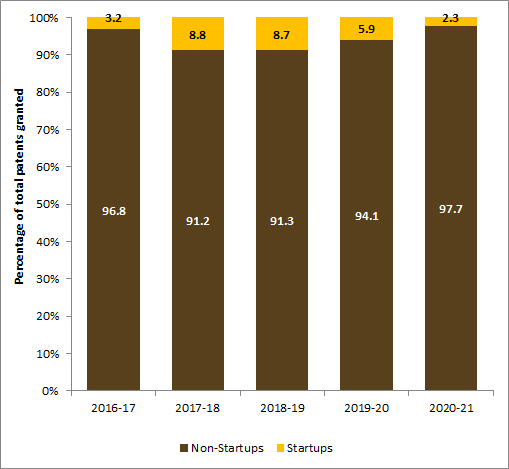
Disproportionately fewer startups were granted patents: The share of patents granted to startups peaked at 8.8 per cent during 2017-18, remained the same the following year and has declined since then. One reason for this could be that startups were obliged to file for a patent to receive registration under DPIIT as well as for applying for IT exemption. The reason for the drop in shares of both patents filed and granted during 2020-21 could be the removal of patents as a condition for registration of a startup and for IT exemption (in May 2017). We also believe that there could be an overall decline in the quality of patents filed. It appears that while the current policy has incentivised firms to file patents, their applications do not pass the more stringent test of proving innovation and hence they fail. The threshold required to grant a patent is strict and requires a firm to prove novelty, which is not the case at the application stage where anyone may file for a patent.

Figure 2: Fraction of patents granted to startups over non-startups (2016-17 to 2020-21)

Source: Annual reports of Indian Patents Office

Figure 1 showed that the share of patents filed by startups in total patents filed was rising during the period 2016-17 to 2019-20. This is not the case for the share of patents granted (Figure 2).

Less than two-fifths of startups registered with DPIIT qualify for benefits: We find that since 2016, the number of companies registered as startups under the Startup India Policy with the DPIIT has increased in absolute terms. However, the growth rate over time has reduced. We further find that out of all the startups that exist in India, only a percentage of them qualify as "startups" under the Startup India Policy and have been registered as such. For instance, there are 2,49,107 startups in India (as on February 2023) out of which only 90,939 (36.5 per cent) are registered by the DPIIT as startups. It is possible that the unregistered startups have either not applied to be registered or have not qualified as startups as per the definitions. This raises the question: is our current definition of a startup under the Startup India Policy the right one? Should we rethink the definition to extend the benefits of the policy to more startups on the ground?

Low grant percentage of IT exemptions for startups: We found that out of the total number of registered startups, less than 2 per cent of startups have been granted the IT exemption, signifying that few startups have been certified as innovative as described in the Startup Policy on external scrutiny by the IMB. We validated this with data on the number of applications for the IT exemption for the year in which this data is available (2017) and found that 90 per cent of registered startups applied for the IT exemption in that year. This indicates that the low fraction of startups receiving IT exemptions is not for the lack of application on the part of registered startups. This has even prompted questions in Parliament.

To be registered as a startup under DPIIT, a startup has to only declare that they are working towards innovation, whereas to obtain an IT exemption, the fact of innovation is scrutinised by the IMB based on specific criteria because of which a startup may not qualify. It is possible that, at registration under the policy a startup need not demonstrate innovation but only declare it, however, for the IT exemption it must now demonstrate and prove innovation in the manner specified in the policy. It appears that few startups are actually being innovative according to the Startup India Policy. Table 1 summarises our findings.

Table 1: Total startups registered and granted IT exemptions based on whether they are "innovative" (2015-2016 to 2020-21).

Year Number of startups registered Growth rate (%) No of startups granted 80-IAC Fraction of total (%)
2015-16 471 -- 7 1.5
2016-17 5233 1011 69 1.3
2017-18 8775 68 18 0.2
2018-19 11417 30 162 1.4
2019-20 14596 28 83 0.6
2020-21 20160 38 70 0.3

Source: Authors' calculations from DPIIT data

Limitations: (i) We do not have access to consistent yearly data on the number of total startups v. those which are registered. (ii) We do not have data on the pre-policy period. (iii) Our present study is not focused on industry-level features. We intend to pursue this in the next leg of our study.

Discussion

Our findings indicate that both measures --- IT exemption grants based on innovation and patents filings and grants --- suggest that innovation in India does not consistently emerge from startups. Instead, our findings are in line with studies in other jurisdictions which suggest that large firms undertake most innovation on account of their risk appetite and R&D capacity (Cohen and Klepper 1996, Symeonidis 1996). Our findings are also aligned with reports that indicate large firms and universities engage most in innovation if measured by patent filings in India. Is this, however, a true picture of innovation on-ground? And what are the implications of our findings for current innovation policies for startups?

The literature makes the case for government intervention on startup innovation citing the disparity in the ability to compete as a market failure (Wang 2018, Symeonidis 1996). The argument is that startups require a boost to even out the playing field as they are unable to compete with larger firms with more resources. Our findings lend some support to this by demonstrating that (i) startups in India are not innovating as much as large firms, and (ii) patent filings by startups have increased since the Startup India policy came into effect. We also, find that patent grants to startups have not increased. Therefore, despite government intervention in India, startups are not driving innovation. Some explanations for this are as follows:

  • The current set of incentives may not be sufficient to drive startups to innovate more. We find some support for this in the literature that finds that supply-side policies alone (e.g. subsidies) are not sufficient to stimulate innovation (Geroski 1989). Focusing on additional demand-side measures such as public procurement of innovation from startups may trigger greater innovation as it reduces the market risk for innovators (Rothwell et al. 1981; Tiwari 2017).
  • Conventional notions of innovation are linked to "novelty" through patenting which is a very high standard for measuring innovation. In reality, startups in India may be engaging in innovation which is not eligible for conventional patents such as technological improvements or modifications suited to the domestic context. Reports suggest that startups in India adopt rather than innovate in the conventional sense. For instance, India is using the technology adoption route for developing Web3.
    Another reason could be that Indian firms are innovating but are not registering patents in India. Reasons for this range from poor enforcement in India to sector-specific commercial preferences. An example of the latter is the semiconductor sector --- India has a large chip design industry but this work is done on a contract basis for US semiconductor firms which file their patents in the US.
    Therefore, patents may not be the best way to measure innovation in India. Current startup policies in India should re-think the definition of "innovation" and make it more suited for the Indian context.

We gain some insights from the innovation-linked incentives that are offered by other countries. In South Korea, which has the highest per-capita granting of patents in the world, all startups irrespective of how innovative they are qualify for reduced fees in patent filings and certain tax exemptions available to SMEs. South Korean policy appears to focus more on promoting linkage between large and small firms to promote networking and market access. In the Netherlands, which ranks ninth in the world in patent filings, vouchers are given to SMEs for patent filing that cover up to 75% of costs. The Dutch Tax Office evaluates and grants specific tax incentives for "technical-scientific research" and "development projects". Both these countries, considered to be highly innovative, have tax schemes that are targeted at specific outcomes and there are some general exemptions for patent filings. India could perhaps learn from these policies.

Conclusion

We set out to answer two questions in this article: Are startups engaging in innovation? How innovative are startups compared to non-startup firms? Our findings using both measures indicate that startups are not driving "innovation" in the conventional sense of the term in India. However, many Indian startups have scaled up by engaging technology towards creative solutions in many industries such as payments (Paytm), e-commerce (Meesho), credit cards (CRED) and healthcare delivery (PharmEasy). While these firms may not do well on the conventional measures of "innovation", they have played a role in encouraging entrepreneurship to solve everyday challenges, all while benefiting their shareholders.[1] Policy in India must, therefore, be suitably modified to recognise such contributions towards innovation. This is an emerging idea that Indian policymakers are increasingly acknowledging. For instance, the Economic Advisory Council to the Prime Minister of India noted the importance of FDI from tech transfers as a key source of promoting innovation in India. We need to think harder about what "innovation" means in India and what role should the government play in encouraging innovation.

In further research, we will analyse the pattern of patents filed and granted across various industries to understand which sectors are more innovative in the traditional sense. We will also examine the firms that have received the IMB's certification of being "innovative" to (i) study the characteristics of these firms and the industries to which they belong, and (ii) study the trends in the grant of certification by the IMB for innovation to startups. This will help us gain a more nuanced understanding of what drives innovation among startup firms in India.

Footnotes

[1] According to its Red Herring Prospectus filed at the time of its IPO (November 2021), Paytm does not own any patents.

References

  1. Tom Eisenmann, Entrepreneurship: A Working Definition. Harvard Business Review, January 10, 2013.
  2. Stevenson, H. H., and Jarillo, J. C., A Paradigm of Entrepreneurship: Entrepreneurial Management. Strategic Management Journal, 11 (1990), 17-27.
  3. Dobrila Rancic Moogk, Minimum Viable Product and the Importance of Experimentation in Technology Startups, Technology Innovation Management Review, March 2012.
  4. Beck, Thorsten and Demirguc-Kunt, Asli and Maksimovic, Vojislav, Financing patterns around the world: Are small firms different?, Journal of Financial Economics, Volume 89, Issue 3, September 2008, Pages 467-487.
  5. Jue Wang. Innovation and government intervention: A comparison of Singapore and Hong Kong. In: Research Policy 47.2 (Mar. 2018), 399-412.
  6. Wesley M Cohen and Steven Klepper, A Reprise of Size and R&D. In: Economic Journal (1996), 106 (437), pp. 925-51.
  7. Gaetan de Rassenfosse, Adam Jaffe, and Emilio Raiteri. The procurement of innovation by the U.S. government. In: PLOS ONE 14 (Aug. 2019), pp. 1-11.
  8. Katila, R. Measuring innovation performance. In: International Journal of Business Performance Measurement (2000), 2: 180-193.
  9. P. A. Geroski. Entry, Innovation and Productivity Growth. In: The Review of Economics and Statistics 71.4 (1989), 572-578.
  10. R Rothwell and W Zegweld. Industrial Innovation and Public Policy: Preparing for the 1980s and the 1990s. In: London: Francis Pinter Publications (1981).
  11. G. Symeonidis, Innovation, Firm Size and Market Structure: Schumpeterian Hypotheses and Some New Themes, OECD Economics Department Working Papers, 161 (1996).
  12. S.A. Low and M.A. Isserman. Where Are the Innovative Entrepreneurs? Identifying Innovative Industries and Measuring Innovative Entrepreneurship. In: International Regional Science Review 38.2 (2015), 171-201.

Aneesha Chitgupi, Karthik Suresh and Diya Uday are researchers at XKDR Forum. We thank Devendra Damle, Josh Felman, Dr. R. A. Mashelkar, Amey Mashelkar, Megha Patnaik, Arjun Rajagopal, Anjali Sharma and the anonymous referees for their feedback and comments.

Wednesday, October 10, 2018

Invoice financing in India: TReDS and way forward

by Sudipto Banerjee and Vishal Trehan.

Introduction


Medium, small and micro enterprises (MSMEs) operate on tight margins and need immediate settlement of invoices to avoid shortage of working capital. However, due to the poor bargaining capacity of MSMEs, their working capital often remains blocked in receivables as they work on an unfavourable credit cycle for goods and services supplied to corporate buyers. This problem is exacerbated due to the existence of a huge funding gap for MSMEs. In order to bridge the gap between invoice date and its due date, invoice discounting emerged as a financing solution for entities which are unable to access funding options such as short term credit and working capital loans. Under invoice discounting, the seller, instead of waiting for the payment to be made by the buyer, gets a certain percentage of the invoice amount from the financier in advance. The seller pays a fee to the financier for this discounting service. Once the invoice amount is received by the seller from the buyer, it repays the amount to the financier.

However, adoption of invoice discounting as a financing mechanism in India has not been as expected. This may be due to several reasons. First, the bargaining capacity is skewed in favour of corporate buyers who express reservations while accepting assignments of receivables made in favour of financiers. Second, it is difficult for financiers to establish the credit rating of MSMEs due to information asymmetry. This, coupled with the absence of pledgable collaterals increases the credit exposure of a financier. Third, the discounting landscape is still dominated by banks and there are very few specialised discounting entities. Finally, there is a lack of awareness among MSMEs about discounting services, especially in non-urban locations. For example, even though many MSMEs are exporters, they lack information about export factoring.


In 2014, the RBI observed that there is a need for institutional setup to boost discounting in India and for this purpose conceptualised an electronic exchange for invoice discounting known as trade receivable electronic discounting system or TReDS. This post looks at the TReDS platform critically in order to assess whether this fintech solution has been able to address specific issues related to invoice discounting in India. Further, we explore the developments around invoice discounting in the context of new technologies and examine whether their adoption holds any merit. It must be noted that the invoice discounting problem space is quite broad and TReDS, a technology based solution, must be seen as a solution for specific problems in the invoice discounting space in India.

Specifically, TReDS seeks to address the problem of information asymmetry and the consequent high rates offered by financiers. Also, it is envisaged to reduce the time taken for sellers to receive payments. TReDS, however, was not conceptualised to address other persistent issues related to invoice financing. For example, although TReDS operates on the concept of 'no rescourse to seller', it is not a solution to the problems arising out of the bargaining power of buyers.

A digital platform to boost invoice discounting


In 2009, SIDBI, in collaboration with NSE set up the first e-discounting platform for MSME receivables. This was based on the lines of the Mexican NAFIN model. However, this was a closed single financier model and therefore, had limited scale of operation. To overcome these limitations, in 2014, RBI released a concept paper to set up a full fledged electronic exchange for invoice discounting. This was followed by TReDS is essentially an online electronic institutional mechanism for facilitating the financing of trade receivables of MSMEs through multiple financiers. The platform enables discounting of invoices of MSME sellers against large corporates including government departments and PSUs, through an auction mechanism, to ensure prompt realization of trade receivables at competitive market rates.

  • In the TReDS ecosystem, sellers, buyers and financiers can come on board by executing a one time agreement with the platform. This reduces the documentation cost for sellers who have to execute a separate agreement everytime there is a discounting transaction with a different financier.
  • After executing the agreement, once the seller provides goods or services to the buyer and after acceptance by the buyer, the invoice is uploaded on the platform. This can be uploaded either by a buyer or a seller. Once the invoice is accepted by the buyer, it is converted into a factoring unit, a nomenclature used for invoices on the platform. Subsequently, an electronic auction involving bidding for the factoring unit takes place on the platform.
  • Once a bid is accepted by the seller, the amount is credited to the account of the seller either on T+1 or T+2 basis depending on the cut-off time. This financier's account is auto-debited through the National Automated Clearing House (NACH) mandate. Instructions are sent electronically by the platform to the parties. On the due date of the invoice, the bank account of the buyer is auto debited and the amount is credited to the account of the financier.

As mentioned previously, the TReDS platform aims to address certain specific aspects of MSME financing. The current invoice financing system is riddled with an asymmetric flow of credit information. Financiers are not always aware of the financial condition of MSME suppliers due to limited publicly available information. Due to this, screening costs incurred by a financier go up for discounting an invoice of a MSME supplier. TReDS ensures easier access to invoice discounting at better rates for MSME suppliers due to the following reasons:

  • Financing on the TReDS platform is done on the credit rating of the corporate buyers, hence, financiers need to define the credit limit of buyers and not sellers. This reduces the due diligence cost for financiers and in turn lowers the cost of discounting for sellers.
  • TReDS operates on the model of without recourse to the seller which means that the financier can recover the invoice amount only from the buyer.
  • Outside TReDS, MSME sellers negotiate with individual banks and NBFCs who may not offer them competitive rates for the reasons discussed above. The average interest rate on working capital loans is 12% as compared to 8-10% on TReDS. TReDS allows multiple financiers to participate and bid for invoices - this is expected to provide better rates to MSME sellers. As described previously, the entire transaction happens digitally on the platform in an efficient and transparent manner.

Establishing the genuineness of an invoice is another challenge that TReDS addresses. Once the seller provides goods or services to the buyer and they are accepted, the invoice is uploaded on the platform. The bidding by financiers start only after the uploaded invoice is accepted by the buyer. However, the issue of double discounting of invoices was not addressed in the original implementation of TReDS. This was addressed through a blockchain implementation recently.

Key issues


The most critical problem in the invoice financing space in India, and consequently in the TReDS setup, is related to the obligation on buyers to repay on time. TReDS too follows the requirement of the Micro, Small And Meduim Enterprises Development Act, 2006 (MSMED Act, 2006) which imposes an obligation on buyers to settle the invoice amount within 45 days. Hence, in the TReDS ecosystem, the buyer has to pay the factored invoice amount to the financier within 45 days from the date of acceptance of bid by the seller. This requirement of adhering to time bound payment, which is otherwise mostly flouted outside TReDS, can cause reluctance on the part of buyeres to sign up. Presently, MSME suppliers facing competition from other players are inclined to accept higher volumes of trade credit on less favourable collection terms.

Interactions with practitioners in the MSME financing segment revealed that at times, sellers also avoid disclosing their MSME status so that the buyer is not deterred by the applicability of MSMED Act in case of delayed payments. Therefore, it is not surprising that buyers have even instructed their vendors not to sign up on the electronic platform to avoid the time bound commitment to pay.

Other related challenges with TReDS


While TReDS is a technology based solution to provide an institutional platform to boost MSME financing, its performance needs to be evaluated against the market's response. The market usually adopts a particular solution for two reasons - it can either be a business need or a legal obligation. Considering that the TReDS platform came about as a result of the practice of delayed payments by buyers, it is important that we examine the incentives for buyers to come on board.

  1. Restriction on raising disputes: It must be noted that presently TReDS is an optional system. Assuming there is a corporate buyer X dealing with several vendors, under TReDS, X has to execute an agreement where it accepts the invoice of the seller (its vendors) and only after such acceptance, an invoice is made available for auction on the exchange. The TReDS Guidelines specifically require that X cannot dispute the goods or services received from the seller at a later stage. This is a major disincentive for buyers. Outside TReDS, X usually does not give acceptance to suppliers but merely records the event that it has received supplies - thereby keeping an option to dispute them in the event of any deficiency.
  2. No recourse to seller: In the non-TReDS setup, if X defaults in paying the financier on the due date, the seller becomes a debtor vis-&agrave-vis the financier for recovery purpose. However, as discussed above, on the TReDS platform discounting is done without recourse to the seller. This means that if X fails to pay the invoice amount on the due date, the financier would have no recourse to the seller. Instead, the financier will have to pursue the buyer. While this mechanism may reduce the financier's risk, it may not attract buyers as they would now have to deal with an institutional lender who replaces the MSMEs.
  3. Enhanced transparency: In case of default or any delay in payment by the buyer to the financier on TReDS, the delay/default gets duly recorded and can feed into the credit rating of the buyer. Outside TReDS, instances of such delay or default are not recorded, unless the MSME seller chooses to pursue action under MSMED Act at the cost of its future business relationship with the buyer. Therefore, the decision of a buyer to join TReDS would most likely depend on a cost-benefit analysis of aspects such as reduced flexibility in cash flow management, more transparency, etc.
  4. Existing arrangements: Experts in the MSME financing area have pointed out during interactions that many big corporate houses have their own discounting business and their suppliers/vendors are required to avail discounting services from their group entities. For instance, Reliance Capital, Mahindra Finance, Tata Capital, Bajaj Finance, Aditya Birla Capital, etc are full fledged NBFCs and have dedicated invoice discounting divisions. Companies not having such an in-house discounting facility usually have pre-existing arrangements with banks or NBFCs. Moreover, these big houses usually consolidate their vendor payments into select groups not falling within the category of MSME who in turn buy products from MSMEs. This may be another reason for big houses to not come on board TReDS.
  5. Cost of integration: Another barrier, especially from the buying corporates, is their reluctance to invest in the cost of integrating into a system like TReDS. Since the buyer bears the costs but the benefits accrue only to vendors, this
    may prove to be a disincentive for the buyers.
  6. Poor awareness: Lastly, the level of awareness about any new solution determines its success. Based on inputs from several stakeholders such as discounting entities and banks, the overall level of awareness about TReDS does not appear to be encouraging. Further, in smaller towns and semi urban setups, banks are the predominant option available to suppliers for their financing needs. These sellers do not easily switch banks with whom they share an established relationship, unless the buyer takes the initiative to migrate their dealings onto TReDS.

Addressing the issues


In order to ensure that the TReDS platform achieves its objectives, broader issues related to invoice financing in India as well as TReDS specific concerns need to be addressed. Extending the timeline of 45 days for settlement of invoice, which presently could be the prime reason for buyers not coming onto the TReDS platform, may be considered. To begin with, the platform should be enabled to give an extension to buyers on a case by case basis. While balancing the conflicting interests of suppliers, buyers and vendors is a challenging task, a middle path can be arrived at by ensuring constant interactions between the regulator and the stakeholders, especially the buyers. Further, it is essential that RBI invests resources to increase the overall level of awareness about TReDS. As discussed previously, the focus of such an awareness programme should be smaller towns and semi-urban setups.

Alternatively, a light-touch approach to regulating the behavior of large buyers could involve doing away with the 45 day payment period for TReDS so as to incentivise big buyers to get onto the TReDS platform. Instead, buyers may be asked to disclose their payment practices. Such reporting is mandatory in the UK where firms are required to disclose payment practices as per the Small Business, Enterprise and Employment Act, 2015. Removing the time-line of 45 days and mandating disclosure of payment practices would require amendment of the MSMED Act, 2006. The disclosures, which can be made public on TReDS, should also form a part of the notes to accounts of financial statements of such firms so that they can be cross verified by statutory auditors. This would require amendment to Schedule III of the Companies Act, 2013.

Further, there could be a mix of other regulatory tools like:

  • A code similar to the Prompt Payment Code in UK can be created and large buyers may be encouraged to sign on to this code. Such a voluntary code can in turn set a maximum payment term.
  • A system for blacklisting companies which violate payment terms repeatedly may also be created based on the payment practices data.
  • The role of MSME associations is important in this context to ensure that big buyers do not abuse market power. As is generally the case, a single MSME will be reluctant to file a complaint against a buyer for fear of losing business as well as the costs involved. Instead, MSME associations can give MSMEs the requisite support and can help MSMEs collectively protest against a buyer to enforce a change in behaviour.

Additional measures for boosting TReDS


RBI may take additional measures after taking stock of bottlenecks currently faced by the TReDS platform to ensure that the platform achieves its intended objectives. These include:

  1. Presently, only banks and NBFCs are allowed to participate on TReDS. These entities lend as per the minimum credit lending rate. TReDS Guidelines do not allow any other entity to participate on this platform as a financier. Considering that the objective of TReDS is to boost MSME financing, RBI may consider lifting this restriction after doing a cost-benefit analysis. More participants such as urban cooperative banks, regional rural banks, high net worth individuals (HNIs), mutual funds, pension funds, etc. may be allowed to ensure the best rates for MSME suppliers. Such participation is allowed in other jurisdictions. For example, UK based MarketInvoice connects businesses with investors, including HNIs through its peer-to-peer invoice finance platform.
  2. On the supplier side, the option of allowing non-MSME entities can also be explored. For example, a corporate buyer on board TReDS presently would have to maintain an additional payment mechanism for non-MSME segment. This leads to operational inefficiencies for the buyer. Allowing both segments on TReDS may ease their way of doing business.
  3. Several MSMEs lack reliable information systems which can generate invoice suitable for discounting. To address this problem, in the Union Budget 2018-19, it was declared that TReDS would be linked to the Goods and Service Tax Network (GSTN). Further, as discussed previously in the post, financing in the TReDS environment is done on the credit worthiness of buyers on 'without recourse to seller' basis. This can potentially create disincentives for buyers to come onboard. If financiers are allowed to access the transactional data of MSME sellers available on GSTN, subject to certain safeguards like privacy of data, this can reduce their information asymmetry in terms of assessing the credit history of sellers. In other words, this measure can enable financiers to discount invoices based on the credit worthiness of sellers.

Technology solutions to address challenges


Some technological solutions are also being explored to address specific challenges with TReDS. The three licensed TReDS exchanges recently got together with MonetaGo, a US based startup, to implement a blockchain based solution for a specific problem - the problem of double invoicing and associated fraud. This permissioned blockchain solution, with each of the exchanges acting as a node, went live recently. This solution has enabled the three exchanges to work together to eliminate instances of double discounting while protecting confidential information of their clients. The system generates a hash which is used by the exchanges for validating whether an invoice has already been discounted or not.

In other parts of the world too, blockchain is being considered to develop end-to-end solutions for invoice financing. Several early implementations already exist - examples being Populous in the UK and the Hive Project in Slovenia. More specifically, blockchain is being used to:

  • Ascertain the legitimacy of an invoice
  • Find out whether the invoice has already been discounted
  • Make available immutable contract information securely to all stakeholders, thus ensuring transparency
  • Create incentives for quicker payments
  • Reduce costs related to the invoice financing process

Need for a cautious approach


In view of the decision by the three exchanges to move the fraud-detection module of the TReDS platform onto a blockchain, going forward, authorities and other stakeholders must follow a cautious approach when considering a blockchain solution for other modules of the invoice discounting process of TReDS. A blockchain based solution is envisaged to reduce costs associated with invoice financing and also incentivise quicker payments by bringing in transparency of transactions through a distributed immutable ledger. However, certain considerations need to be made to come up with the most appropriate design approach in the Indian context:

  1. Will a blockchain solution incentivise buyers? Considering the reluctance of buyers to come onboard TReDS due to
    the lack of a dispute resolution mechanism, it is critical for any future blockchain implementation to tackle this issue. Buyers may want a transparent mechanism on the blockchain which allows them to flag the quality of goods/services sold to them even after accepting the invoice.
  2. Is a blockchain the best design choice?
    Various design choices, including centralised and distributed databases, must be considered and a cost benefit analysis must be done to choose the most efficient solution.
  3. Will the solution help achieve RBI's objectives?
    Depending on RBI's objectives and factors such as trust among stakeholders, a permissioned or permissionless blockchain solution might be more suitable in case a blockchain solution is found to be the right choice.
  4. Issues of security, scalability and governance: Blockchain solutions with public facing data and handling a large number of transactions have been known to struggle with issues of throughput capacity and security. Further, complex questions such as who controls the blockchain, who are the nodes in case of a permissioned blockchain with multiple stakeholders and what is the consensus mechanism need to be answered.
  5. How will the solution respond to a complex and dynamic environment?: A blockchain based 'smart contract' solution for invoice financing should be able to quickly adapt to complex and fast-changing real world environments - for example, changes in the regulatory framework.

It is important that a blockchain solution is adopted only if it is addressing persistent challenges in the Indian context. Characteristics/features of the technology itself pose another set of questions when considering the solutions. Thus, a cost-benefit analysis is of paramount importance before deciding the design of the solution.

Conclusion


Several measures have been taken over the past few years to boost invoice financing in India. Although TReDS is a good initiative, we must carefully evaluate its effectivesness to address the lacunae in the system. To this end, we have examined the existing design and performance of TReDS after considering the market's response and expectations of stakeholders. Primarily, a lack of incetives for buyers is holding up widespread adoption of TReDS. This is due to structural issues in the invoice discounting space as well as challenges with the TReDS platform. This classification of challenges is necessary since merely fixing the technology platform may not address the underlying distortions. Thus, both types of challenges - structural ones such as the bargaining power of buyers and TReDS related challenges like the absence of a dispute resolution mechanism within TReDS - need to be addressed to ensure TReDS' success.

Further, a cautious approach needs to be adopted when considering novel technology solutions for such challenges. In sum, this multi-layered problem needs a concerted effort from the authorities to uncover issues at the ground level and come up with the appropriate policy and technical solutions.

References


Department of Economic Affairs, Industry and Infrastructure, Economic Survey 2017-18 Volume 2, 127-128.

Mohmad, K. M. Factoring Services in India: A Study, 2015.

Reserve Bank of India, Concept Paper - Trade Receivables and Credit Exchange for Financing of Micro, Small and Medium Enterprises, 2014.

Dylan Yaga et al, Blockchain technology overview, 2018.


The authors are researchers at the National Institute of Public Finance and Policy. The authors would like to thank Radhika Pandey and Anirudh Burman for useful discussions.

The editor for this article was Anjali Sharma.

Wednesday, March 21, 2018

Financial regulation for the fintech world

by Ajay Shah.

In India, there is a confusing term `non-bank financial company' (NBFC). This is an unfortunate phrase as the term, when taken literally, includes insurance companies, etc. In India, it denotes a $10 \times 2 \times 2$ classification of business models which are regulated by the RBI.

There is a lot of confusion in the present regulatory treatment of these classes of firms. The existing levers of regulation are inappropriate, and it is not clear why RBI -- which should be about sound money and sound banking -- is doing all this work. These concerns are becoming particularly important in the context of the fintech revolution, where all kinds of new firms are being shoe-horned into NBFC regulation.

It's hence useful to take one step back and think about  financial regulation from first principles. Where and why is financial regulation required? Financial regulation is based on exactly four motivations:

  1. Consumer protection. Financial firms generally require a layer of restrictions, that impact upon their dealings with customers, that improve fair play. These problems are heightened when the financial firm directly deals with unsophisticated individuals.
  2. Micro-prudential regulation. When a financial firm makes a high intensity promise to a consumer, generally there is a need for restrictions upon the risk-taking by the firm, to curtail the probability of firm failure. Such micro-prudential regulation is  (in turn) motivated by consumer protection: we wish to improve how consumers are treated in their dealings with the financial firm. When a firm takes a deposit from a household, that requires micro-prudential regulation, but when the firm lends to a household, the household is quite comfortable with the prospect of firm default, and no micro-prudential regulation is required.
  3. Resolution. When a financial firm makes promises to consumers, or when a financial firm is systemically important, the conventional bankruptcy process (of IBC) is inadequate. A specialised bankruptcy process is required, which is run by the Resolution Corporation. 
  4. Systemic risk regulation. The behaviour of firms needs to be restricted from the viewpoint of systemic risk. This is mostly about system thinking, and not looking at individual firms ("the woods and not the trees"). But one ("trees") element of this tends to be a reduced target failure probability for a few firms which are termed `systemically important'.

FSLRC drafted the Indian Financial Code (version 1.1, 2015). The four components of financial regulation show up there as:

  1. Part VII which does consumer protection (S.105 to S.151)
  2. Part VIII does micro prudential regulation (S.152 to S.184)
  3. Part XII does resolution (S.286 to S.310). This has morphed into the FRDI Bill.
  4. Part XIII does systemic risk regulation (S.311 to S.341).

This treatment is non-sectoral. There is no special law which defines consumer protection for banks vs. consumer protection for mutual funds. All kinds of financial business is treated identically, within these four components. The advantage of  non-sectoral law is that the law does not have to be modified when new business models are invented, or when multiple kinds of activities are undertaken under one roof.

Now let's apply this thought process to what, in today's India, would be called an NBFC. To keep things simple, consider a company which finances itself using the bond market, has no unsophisticated consumers, and gives out loans to companies. How would we think about regulating this?

  1. Consumer protection: As this firm has no unsophisticated customers, this simplifies the problem of consumer protection. See Table 5.5 in FSLRC Volume 1. The protections that would have to be enforced are: professional diligence, unfair contract terms, unfair conduct, privacy, fair disclosure and redress.
  2. Micro prudential regulation: As this firm makes no promises to unsophisticated individuals, there is no need for micro-prudential regulation. The bond market is what will discipline the risk taking of this firm. This is similar to how the bond market shapes the leverage and access to debt capital of an ordinary non-financial firm.
  3. Resolution: Ordinary IBC processes will suffice to deal with failure. The bond market will reward more resolvable businesses with a lower cost of capital.
  4. Systemic risk regulation: Until the balance sheet becomes 1 per  cent of GDP, i.e. $20 billion, the firm is not systemically important.

By this logic, for most NBFCs, there is a need for a little bit of consumer protection and nothing else. Most of the existing edifice of NBFC regulation, which seems to be inspired by the regulation of banks, is not required.

Enacting the Indian Financial Code addresses this situation at two levels. First, as described above, it gives a clear conceptual framework on how to think about financial regulation, without encoding business models into the law. Second, the FSLRC regulation-making process encourages the institutionalised application of mind. When mistaken ideas start out in the regulation-making process, there will be greater push back. The staff of financial agencies will rise to higher quality thinking when placed into the FSLRC regulation-making process.

In a previous article, Renuka Sane and I wrote about the barriers faced for the Fintech Regulatory Sandbox. The question discussed here -- the problems associated with shoe-horning fintech into the NBFC framework -- connects integrally to that. Once a project is proven in the sandbox, it will come out into the regulation making process. If the concepts and principles of the regulation-making process have basic defects, this will hamper the working of the regulation-making process, and yield poor outcomes.

Sunday, March 18, 2018

Experimentation that fosters fintech innovation in India

by Renuka Sane and Ajay Shah.

The problem


Fintech innovation in India has been hampered by financial regulation. Three examples are instructive: the Uber cashless transaction, regulation for pre-paid instruments (PPIs), and the more recent P2P regulations. In each of these situations, regulators (who have the power to write regulations) looked at an incipient industry and chose to write regulations that placed important restrictions upon innovators. The notion that fintech companies are a few new categories of `NBFCs', which has been accepted by regulators in India, contains many difficulties.

Experimentation in public policy


Controlled experimentation can be a valuable tool to support the objectives of public policy or a tool for rational thinking to help formulate public policy. Here are a few examples:

  • In many countries, there are geographical regions that are demarcated for drone experimentation. Anyone (even a foreigner) is allowed to go into certain regions in the US, and fly an unregulated drone. These are empty lands where the damage that a drone can do is near zero. There is no connection with the government, or the public policy process, in the activities that take place in this sandbox. All that is done is to give a place for people to fly drones that are otherwise prohibited. This fosters experimentation and (ultimately) the knowledge that will shape regulations in the future.
  • Exchanges have a framework where algorithms can be put into fake market settings, in order to help developers test new algorithmic trading software. As with the drones example, there is no connection at all with the rule-making functions of the regulator or the exchange. All that is done is to provide a safe space where software can be tested, and mistakes made, without repercussions either for the experimenter or the overall market. Exchanges in India have been pioneers in this regard on a global scale, and it was a successful innovation.
  • There is a sense in which China has used SEZs as a sandbox, to experiment with new concepts in policy. The influence of this sandbox is, however, only intellectual. The policy community sees what worked and what did not work. There is no systematic channel through which policy innovations migrate from the sandbox to the mainland, other than intellectual influence.
  • Financial regulators worldwide have been doing experiments with policy initiatives that are put into motion in small pilots. As an example, the US SEC has begun an experiment on tick size for small stocks. The policy initiative is being rolled out for a few firms, and then evidence will be obtained on the impact of the policy change. This is much better than rolling out a policy change for the entire country.

In this article, we think about how mechanisms for experimentation can be developed in India to support fintech innovation.

A Technology Demonstrator Environment


Can we transplant the drone experimentation or algorithm experimentation into the fintech context? In the drone case, there is some empty land where a misbehaving drone can do little damage. Could we this in finance?

A Technology Demonstrator Environment could be a community (e.g. a university campus) which is designated as a place where innovative firms can experiment with products and processes that are in violation of existing financial law and regulation. The founding premise would be that when a red alert sign is shown to the users at a university campus, they know that they are on their own, and after that are smart enough to fend for themselves.

While this seems to be a plausible idea, it is more complicated than meets the eye.

In this territory, firms would be able to launch products and services that violate financial law but not other laws. There are numerous requirements in the Indian Penal Code, and in local law such as the Maharashtra Money-lending (Regulation) Act and the Maharashtra Protection of Interests of Depositors (in Financial Establishments) Act, that impinge upon fintech firms. Once India has a data protection law, that would constrain firms on questions of privacy. These firms would still need to carefully navigate this legal landscape.

A mechanism would be needed to ensure that persons outside the community do not come in as customers. Participants would need to be given clear disclosure about the risks that they are accepting. Firms would need to impose no risks upon these persons other than the risks that have been willingly accepted.

This will require an institutional structure that will work with technology companies and the end-customers. It is not as simple as drone experimentation where some blank space is opened up for experimentation with unregulated drones. This institutional structure would, however, have no direct link to the regulation-making process at financial regulators, that would pave the way for rollout of products in the mainland.

Such experimentation can help firms refine products and processes. The construction of living working product samples would foster knowledge in the Indian policy community.

The proposed Fintech Regulatory Sandbox


Many feel that the path to a more supportive regulatory environment lies through building a `Fintech Regulatory Sandbox' [example]. The RBI Household Finance Committee Report, 2017 proposed the creation of a sandbox:

Such an institution can provide a structured avenue for regulators to engage with the financial supply side, develop innovation enabling regulations, and holds promise to facilitate the delivery of relevant, customised, and low-cost financial products to Indian households.

How can this be done?

The concept of the Fintech Regulatory Sandbox


The concept of a regulatory sandbox - a testing ground for new business models - has caught the attention of regulators around the world. Regulators in almost 20 countries are working towards setting up such sandboxes in their jurisdictions. The English word `sandbox' is familiar to all, so it helps to make precise what we mean by a regulatory sandbox for fintech innovators.

The Fintech Regulatory Sandbox is similar to the long-established processes that are used in clinical trials and the drug approval process in the pharmaceutical industry. The kind of risks that are intended to be addressed are identified (safety in first stage, efficacy next, and so on). While the onus of clearing these hurdles lies on the innovator, regulators sit with the innovators to provide inputs into the trial design (size of trial, control set requirements, etc). These inputs serve as a baseline for decisioning. In this environment, the entrepreneur has a relatively clearer sight of what risks need to be mitigated to get to her desired outcome.

Turning to finance, according to a report by the UK Financial Conduct Authority (FCA), regulatory uncertainty is a hurdle to innovation. When investors in projects with new ideas are not able to assess risks, valuations become lower, and sometimes innovations get abandoned at an early stage. A regulatory sandbox allows the regulator to work with innovators to ensure that appropriate consumer protection safeguards are built in to their new products and services. The sandbox would enable FCA and innovators to work together to reduce some of this uncertainty.

The traditional regulation-making process works as follows:


Two kinds of impulses come into the traditional regulation-making process: the broad development of knowledge, or a specific request from an innovative firm. The Fintech Regulatory Sandbox is a formal institutional arrangement that is added, upstream of the regulation-making process:


This gives a third pathway into the regulation-making process, the regulatory sandbox. It is important to see that the sandbox sits upstream of the regulation-making process. The outcomes obtained from the sandbox are handled by the regulation-making process, and are thus dependent upon the sound functioning of the regulation-making process. In countries like the UK, the foundations of the regulation-making process have been in place for decades. Hence, when the sandbox was discussed and built in the UK, there was no discussion about the regulation-making process which was a solved problem.

Firms apply to enter the sandbox, and if selected, may be provided with tools that include (i) restricted authorisation (ii) rule waivers (iii) individual guidance (iv) no enforcement action letters to conduct the tests. When doing the tests, the UK FCA works with firms to mitigate potential harm during and after testing - this could be in the form of extra capital requirements, and reviews of the product/advice by other qualified advisors.

What kinds of projects go into a sandbox? Simple fintech ideas, like Uber's cashless payment, or basic P2P systems, obtain regulatory approval directly, through the normal regulatory process, as there is not much complexity there. Most firms approved for the sandbox by the FCA were applying new technological tools to rethink traditional products or services. These included Distributed Ledger Technology (DLT), use of online platforms, APIs and biometrics, and robo-advice for distribution of products.

Projects that entered the UK sandbox had a high chance of obtaining the desired full product launch. According to the FCA status report, about 90% of firms that completed testing in the first cohort are continuing toward a wider market launch following their test. For the majority of firms, the restricted authorisation was turned into a full authorisation following completion of their tests. This has also helped innovators raise finance.

This high probability of successful exit is important in shaping the incentives of firms. The entrepreneur is expected to put down capital to build a product and run it in the sandbox for (say) six months. After this, she expects that the evidence that has been created will be rationally utilised by a regulator, i.e. in a well structured regulation-making process, to evaluate the modifications to regulations that will be required. If such an expectation is not, in fact, present at the outset, firms have little incentive to put resources into experimentation in the sandbox.

The appeal of the sandbox lies in the belief that it allows for testing of subtle implications of new technologies on consumer protection or systemic risk issues. This requires the ability to extrapolate the results of the sandbox experiment to the larger question of risk to consumers in a full scale deployment. It also requires an openness to acknowledge that existing regulations may be unreasonably restrictive given the change in technology, and a responsiveness to changing the regulations when experiments suggest the same.

Envisioning the Fintech Regulatory Sandbox in India


The first port of call is reforms of the regulation-making process. No matter how well the sandbox works, its results go into the regulation-making process. At present, financial regulators in India, when presented with questions about how regulations should be written, tend to come up with a conservative answer: one that involves creating entry barriers, hampering innovation, micro managing operations, or banning processes or entities from operation, often without an explanation. Regulators rarely do a cost-benefit analysis, or engage in a serious public comments process. There are poor checks and balances surrounding the regulation-making process. This yields low quality regulations. These deficiencies would hamper the extent to which the sandbox would yield useful outcomes.

Hence, process reform in regulation-making at financial regulators in India is required. The regulation-making process needs to be put on a sound institutional foundation with clear identification of areas of regulatory concern, cost-benefit analysis, request for comments from the public, responses to ideas from the public, all under the oversight of the board. This would address a large number of elementary fintech problems, such as the Uber cashless payment, a large number of P2P startups, etc.

After this, we can build the Fintech Regulatory Sandbox. This requires an institutional arrangement with the following elements:

  1. Screening applications.
  2. Articulating the regulatory concerns associated with a given project.
  3. Designing the minimal guard rails that are required for a test rollout.
  4. Designing a fair set of tests that will answer the concerns. Ideally determining, up front, the thresholds in the test data that will guarantee approval.
  5. Rolling out the innovation in a controlled way (e.g. capped at 50,000 users), and auditing the captured data.
  6. Extrapolating from the sandbox to real world deployment.
  7. Producing sound documentation packets associated with each experiment.
  8. Doing all this in a way that conforms with the rule of law.
  9. Feeding the result of each sandbox experiment into the regulation-making process.

Conclusion


The fintech revolution offers important gains for India. At present, fintech innovation faces regulatory constraints. There is value in obtaining an environment where more experiments take place, which permit firms to innovate and that bring knowledge into the policy process. This can be done using a lightweight Technology Demonstrator Environment, reforms of the regulation-making process and then the establishment of a Fintech Regulatory Sandbox.


Renuka Sane and Ajay Shah are researchers at the National Institute of Public Finance and Policy. We thank Smriti Parsheera, Suyash Rai, Susan Thomas, Ashish Aggarwal, Anjali Sharma, Bhargavi Zaveri, Vimal Balasubramaniam, Sharad Sharma, Lalitesh Katragadda, and Alok Mittal for useful discussions.