Search interesting materials

Showing posts with label currency regime. Show all posts

Tuesday, May 19, 2026

Words and deeds in the Indian exchange rate

by Rajeswari Sengupta and Ajay Shah.

The most important price in any economy is the exchange rate. In India's case, this is the price of the Indian rupee against the US dollar. By default, the exchange rate is controlled by market forces. The policy stance of the government, towards the exchange rate, is termed 'the exchange rate regime'. This is one of the most consequential economic policy choices.

In most advanced economies, the answer is straightforward: the exchange rate is set by financial markets, and the government stays out. In India, it is more complicated. The RBI regularly intervenes in the foreign exchange market. India's exchange rate regime needs to be deciphered from the data using statistical tools.

At any point in time, to understand the Indian economy, knowing the present exchange rate regime is central. Looking back at economic history, knowing the dates and characteristics of the changing exchange rate regime is central.

Inferring the true exchange rate regime from the data

We now have mature tools for deciphering the exchange rate regime using exchange rate data, without requiring information about the actions taken by the government. This runs in two steps: the first is a sweet linear regression called 'the exchange rate regression' and the second is the econometrics of structural change through which structural breaks in the regression coefficients and the residual standard deviation are detected. This idea for structural breaks in linear regression models where the residual standard deviation can also change is taken from Zeileis, Shah and Patnaik (2010) and implemented in the R package fxregime which now has numerous applications into fields well beyond exchange rate regimes and structural change.

In this article we will first rev up this tool chain for the Indian rupee, offering measures of the present exchange rate regime and of the history of Indian macroeconomic policy. We will then turn to a comparison against RBI and IMF statements about the Indian exchange rate regime. Finally, we will offer ready access to reproducible research so that everyone can perform these calculations.

Reading the data: six distinct regimes since 2000

The exchange rate regression estimates how much of the movement in the rupee is explained by movements in the world's major floating currencies - the US dollar, the euro, the British pound, and the Japanese yen. The greater the role of these foreign currencies in explaining the rupee's movement, the less independently the rupee is floating. Alongside this, we get the residual standard deviation: the extent to which the movements of the rupee reflect none of the above. The dates of structural breaks mark the boundaries between different exchange rate regimes.

We apply this method to weekly exchange rate data from the BIS, covering the period from 1 January, 2000 to the most recent data available at the time of publication (15 May, 2026). The analysis shows six distinct exchange rate regimes. This gives us an updated version of the knowledge in Patnaik and Sengupta (2022) and Pandey, Patnaik and Sengupta (2024).

Figure 1: USD/INR exchange rate with structural breaks.

Figure 2: Annualised volatility of USD/INR (6 month rolling window) with structural breaks.

The six periods are as follows:

Regime 1 (14 January 2000 - 19 March 2004): This was a tight peg to the dollar. The rupee moved very little independently. The annualised INR-USD volatility averaged just 2.2%.

Regime 2 (26 March 2004 - 16 March 2007): This was a move towards greater flexibility. The rupee was moderately pegged to a basket of currencies. The volatility rose to 4.1%.

Regime 3 (23 March 2007 - 13 December 2013): This was the most flexible period in the 25 years under examination. This was the era when India came closest to a genuinely market-determined exchange rate. The USD/INR volatility was 8.7%. There were many months in this period where RBI trading on the currency market was 0. This gives us an interesting conjecture: If the rupee were to float, it would have an annualised vol of about 9%.

Regime 4 (20 December 2013 - 25 August 2023): This was a retreat to greater currency management. This was the longest single regime in our sample - nearly a decade. The INR-USD volatility fell back to 5%, and the RBI's interventions in the foreign exchange market grew steadily. It is ironic that inflation targeting came into India in February 2015, with the signing of the Monetary Policy Framework Agreement. This was roughly the same time that rupee flexibility was in retreat.

Regime 5 (1 September 2023 - 20 December 2024): A remarkable de-facto peg; the lowest volatility in 25 years. For this 15-month period, INR-USD volatility was just 1.5%: the lowest in our 25-year sample, lower even than Regime 1 which reflected the macroeconomics knowledge of long ago. The rupee barely moved against the dollar, even as other emerging market currencies fluctuated.

Regime 6 (27 December 2024 - 15 May 2026): Finally, we got a partial retreat from the peg. Volatility rose to 5%, comparable to Regime 4. In our analysis, this regime ends on 15 May 2026, because that is the latest available data.

What the RBI says

In 1993, India officially moved towards a "market-determined exchange rate". The RBI website states that its "exchange rate policy focuses on ensuring orderly conditions in the foreign exchange market" - implying that it intervenes only to prevent excessive volatility, not to target any particular level of the rupee.

The empirical evidence, however, shows that the Indian economy experienced six different exchange rate regimes without any changes in official statements, announcements, or rationale.

What the IMF says

The International Monetary Fund, which classifies every member country's exchange rate regime every year, had long described India's regime as "floating", noting that the rupee is "largely market determined" and that the RBI intervenes only to manage "excessive volatility". The IMF classification does not see the six regimes that the data reports.

Figure 3: USD/INR exchange rate with regime classification from IMF AREAER.

The econometrics of structural change shows the recent nearly-fixed exchange rate regime as running from 1 September 2023 - 20 December 2024. This event was so large and remarkable that the IMF picked it up. In its 2023 Annual Report on Exchange Arrangements and Exchange Restrictions (released in December 2024), the IMF reclassified India's de-facto exchange rate regime retroactively:

"Since December 2022, the exchange rate stabilized within a 2% band against the US dollar, with one realignment in August 2023. Therefore, the de facto exchange rate arrangement was reclassified retroactively to 'stabilized' from 'floating', effective December 6, 2022."

The structural change econometrics picks up different dates compared with these statements. The statistical techniques isolate precise dates for structural breaks down to the week, in contrast to the IMF classification, which is updated annually.

The centrality of the exchange rate regime in the Impossible Trinity

The Impossible Trinity is a foundational concept in economics. It states that a country can achieve at most two of the following three objectives simultaneously: an open capital account (allowing money to flow freely in and out of the country), a fixed or managed exchange rate, and an independent monetary policy. It is impossible to have all three at once.

India adopted inflation targeting in February 2015, which means it chose to have autonomy in domestic monetary policy with the legal mandate to keep CPI inflation at 4%. India also has a substantially open capital account after three decades of gradual liberalisation. According to the Trilemma, these two choices leave no room for a managed exchange rate. India cannot simultaneously target 4% inflation, maintain an open capital account, and stabilise the rupee against the dollar.

Yet the data show that from late 2022 to late 2024, that is what the RBI attempted to do. In this period, India's nominal anchor - what the monetary system was supposed to be anchored to - quietly shifted from the inflation target to the exchange rate. In effect, RBI's legal mandate under IT was temporarily displaced by an unannounced exchange rate objective. These attempts induce many difficulties; financial restrictions impeded economic growth, and inflation was excessively volatile owing to the pursuit of extraneous objectives.

Macroeconomic stability requires credibility of monetary policy. Under inflation targeting, the authorities must say what they will do, and then do what they just said. Even if all the right things are done immediately, it would take decades for private persons to learn to trust that there is a stable framework of macroeconomic policy.

It is easy to do these calculations

We have made this analysis a self-contained Google Colab notebook, which can be used by you to do runs or classroom teaching.

References

Radhika Pandey, Ila Patnaik and Rajeswari Sengupta (2024) "The journey of inflation targeting in India," Indira Gandhi Institute of Development Research, Mumbai Working Papers 2024-022, Indira Gandhi Institute of Development Research, Mumbai, India.

Patnaik, Ila and Rajeswari Sengupta (2022) "Analyzing India's Exchange Rate Regime," India Policy Forum, National Council of Applied Economic Research, vol. 18(1), pages 53-85.

Zeileis, Achim, Ajay Shah and Ila Patnaik (2010) "Testing, monitoring, and dating structural changes in exchange rate regimes", Computational Statistics & Data Analysis, Volume 54, Issue 6.


The authors are researchers at IGIDR, Bombay and XKDR Forum, Bombay, respectively. The authors thank Rounak Hande for excellent research assistance with the data and analysis, and Anjali Sharma for valuable discussions and comments.

Thursday, April 10, 2025

Be you ever so high, the markets are always above you

by Ajay Shah.

Purposive state action is fraught with error. Human and social systems are poorly understood and contain nonlinearities, so there is a law of unintended consequences. Grand schemes go wrong. What works well is a humble approach, of crossing the river by feeling the stones, in an environment of expertise. There are two rings of containment of power, that help address a regime which diverges from this approach.

Two rings of check-and-balance

The first ring of containment of power is the checks and balances of the political system. Liberal democracies work by dispersing power, by using ambition to counteract ambition. This curtails mistakes.

In some situations, these things break down. Power becomes concentrated, which induces mistakes. The second ring of containment is the financial markets.

  1. When Liz Truss was Prime Minister in the UK, the markets pushed back. The 30-year yield went from 3.6% to 5.1%. The GBP dropped 7.6%. The FTSE fell 7%. Ultimately, this led to her being ousted in 44 days.

  2. When Tony Blair and the labour party won the elections on 2 May 1997, the financial markets expressed skepticism. When a new government is greeted with a higher interest rate, this immediately curtails spending power. This pushed the new government to go through with a group of responsible decisions. On 6 May 1997 (i.e. 4 days after winning), they announced independence for the Bank of England coupled with the creation of an independent Debt Management Office so as to unburden monetary policy from the debt management conflict of interest. On 2 July, in the budget speech, they were cautious in their spending commitments. All these actions were crafted because the second ring of containment impinged upon the political leadership.

  3. Vijay Kelkar has long argued that the stock market crash of 17 May 2004 helped encourage Sonia Gandhi to choose the team of Manmohan Singh, P. Chidambaram and Montek Ahluwalia as the UPA economic policy leadership, which delivered the economic successes of 2004-2011.

  4. James Carville worked for Bill Clinton. A rough analogy into Indian politics would be Amar Singh. He once said: "I used to think that if there was reincarnation, I wanted to come back as the President or the Pope or as a 400 baseball hitter. But now I would like to come back as the bond market. You can intimidate everybody." This awareness tempered and shaped the early actions of the Clinton presidency, which worked out as a successful period for the American economy. 

  5. It is starting to work out similarly with the Trump Tariffs. The wheels of global general equilibrium started turning on 2 April, with forward looking forecasts embedded in financial market prices. Financial players everywhere asked: How well will the US economy work? Is the US the safe haven, with sound institutions, that we thought it was?

    The 10 year US Treasury went up from 3.9% to 4.5%. The 30 year bond briefly went up to 5%. The S&P 500 dropped 12.1%. Safe haven seekers turned to Germany, and yields on government bonds there fell. Larry Summers said on 9 April:  "We are being treated by global financial markets like a problematic emerging market".

    In my column in the Business Standard of 3 March, I had said that in the US, the first ring of containment has broken down --
    The US is in a constitutional crisis, with a failure of checks and balances, with the inability of the judiciary, the legislature, the electoral system, the agencies, the special counsel and the press to rein in a strongman.
    and that the second ring of containment would have to do its work --
    Market discipline will then impinge upon Trump and the MAGA world, and we hope, atleast partly kick them into shape. Be you ever so high, the markets are always above you.

Market discipline is not perfect. In the field of sovereign risk, we know well that the market tolerates a lot of fiscal misbehaviour for a long time, and then abruptly pulls access. Similarly, I have argued that the Indian equity market fares poorly on macro forecasting while it does well on micro-forecasting. The wrath of the market involves caprice. The key point here is that markets do speak truth to power, over and beyond the checks and balances of the political system.

A development perspective

The yearning for raw power is there in many people. On 9 April 2025, Donald Trump described his decision process: "Instinctively, more than anything else. I mean, you almost can’t take a pencil to paper. It’s really more of an instinct, I think, than anything else".  Montagu Norman, Governor of the Bank of England said in 1930: "I don't have reasons, I have instincts". For a country to have a high level of per capita GDP, this primeval yearning for power needs to be contained.

The first ring of containment is the checks and balances in the political system (e.g. converting the Bank of England into an inflation targeting central bank with dispersed power in the Monetary Policy Committee). A good financial system constitutes the second ring of containment that checks such impulses, that induces better decisions by the political masters.

From an Indian perspective, checks and balances are the essence of the growth journey. The first ring of containment is relatively well accepted (Kelkar & Shah 2022). More attention is required upon the second: a financial markets system that would induce checks and balances, that would matter enough to reduce the incidence of mistakes in public policy.

Consider government borrowing. When government borrowing takes place as a set of acts between consenting adults, where voluntary lenders negotiate a price on the bond market, this creates the checks and balances in the episodes narrated above. In India, about 95% of government borrowing is mobilised coercively (Chitgupi et. al., 2024), which limits the role that the financial markets play in reshaping the incentives of the state. 

Consider the exchange rate. The checks and balances in the episodes narrated above involved a starring role for the exchange rate. When poor countries run a government controlled exchange rate, this channel of influence is limited [EiE Ep67 Floating exchange rate], which sustains poverty.

In India, a disproportionate burden of adjustment falls upon the equity market as other markets adjust less.

In today's mainstream thinking, financial development is seen as integral to the journey of economic development through its allocative function.  `Finance is the brain of the economy', `Wall Street tells Main Street what to do'. The financial system should occupy `the commanding heights of the economy' and make all the detailed allocative decisions about firms, technologies or industries which receive investment [EiE Ep21 The beauty of finance]. A good financial system performs the allocative function better than `industrial policy' can [EiE Ep89 Industrial policy]. 

But finance plays another important function as well: that of reshaping the checks and balances of the state, or being the second ring of containment for power. The second ring of containment matters most when the first ring of containment -- checks and balances of the political system -- falters. These two lines of reasoning encourage us to place financial sector development at the centre of the growth journey [EiE Ep57 How to do development].

There was a time in India when we were making progress in building a financial system. This has faltered (Shah 2023;  EiE Ep71 The Journey of Finance). We need to get back to the knowledge building and community building that began in the early 1990s in this field.

Tuesday, September 21, 2021

Instant cross-border payments vs. current account inconvertibility

by Ajay Shah and Bhargavi Zaveri-Shah.

The Reserve Bank of India announced a project that may potentially link an Indian payments system, UPI, with PayNow, a peer-to-peer payment system operated by the Monetary Authority of Singapore. A UPI-PayNow linkage will facilitate instant peer-to-peer cross border payments. It would be a striking solution to the long-standing problems of high transaction costs faced by cross-border transactions. It would help increase India's internationalisation.

In this article, we examine the legal foundations for making this project a reality for the end consumer and merchant. We argue that connecting Indian payment systems with cross-border payment systems would face significant procedural complexities involving current account transactions. While UPI-PayNow connectivity is desirable -- as is connectivity between diverse cross-border payments systems -- barriers to convertibility on the current account can render this connectivity illusory.

Current account inconvertibility

What does a desirable cross border payments system look like? It should allow economic agents to make and receive payments with high speed and low cost. It should impose the minimum inconvenience upon every user. In the field of international trade, there is a clear distinction between tariff barriers and non-tariff barriers, in recognition of the idea that there can be substantial barriers to trade even when an overt tariff barrier is absent.

As per India's commitment to the IMF's Articles of Agreement, Indian residents enjoy full current account convertibility. This means that Indian residents should be able to exchange Indian currency, free of restrictions, for any foreign currency of their choice at market determined or pre-fixed (in case of managed currency regimes) rates. Article VIII(2) of the IMF's Articles of Agreement codifies the obligation of full current account convertibility for its members, thus:

Subject to the provisions of Article VII, Section 3(b) and Article XIV, Section 2, no member shall, without the approval of the Fund, impose restrictions on the making of payments and transfers for current international transactions.

Section 3(b) of Article VII deals with the replenishment of scarce currency. Section 2 of Article XIV deals with transitional arrangements. None of these provisions, which are more exceptional in nature, apply to normal circumstances.

A multilateral treaty such as the IMF's Articles of Agreement is given binding effect by enacting domestic law to that effect. In India, the International Monetary Fund and Bank Act, 1945 ("IMF Act"), was enacted to give effect to the IMF's Articles of Agreement. However, at the time of its enactment, the IMF Act excluded the said Article VIII(2) as India was not a fully current account convertible country at that time.

When India graduated to current account convertibility in 1993, the Foreign Exchange Regulation (Amendment) Act, 1993 amended FERA to reflect a more liberalised current account regime. However, it allowed the RBI to wield considerable discretion in introducing frictions for making and receiving cross-border payments on the current account. At the same time, the IMF Act was not amended to give binding effect to the said Article VIII(2) of the IMF's Articles of Agreement as domestic law.

After FERA was replaced by the Foreign Exchange Management Act, 1999, more transactions in foreign exchange became feasible for Indian residents than was once the case. However, the economic notion of full current account convertibility of being able to buy and sell foreign exchange, free of all restrictions, for current account transactions, was not realised in the new law. The FEMA, six years after the 1993 announcement, allows the Central Government to impose restrictions on current account transactions. The current account is less restricted than the capital account. But in 2021, Indian residents continue to face barriers to realising the benefits of `full current account convertibility'. Several barriers, both substantive and procedural, exist that make current account transactions difficult or costly for the average Indian retail consumer and merchant, that are not found in countries that have current account convertibility. These barriers are of two types:

  1. Some hurdles are explicitly imposed by the foreign exchange law and its ad hoc enforcement.
  2. India has restrictions on capital account convertibility. To ensure that the payments ostensibly made or received for current account transactions are not applied towards settling obligations arising from restricted capital account transactions, banks are appointed as gatekeepers. Banks, in turn, have implemented an elaborate procedural machinery to effectively vet each foreign exchange transaction made by a consumer. This creates frictions that hinder current account transactions.

The IMF Articles of Agreement envisage this possibility and attempt to pre-empt it. Article VI(3) of the IMF Articles of Agreement, which allows members to impose controls necessary to regulate international capital movements, specifically provides that, "no member may exercise these controls in a manner which will restrict payments for current transactions or which will unduly delay transfers of funds in settlement of commitments."

There is a third set of rules and regulations under FEMA that violate the spirit of current account convertibility, even if not the strict text of the IMF's Articles of Agreement. These rules and regulations mandate exporters and earners of foreign exchange to repatriate their foreign exchange earnings within a certain period after their realisation. While this period is generally in the range of six to nine months, again, like all other provisions of FEMA, this too is amenable to revision by the RBI and the Central Government.

Barriers to instant peer-to-peer cross-border payments

While the technicalities may differ across transaction type, the bank in question, the merchant and the jurisdiction of the counter-party involved, the hurdles that consumers and merchants face when making cross border payments for current account transactions can be broadly classified into three categories:

Legal restrictions on current account transactions

In exercise of the power conferred on the Central Government under the FEMA, the Central Government has enacted the Current Account Transaction Rules, 2000. These rules prohibit some current account transactions altogether. For example, they prohibit remittances for "hobbies" or the purchase of banned magazines. They also mandate the prior approval of the Central Government for certain types of current account transactions, such as remittances for cultural tours or publishing advertisements in foreign print media. For a third set of transactions, the rules impose caps that may be revised by the RBI from time to time. This effectively means that authorised dealers in foreign exchange must check the rule book when undertaking current account transactions, for they may fall in any of these categories. Particularly, since the restrictions are imposed by rules and legislation made by agencies (not the Parliament), the frequency of revisions is likely to be higher and allow for lesser transition time as they often take effect overnight.

Restrictions linked to payment instruments

Several restrictions against current account convertibility operate through rules about the payment instrument or payment service provider even when it is used for current account transactions.
The Current Account Rules, 2000 impose restrictions on the usage of international credit cards (ICCs) from an Indian issuer. Some of these are in the letter of the law. For example, the rules explicitly prohibit the usage of an ICC for making payment to foreign airlines in a currency other than INR. Other restrictions manifest themselves through enforcement processes. For example, there have been instances of the RBI having issued enforcement letters to holders of ICCs for availing cloud computing services by a foreign company not having operations in India. The basis of the enforcement actions was that the ICCs were meant to be used for current account transactions 'while on a visit outside India'. The outcomes and due process underyling the enforcement actions undertaken by the RBI are rather opaque. The RBI does not issue reasoned orders for its enforcement actions, unlike most other regulators in India. Owing to this opacity, we are not able to know whether holders of ICCs actually ended up paying fines for having used their credit cards for certain current account transactions and the legal foundations of such enforcement actions.
Similarly, until 2015, Indian residents could use the services of online payment gateway service providers (OPGSPs) for the receipt of export proceeds of upto USD 10,000. Later, in order to promote online e-commerce, the RBI allowed Indian importers to use the services of OPGSP to make payments of upto USD 2,000 for imports. Additionally, the RBI mandated OPGSPs that wish to facilitate cross border payments from or to India to set up liason offices in India.

Transaction vetting by banks

RBI has vested banks with the responsibility of acting as gatekeepers for ensuring that payments ostensibly made for current account transactions are not used for engaging in capital account transactions. Technically, this requires banks to vet every single cross border transaction in order to judge its compliance with the FEMA.
To make cross border outward remittances easier for Indian individual residents (as distinguished from corporate bodies and other artificial juridical entities), the RBI issued a `Liberalised Remittance Scheme', which sets annual caps on the amount of foreign exchange that Indian residents can repatriate outside the country, for both capital and current account transactions. This means that making outward remittances requires a payer to fill up atleast one form swearing compliance with the limits and the terms and conditions of the LRS.
Counter intuitively, the friction is exacerbated for inward remittances in the INR denominated bank account of the recipient. To comply with the letter of the law, banks have put in place a system that requires the beneficiary to furnish the bank with a whole bunch of information, such as the purpose of the inward remittance, the bill numbers where the remittance is on account of exports, etc. This form is required to be filled up and submitted for every transaction. Depending on whether the recipient bank is a public sector bank or not and its operational efficiency levels, these forms may require to be furnished in hard copy by visiting a bank branch. It may involve a couple of phone calls from bank representatives asking this, that or the other clarification. For a first time or the occasional recipient of a foreign payment, this practically puts inward remittances on a T+1 settlement cycle!

Current account convertibility means that there is no difference between going onto an e-commerce website and buying from an Indian merchant vs. buying from an overseas merchant. But Indian residents are often asked to perform know-your-customer checks, uploading images of identity documents, when buying from an overseas merchants. In contrast, domestic purchases only require supplying money and not the burden of KYC procedures. This violates globally accepted notions of full current account convertibility, and will be a significant hurdle to making instant cross-border payments a reality for the average Indian consumer.

The problem of convertibility on the current account

Current account convertibility means that cross-border transactions, for the purpose of current account activity, are as frictionless as domestic transactions. Many people believe that India is fully current account convertible; it is sometimes claimed that India has achieved current account convertibility in 1993 and is now inching towards convertibility on the capital account. This is an inaccurate depiction of where India is. There are explicit prohibitions, restrictions or tarriff barriers. There are procedural barriers that drive up the cost of cross-border transactions. There are threats of ad hoc enforcement or disparity across payment instruments or payment service providers.

At first blush, UPI-PayNow connectivity is a sweet and logical idea, there is the possibility of obtaining a quantum leap in reducing transactions costs for cross-border payments. However, it requires the invisible infrastructure of current account convertibility, which is at present lacking in India. The project of building UPI-PayNow connectivity is a great opportunity to re-open these questions and remove all the frictions, whether on paper or in practice, described above. Our objective should be to make India-Singapore payments on the current account as frictionless as (say) payments between the UK and the US.

This situation is not unique to the UPI-PayNow connection. The `fintech revolution' is limited by infirmities of financial regulation in numerous dimensions. Many ideas that first appear eminently sensible tend to break down when placed into the Indian policy environment [example: regulatory sandbox].


Ajay Shah is a researcher at xKDR Forum and Jindal Global University. Bhargavi Zaveri-Shah is a doctoral candidate at the National University of Singapore.

Wednesday, June 23, 2021

Exchange Market Pressure: Data release Version 2.1

by Madhur Mehta.

Girton and Roper (1977) introduced the concept of Exchange Market Pressure (EMP). They defined it as the measure of total pressure on exchange rate, some part of which is resisted through central bank interventions, while some is indicated in exchange rate changes.

This concept was intruiging, and many researchers have tried to devise methods that would yield sound EMP measures. Some developments to EMP measurement were made by Eichengreen et al. (1996), Sachs et al. (1996), and Kaminsky et al. (1998). These developments have had their own share of well documented problems with respect to crisis threshold and arbitrary choice of weights.

An innovative pathway to measuring EMP was introduced in Patnaik et al. (2017). On May 27th, 2017, the authors published a cross-country EMP data set which covered 139 countries for the period, January 1996 till May 2017. This was followed by the second release of the same data set, which covered 135 countries for the period, January 1996 till November 2018, which was released on April 6th, 2020.

This article unveils the third release of the cross-country EMP data set. This covers 75 countries for a period of 23 years, starting from January 1996 till December 2019. The data is available on our EMP project page. In the interests of reproducible research, all the three datasets are available for download from this page.

Updation to December 2019 has come at a cost, of a reduced number of countries. For versions 1.1 and 2.0 of the dataset, we were using data from Datastream. Now we have switched to IMF data. This has given the reduced country coverage.

On the EMP project page, we have .csv files for the datasets. We also show the (tiny) R code that is required to load the data and make graphs.

We now show some pictures for the EMP for a few countries.

Example: EMP for China

The above figure plots China's EMP measure. In the years prior to the Lehman collapse and Chinese financial crisis, the renminbi was under a persistent pressure to appreciate. However, after the crisis, the renminbi has been under a consistent pressure to depreciate.

Example: EMP for India

In India's case, before the Lehman collapse, rupee was under pressure to appreciate. However after the Lehman collapse, rupee EMP went through high volatility with considerable number of months of high depreciation pressure. The EMP estimates for the taper tantrum line up nicely with a careful analysis. Since 2018, there has been persistent pressure to appreciate.

Example: EMP for Russia

Before the collapse of the Lehman Brother's, rouble experienced persistent appreciation pressure. However, in all months after the collapse and prior to taper tantrum and conflict in Ukraine, rouble saw high EMP volatility. Since 2018, rouble has been under pressure to appreciate.

Example: EMP for Brazil

Prior to taper tantrum, brazilian real had a highly volatile EMP, with months that saw high depreciation pressure. However, since 2018, real has been under a persistent depreciation pressure.

References

Desai, M., Patnaik, I., Felman, J. and Shah, A., 2017. A cross-country Exchange Market Pressure (EMP) Dataset . Data in Brief.

Eichengreen, B., Rose, A., Wyplosz, C., 1996. Contagious Currency Crises , Technical Report. National Bureau of Economic Research.

Felman, J., Patnaik, I., and Shah, A., 2017. Improved measurement of Exchange Market Pressure (EMP). The Leap Blog.

Felman, J., Mehta, M., Patnaik, I., Shah, A., and Sharma, B., 2020. Release of v2.0 of the Exchange Market Pressure dataset associated with PFM 2017. The Leap Blog.

Girton, L., and Roper, D., 1977. A monetary model of exchange market pressure applied to the postwar Canadian experience. American Economic Review, vol. 67, pp.537-538.

Kaminsky, G.A., Lizondo, S. and Reinhart, C.M., 1998.Leading indicators of currency crises. Staff Papers-Int. Monet. Fund (1998), pp. 1-48.

Patnaik, I., Felman, J. and Shah, A., 2017. An exchange market pressure measure for cross country analysis . Journal of International Money and Finance, 73, pp.62-77.

Sachs, J., Tornell, A., Velasco, A., 1996. Financial crises in emerging markets: The lessons from 1995. National Bureau of Economic Research.


Madhur Mehta is a researcher at the National Institute of Public Finance and Policy.

Saturday, May 27, 2017

Improved measurement of Exchange Market Pressure (EMP)

by Ila Patnaik, Josh Felman, Ajay Shah.

Exchange rates vs. exchange market pressure


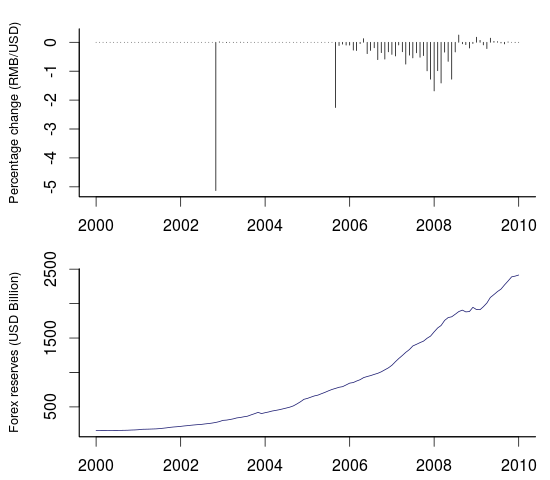
Changes in the exchange rate are very visible. But is the apparent change in the exchange rate a fair depiction of the pressure on the currency market? As an example, consider China's story with the exchange rate:

Figure 1: China's monthly exchange rate returns (upper) and foreign exchange reserves (lower)

The upper panel is monthly returns on the CNY/USD. Positive returns are depreciations and vice versa.  We see large periods of zero change separated by a few months in which there was an appreciation. Does this mean that in the long periods of zero change in the exchange rate, the currency market was quiescent? No. This is a period in which the Chinese central bank was trading in the currency market on a large scale. As the graph of their foreign exchange reserves shows, they went from \$0.4T in 2004 to \$1.9T in 2009. There was a lot of pressure on the currency to appreciate. What we see, as zero or small negative returns, understates the true story.

In order to address this problem, economists aspire to construct a measure of `exchange market pressure' (EMP), which would show the true conditions on the currency market in each month. To borrow a phrase from Amit Varma's podcast, there's an important difference here between the seen and the unseen. The apparent exchange rate change is what we see. What's really going on, in terms of the macroeconomic situation on the currency market, is the exchange rate pressure.

Conventional thinking in EMP measurement


Attempts at EMP measurement have been in progress since Girton and Roper, 1977. There are many EMP measures in the literature. An important one, which expresses the mainstream strategy, is by Eichengreen et. al., 1996 . They propose an EMP index for a country is given by:

\[
\textrm{EMP}_{t} = \frac{1}{\sigma_{e}} \frac{\Delta e_{t}}{e_{t}} - \frac{1}{\sigma_{\bar r}} \left ( \frac{\Delta \bar r_{t}}{\bar r_{t}} - \frac{\Delta \bar r_{US_t}}{\bar r_{US_t}} \right) + \frac{1}{\sigma_i} \left (\Delta \left (i_{t} - i_{US_t} \right) \right)
\]

Where the exchange rate is denoted by $e_t$, reserves divided by base money is $\bar r_t$ and intervention of the central bank at time $t$ is $i_t$. The change in $e_t$ is denoted by $\Delta e_t$; the change in $\frac{r_t}{m_0}$ is denoted by $\Delta \bar r_t$. The three sigmas, $\sigma_e$, $\sigma_{\bar r_t}$, and $\sigma_i$, denote the standard deviations of the relative change in the exchange rate, difference between relative changes in the ratio of foreign reserves and base money in the home country against the reference country (US), and the nominal interest rate differential.

This EMP measure is essentially a weighted average of changes in exchange rate, foreign exchange reserves, and interest rates. To prevent the most volatile component of the index from dominating (usually the forex reserves), each component is weighted by its standard deviations. The resulting EMP index is dimensionless. There is a literature (Pentecost et. al., 2001, IMF.,2007) which finds that these kinds of measures are useful in forecasting currency crises.

Problems with conventional EMP measurement


This approach to measurement has several problems. When there is a fixed exchange rate, the standard deviation in the denominator goes to zero. When a country with an inflexible rate (low $\sigma_e$) experiences a modest change in the exchange rate, this shows up as a large value of EMP. As an example, consider the Chinese experience in the time period covered in Figure 1:

Figure 2: Conventional EMP measure for China

In some months, it is not possible to compute the EMP as we get a divide by zero. In other months also, the graph above does not square with our understanding of what was going on. As an example, consider the period after the Lehman collapse. The EMP measure seems to suggest that this is where the highest pressure to appreciate was seen, which seems incorrect.

A better EMP measure


A recent paper, Patnaik et al., 2017 introduces a new method for measurement of EMP. This new approach seeks to measure EMP in the units of percentage change of the exchange rate of the month. The EMP reported for a month is an estimate of the unseen - the exchange rate change (measured in per cent) which would have taken place if there had been no currency intervention in that month.

Let's treat this new method as a black box and examine how well it works.

Example: EMP in China


Figure 3: Conventional vs. new EMP measures for China

The figure above juxtaposes the conventional EMP measure against the new proposed measure.

There are two gray blocks in the conventional measure, where EMP can't be computed as it was a fixed exchange rate and we encounter the divide by zero. The new measure has no such problem.

In the long period of pressure to appreciate, the new measure shows an interpretable value such as a 5% appreciation in the month, which would have taken place if there had been no trading by the central bank in the currency market. The conventional EMP index is dimensionless and cannot be interpreted in similar fashion.

At the Lehman crisis, the new measure shows a sudden shift in exchange market pressure, followed by a return to the pressure to appreciate. The conventional measure suggests the highest ever pressure to appreciate was found at the time of the Lehman crisis, and this pressure subsided later.

Example: EMP in India


Figure 4: Conventional vs. new EMP measures for India

For macroeconomists who know the Indian experience closely, the new measure makes a lot of sense.

In early 2007, it is rumoured that RBI was purchasing as much as \$1B a day, and there was very high pressure to appreciate prior to the structural break in the exchange rate regime on 23 March 2007. This shows up correctly in the new measure. The conventional measure, in contrast, thinks there was not much going on then.

The conventional measure seems to say that at the Lehman crisis, there was a switch from depreciation pressure to appreciation pressure. This seems unlikely. The new measure shows the highest-ever pressure to depreciate right after the Lehman crisis. This seems correct.

Example: EMP in Russia


Figure 5: Conventional vs. new EMP measures for Russia

There was a long period (2002-2008) with one-way pressure to appreciate. This is picked up in the new measure but not in the conventional measure.

The Russian invasion of Georgia (08/08/08), followed by the Lehman shock in the next month, are associated with an immediate shift to depreciation pressure in the new measure (from August itself, reflecting the Georgia invasion). The conventional measure does not pick up these events correctly.

The Russian invasion of Crimia is followed by pressure to depreciate, in the new measure. This does not appear as clear in the conventional measure.

Example: EMP in Brazil


Figure 6: Conventional vs. new EMP measures for Brazil

The Lehman failure, and the Taper tantrum, show up as episodes of pressure to depreciate in the new measure but not in the conventional measure.

Conclusion


Exchange market pressure is an important tool for better understanding macroeconomics. While the concept has always been attractive, conventional methods for measurement have had limitations. The new measure makes it possible to take interest in EMP as a tool for macroeconomic analysis. This article aims to unveil the new measure as a black box, to show that it works better than the conventional measure. The methodology is presented in the underlying paper. The resulting dataset, with monthly EMP data for 139 countries, has been released, and has diverse potential research applications.

Bibliography


Eichengreen, B., Rose, A., Wyplosz, C., 1996. Contagious Currency Crises , Technical Report. National Bureau of Economic Research.

Patnaik, I., Felman, J. and Shah, A., 2017. An exchange market pressure measure for cross country analysis . Journal of International Money and Finance, 73, pp.62-77.

Desai, M., Patnaik, I., Felman, J. and Shah, A., 2017. A cross-country Exchange Market Pressure (EMP) Dataset . Data in Brief.

Pentecost, E., Van Hooydonk, C., Van Poeck, A., 2001. Measuring and estimating exchange market pressure in the EU . J. Int. Money Finan. 20, 401¡V418.

IMF, 2007. Managing Large Capital Inflows , Technical Report. International Monetary Fund.

Friday, September 16, 2016

Arriving at the correct value of the rupee

by Ajay Shah.

A recent front page story in the Indian Express came as a surprise examination for many economists in India. When currency policy is proposed, four ideas are useful:

  1. Nobody knows what is the correct exchange rate. Asking a government official the correct price of the rupee is as pointless as asking him the correct price of steel or the correct level of Nifty.
  2. We were once in a complicated world where RBI openly said that it had no framework. RBI governors heard pleas from importers and exporters, played favourites, and earned political capital. That period (1934-2015) is now behind us. Now, for the first time, RBI is accountable. It has an objective: inflation. The instrument (control of the policy rate) is used up in giving us the outcome (4% inflation).
  3. Chasing an exchange rate objective can lead to small problems (e.g. the exchange rate management of 2002-2007 kicked off an inflation crisis from 2006) or big problems (the rupee defence of 2013). Wisdom in public policy involves avoiding such adventurism.
  4. While an inflation targeting central bank should not pursue exchange rate policy, the exchange rate is an important input for an inflation targeting central bank. Changes in the exchange rate feed into domestic inflation through the price of tradeables. Thus, changes in the exchange rate are a useful input for forecasting inflation. The essence of good monetary policy is forecasting inflation [example]. RBI should consume the exchange rate, made by the market, as an input into its monetary policy process.

Thursday, September 01, 2016

Measuring the transmission of monetary policy in India

by Rajeswari Sengupta.

The Finance Bill, 2016 amended the RBI Act, 1934 to establish the objective for RBI (where previously there was none): an inflation target. With the enactment of this law, the RBI is committed to meet pre-announced inflation targets within a specific period of time. For long, India has faced the adverse consequences of a discretionary monetary policy (link, link). Inflation targeting (IT), if implemented successfully, will improve accountability, certainty and transparency in India's monetary policy, and help stabilise the Indian macroeconomic and financial environment.

The weak link today is the monetary policy transmission (MPT). In the absence of strong and reliable links between the policy instruments controlled by the RBI and aggregate demand in the economy, it becomes difficult to do IT. In a recent paper (Mishra, Montiel, and Sengupta, 2016), we present evidence of a weak monetary policy transmission in India.

We explore two main issues in the paper:

  1. How does India fare in the factors that affect MPT?
  2. How effective is the bank lending channel of MPT in India?

Factors affecting MPT


Changes in monetary policy instruments translate into changes in aggregate demand through three main channels: bank lending or the interest rate channel, the exchange rate channel, and the asset price channel. The effectiveness of these channels is shaped by the extent of capital controls, policy constraints on exchange rate flexibility, and the structure of the financial system.

Financial markets integration and Exchange rate regime: According to Robert Mundell's "impossible trinity", in an economy with fixed exchange rate, monetary policy loses autonomy of choice when there is high integration between domestic and international financial markets. On the other hand, under a floating exchange rate, as the degree of financial integration increases, the power of monetary policy to affect aggregate demand increases.

We show in the paper that India has a relatively closed capital account in de facto terms, compared to major emerging economies such as Argentina, Brazil, Chile, Colombia, Israel, Malaysia, Mexico, Thailand, Turkey, Russia and South Africa. The exchange rate of the Rupee is determined in the interbank market. The RBI periodically intervenes in that market, buying and selling both spot and forward dollars at the market exchange rate. The limited degree of financial markets integration and RBI's interventions in the foreign exchange market are likely to mute the exchange rate response to monetary policy.

Structure of the domestic financial system: According to Mishra, Montiel and Spilimbergo (2012), MPT works better as the size and reach of the financial system increase, the degree of competition in the formal financial sector goes up and the domestic institutional environment lowers the costs arising from financial frictions.

We present evidence in our paper that the size of the formal financial system in India, measured by conventional indicators (such as the number of bank branches scaled by population or the percentage of adults with accounts at a formal financial institution) is relatively small compared to other advanced and emerging economies. The formal banking sector does not intermediate for a large share of the economy and is highly concentrated. India lags behind advanced and emerging economies in developing its bond market. Indicators of domestic institutional environment such as rule of law, regulatory quality, control of corruption, and political stability, show that India is roughly at the global median.

This suggests that the kind of public goods on which the financial system depends (such as enforcement of property rights, accounting and disclosure standards) may not be as readily available in India as in other countries. This would make financial intermediation a costly activity, weakening the effect of monetary policy actions.

Bank lending channel of MPT


There are two stages of the transmission process in the bank-lending channel, (i) the transmission from policy instruments to bank lending rates and (ii) the transmission from bank lending rates to final outcomes such as inflation and output. We use a structural vector autoregression (VAR) model in the paper to estimate the effects of a shock to monetary policy instruments on outcome variables through the impact on bank lending rates. The VAR model captures the full dynamic interactions among all the variables of interest. Given a shock to say the policy rate, it is possible to trace out the responses of all other variables to that shock, period by period.

In India, two broad groups of instruments have historically been used by the RBI to conduct monetary policy: (i) price based instruments such as the repo rate and the reverse repo rate: these affect the cost of funds for banks, and (ii) quantity-based instruments such as the Cash Reserve Ratio (CRR) and Statutory Liquidity Ratio (SLR): these affect the supply of banks' loanable funds.

We consider the effects of four instruments in our analysis: (i) the repo rate, (ii) the average of repo and reverse repo rates (price indicator), (iii) the sum of CRR and SLR (quantity indicator), and (iv) a composite score-based indicator of monetary policy stance. The price and quantity indicators have generally moved in the same direction during our sample period of 2001 to 2014. The exception is between 2011 and 2012, when increases in the policy rates suggested a tightening of monetary policy while the quantity indicator continued to move in a loosening direction.

To address this complication, we construct a score-based indicator of monetary policy stance following Das, Mishra and Prabhala (2015). We assign scores of 0, +1, -1, respectively if there is no change, an increase, or a decrease in the values of the four monetary policy instruments in any given month during our sample period. We calculate the overall stance of monetary policy by taking an unweighted sum of the scores for the individual instruments.

We use the "benchmark prime lending rate (BPLR)" of the banking sector till June 2010 and the "base rate" thereafter. Till 2010, the BPLR determined the interest rates charged by Indian banks on different categories of loans. From July 2010, it was replaced by the average base rate charged by the five largest commercial banks. We use the seasonally adjusted headline CPI inflation as an outcome variable. Another outcome variable is the output gap measured using the Index of Industrial Production (IIP). Since IIP covers only the manufacturing sector, we interpret the results on transmission to output with adequate caution.

We motivate our choice of endogenous variables in the VAR model using a modified version of the simple, open-economy New Keynesian model developed by Adam et. al. (2016). The model consists of an IS equation, a New Keynesian Phillips curve, an uncovered interest parity condition, an interest rate pass-through equation, and a Taylor-type monetary policy rule. Consistent with this model, we estimate a VAR for India with five endogenous variables: output gap, inflation rate, exchange rate, bank lending rate and the monetary policy instrument.

Shocks to the world food and energy prices may exert important effects on inflation in India. Since India is less likely to affect world food and energy prices, these prices measured in US dollars can be considered exogenous to developments in India. So we include these as exogenous variables in some versions of our estimated VARs. This is important because to the extent that shocks to either of these variables may help predict future headline CPI inflation in India, excluding them would undermine the identification of monetary policy shocks in India.

We follow two alternative identification schemes in the paper. One in which the monetary policy variable is ordered first, reflecting the assumption that the RBI does not observe (or does not react to) macroeconomic variables within the month, but the macro variables are potentially affected by monetary policy shocks contemporaneously. In this scheme the monetary policy variable is ordered first, followed by the bank lending rate, output gap, CPI inflation and exchange rate.

In the second scheme, the RBI responds to macro variables within the month, but those variables in turn respond to monetary policy only with a lag. Monetary policy variable is ordered last in this scheme and the ordering of the other variables remains the same.

Results


Across both identification schemes and for all four monetary policy measures, a tightening of monetary policy is associated with an increase in bank lending rates. However the effect is statistically different from zero only at the 90 percent confidence level. This suggests that there is weak evidence for the first stage of transmission in the bank lending channel.

The effect of monetary policy changes on bank lending rates is hump-shaped, with the peak effects appearing between 5-10 months in all the cases considered.

The pass-through from the policy rate to bank lending rates is incomplete. For example, an increase of 25 basis points in the repo rate, is associated with an increase in the bank lending rate of only about 10 basis points.

The effect of monetary policy changes on the exchange rate is not statistically significant for any of the four monetary policy measures used. This suggests a non-existent exchange rate channel of MPT in India.

Our results provide no support for the second stage of transmission in the bank lending channel. We do not find evidence of effect of monetary policy changes on either the CPI inflation rate or the output gap.

Conclusion


A low degree of de facto capital mobility, RBI's interventions in the foreign exchange market, and the structure of the financial system suggest that the exchange rate and the asset price channels of MPT have low effectiveness in India. The burden of monetary transmission is likely to fall on the bank lending or interest rate channel. We present new evidence in our paper that the bank lending channel of MPT does not work well either.

With the adoption of IT, RBI has taken a step in the right direction. The enactment of the law by itself will not achieve price stability. A strong transmission mechanism from the policy rate to aggregate demand is crucial for the successful implementation of the new monetary policy framework. The legal mandate of IT must now be used to improve the effectiveness of MPT.

References


Das, Abhiman, Prachi Mishra, and Nagpurnanand Prabhala (2015), The Transmission of Monetary Policy Within Banks: Evidence from India, mimeo.

Li, Bin Grace, Stephen O'Connell, Christopher Adam, Andrew Berg, and Peter Montiel (2016), VAR meets DSGE: Uncovering the Monetary Transmission Mechanism in Low-Income Countries, IMF Working Paper, No. 16/90.

Mishra, Prachi, Peter J. Montiel, and Antonio Spilimbergo (2012), Monetary Transmission in Low-Income Countries, IMF Economic Review, 60, 270-302.

Mishra, Prachi, Peter J. Montiel and Rajeswari Sengupta (2016), Monetary Transmission in Developing Countries: Evidence from India, IMF Working Paper, No. 16/167.


Rajeswari Sengupta is a researcher at the Indira Gandhi Institute for Development Research, Bombay.

Tuesday, April 05, 2016

Motivations for capital controls and their effectiveness

by Radhika Pandey, Gurnain K. Pasricha, Ila Patnaik, Ajay Shah.

The global financial crisis has re-opened the debate on the place of capital controls in the policy toolkit of emerging-market economies (EMEs). The volatility of capital flows during and after the global financial crisis, and the use of capital controls in major EMEs spawned a vigorous debate among policy-makers on the legitimacy and usefulness of capital controls.

In order to aid the development of best practices in capital controls policy, the literature needs to address four questions:

  1. Under what circumstances do policy makers utilise capital controls? Do policy-makers use capital controls as macroprudential tools, as envisioned in the recent literature?

  2. What impact do different capital controls have?

  3. Do the benefits outweigh the costs?

  4. How should real world institutional arrangements be constructed, to utilise these tools appropriately?

In a recent paper (Pandey et. al, 2016) we offer new evidence on the first and second of these questions.

A rich literature has sprung up in recent years, which has re-engaged with these questions. A number of recent studies examine effectiveness of controls in a single country (Brazil or Chile) or a multi-country setting. See for example, Alfaro et al, 2015; Fernandez et al., 2015; Forbes and Klein, 2015; Pasricha et al., 2015. A full list of references is in our paper. In this literature, several researchers have argued that capital controls may be particularly effective in a country like India with the legal and administrative machinery to implement controls (Habermeier et. al., 2011; Klein, 2012).

Indian policy makers have modified the capital control framework frequently to address concerns about the exchange rate, country risk perception and other issues. For example page 15 of RBI's 2014 Annual Report states that RBI's response to the developments following the US Fed's indication that it would taper its large-scale asset purchase program ``aimed at containing exchange rate volatility, compressing the current account deficit (CAD) and rebuilding buffers.'' This response included use of capital controls, foreign exchange intervention as well as interest rate changes. India is thus a good laboratory for studying the motivations and consequences of capital controls.

Credible research designs in this field require precise measurement of capital controls or capital control actions (CCAs). There are many concerns about the measurement obtained through conventional multi-country databases. We comprehensively analyse primary legal documents from 2004 to 2013, in order to construct a new instrument-level dataset about every capital control action for one asset class (foreign borrowing by firms) for one country (India).

In constructing this database, we differentiate between capital control announcements and capital control instruments (e.g., controls on minimum maturity of loans, controls on eligible borrowers, interest rate ceilings, etc.). In India, several instruments can be changed in the same announcement, and we count each instrument separately. We compare our approach with other recent work that compiles datasets on capital control actions (e.g. : Pasricha et al 2015; Pasricha 2012; Forbes et al. 2015) in our paper.

Q1: Under what circumstances do policy-makers utilise capital controls?


We use event studies to ask whether EME policy-makers use capital controls as macroprudential tools, as envisioned in the recent literature. Specifically, do EME policy-makers use capital controls to pursue macroprudential objectives or to achieve exchange rate objectives? A large literature since 2008 envisions capital controls as prudential tools, that can help mitigate systemic financial sector risk, and therefore views them in a more benign light than controls aimed at managing the exchange rate (See Korinek, 2011; Jeanne and Korinek, 2010; Bianchi, 2011, among others).

Factually assessing the motivations for past EME CCAs can help inform the debate on capital controls, as well as the resulting international consensus on the rules of governance for their use. On the one hand, if it can be discerned in the data that emerging markets have, in fact, been using capital controls to target systemic risk, this bolsters the legitimacy of the EME case for continued use of these instruments. On the other hand, if the data suggest that CCAs have been used for currency manipulation, this bolsters the case of those who argue that further international discussions on the rules of the game are needed to address multilateral concerns.

Figure 1: Exchange rate change prior to a easing CCA. Positive values denote depreciation.

Figure 2: Exchange rate change prior to a tightening CCA. Positive values denote depreciation.

The key result is in the two figures above. In the five weeks prior to an easing action, USD/INR depreciated by 3% on average. In the five weeks prior to a tightening action, USD/INR appreciated by 5% on average. Not only was the average trend prior to easing of inflow controls that of a depreciation of the currency, this also held true for the broad majority of events in sample: 42 out of the 68 instances of easing in our sample were preceded by exchange rate depreciation.

For the easing events which were preceded by an appreciation, the extent of the appreciation was small compared with that seen with events preceded by depreciation: the largest 5-week appreciation prior to an easing was 1.3%, compared to 9.2% for depreciation. The average appreciation prior to an easing was only 0.5%, compared to an average depreciation prior to easings of 5%.

None of the variables that measure the build-up of systemic risk show a similar strong pattern in the 6 months prior to the event date (see Figures 5-8 and Table 5 in the paper). The prime motivation for CCAs in India appears to be exchange rate policy and not macroprudential policy. This shows a certain gap between capital controls in the ideal world and capital controls as they operate in the field.

Q2: What impact do different capital controls have?


Next, we measure the impact of capital control actions. In order to obtain a credible estimation strategy, we utilise propensity score matching to identify time points which are counterfactual. This yields a quasi-experimental design where the treatment effect can be measured. Specifically, for each week in which a capital control action was taken, we identify a week in which macro / financial stress was similar, but no capital control action was taken.

Table 1: Causal impact of CCAs on various indicators
Impact uponCoefficientStd. Errort-statistic
Credit growth-0.441.7-0.46
Stock prices1.173.550.49
Frankel-Wei Residual-0.230.92-0.25
Net foreign inflow-0.040.03-1.33

Our results suggest that there was no significant impact of the capital control actions, either on the exchange rate or on measures connected with systemic risk (Table 1). Table 1 above shows the coefficient for the period 4 weeks after the capital control action. Similar values are found for all other time horizons. There is no statistically significant impact upon any of the outcomes at horizons from 1 to 4 weeks.

Broader implications of our results


These results have many implications for the global debate about capital controls. In many countries, the capital controls system was fully dismantled. In such an environment, it may be particularly easy to evade capital controls, for example through financial engineering. The best opportunity to obtain effectiveness of capital controls may be in countries like China or India, where large bureaucracies implement capital controls, and the detailed system of specifying rules about every asset class and every type of economic agent was never dismantled. For this reason, India is an ideal laboratory to study capital controls. If capital controls are found to be useful in India, the case could potentially be made that other EMEs, which dismantled the overall capital controls system, should reverse these reforms.

Our results show that Indian authorities seem to be using capital controls as a tool for exchange rate policy and not for systemic risk mitigation, and their actions seem to be ineffective. These results are also consistent with many papers in the recent literature which are skeptical about the usefulness of capital controls (Chamon and Garcia, 2015; Fernandez et. al, 2015; Forbes and Klein, 2015; Forbes et. al., 2015; Hutchison et. al, 2012; Klein, 2012; Patnaik and Shah, 2012; Pasricha et.al, 2015; Warnock, 2011).

The strength of the research presented here is that it provides credible estimates about one locale, India. A fruitful line of inquiry would be to apply such strategies to multiple countries, and build up a literature with careful assessment of country experience, one country at a time, about the ways in which capital controls are used, in the field, and about their treatment effects. A much more expansive strategy would seek to undertake such thorough instrument-level analysis on a multi-country scale in order to construct a consistent database about capital control actions on the scale of all EMEs or the whole world.

Even when capital controls do yield a desired treatment effect, the important question of cost-benefit analysis remains. A body of research is required which would assess the costs and the benefits of utilising these tools. On the cost-assessment side, a wide body of research on capital controls focuses on microeconomic distortions from capital controls (Alfaro et al, 2015; Forbes, 2007). On the benefits side, the evidence is mixed regarding the extent to which capital controls are able to deliver on the objectives of macroeconomic policy. While capital controls seem to be able to change the composition of flows toward more long-term debt, it is not clear to what extent this represents a mislabelling of flows (Magud et al., 2011; Carvalho and Garcia, 2008). Pasricha et al. (2015) find that capital control actions were not useful in allowing major emerging markets to change their trilemma configurations and Patnaik and Shah (2012) find that the Indian capital controls are not an effective tool for macroeconomic policy.

Further research is required on the institutional arrangements for capital controls. As an analogy, monetary policy was long viewed as being effective, but it was only in the 1980s that clarity was obtained around the institutional structure of independent central banks with inflation targets and monetary policy committees. In similar fashion, if capital controls have to graduate into the macroprudential policy toolkit, normative research is required in designing the optimal institutional arrangements for systemic risk regulation with mechanism design, akin to a monetary policy committee, and accountability, similar to an inflation target.

References


Laura Alfaro, Anusha Chari and Fabio Kanczuk. The real effects of capital controls: Financial constraints, exporters and firm investment NBER Working Paper 20726, Dec 2014.

Marcos Chamon and Marcio Garcia. Capital controls in Brazil: Effective? Journal of International Money and Finance, 2016 (Forthcoming).

Bernardo S. de M. Carvalho and Marcio G. P. Garcia. Ineffective controls on capital inflows under sophisticated financial markets: Brazil in the nineties In Sebastian Edwards and Marco G. P. Garcia (Eds.), Financial markets volatility and performance in emerging markets, pp. 29-96. University of Chicago Press.

Andres Fernandez, Alessandro Rebucci, and Martin Uribe. Are capital controls countercyclical? Journal of Monetary Economics, 76:1--14, 2015.

Anton Korinek. The new economics of capital controls imposed for prudential reasons. IMF Working Paper, Dec 2011.

Javier Bianchi. Overborrowing and systemic externalities in the business cycle. American Economic Review: Vol. 101 No. 7, Dec 2011.

Kristin J. Forbes. One cost of the Chilean capital controls: Increased financial constraints for smaller traded firms. Journal of International Economics 71(2): 294-323, Apr 2007.

Kristin J. Forbes and Michael W. Klein. Pick your poison: The choices and consequences of policy responses to crises. IMF Economic Review, 63(1):197--237, Apr 2015. ISSN 2041-4161.

Kristin J. Forbes, Marcel Fratzscher, and Roland Straub. Capital-flow management measures: What are they good for? Journal of International Economics, 96, Supplement 1:S76 -- S97, 2015. ISSN 0022-1996. 37th Annual NBER International Seminar on Macroeconomics.

K. F. Habermeier, C. Baba, and A. Kokenyne. The effectiveness of capital controls and prudential policies in managing large inflows. IMF Staff Discussion Note SDN/11/14, International Monetary Fund, 2011.

Nicolas E. Magud, Carmen M. Reinhart and Kenneth S. Rogoff. Capital controls: Myth and reality - A portfolio balance approach. NBER Working Paper No. 16805, Feb, 2011

Michael M. Hutchison, Gurnain Kaur Pasricha, and Nirvikar Singh. Effectiveness of capital controls in India: Evidence from the offshore NDF market. IMF Economic Review, 60(3): 395--438, 2012.

Michael W. Klein. Capital controls: Gates versus walls. Brookings Papers on Economic Activity, 45(2 (Fall)):317--367, 2012.

Olivier Jeanne and Anton Korinek. Excessive Volatility in Capital Flows: A Pigouvian Taxation Approach. American Economic Review, 100(2), May 2010.

Radhika Pandey, Gurnain Kaur Pasricha, Ila Patnaik, Ajay Shah. Motivations for capital controls and their effectiveness. Working paper, 2016.

Gurnain Kaur Pasricha. Recent trends in measures to manage capital flows in emerging economies. The North American Journal of Economics and Finance 23 (3), 286-309.

Gurnain Kaur Pasricha, Matteo Falagiarda, Martin Bijsterbosch and Joshua Aizenman. Domestic and multilateral effects of capital controls in emerging markets. NBER Working Paper No. 20822.

Ila Patnaik and Ajay Shah. Did the Indian capital controls work as a tool of macroeconomic policy. IMF Economic Review, 60(3):439--464, 2012.

Frank E. Warnock. Doubts about capital controls. Working Paper 14, Council on Foreign Relations, 2011.


Gurnain Pasricha is at the Bank of Canada, and the other three authors are at the National Institute for Public Finance and Policy, New Delhi. The views expressed in this post are those of the authors. No responsibility for them should be attributed to the Bank of Canada or NIPFP.

Sunday, April 03, 2016

Foreign Currency Borrowing by Indian Firms: Towards a New Policy Framework

by Ila Patnaik, Ajay Shah, Nirvikar Singh.

A well established concept in the field of international capital flows is the problem of `original sin': where governments or firms have currency mismatches with foreign borrowing that is typically in dollars. When such exposures exist, there is the possibility of substantial balance sheet effects in the event of a large depreciation. In India, foreign currency borrowing has grown seven-fold, from \$20 billion in 2004 to \$140 billion in 2014. This has generated concerns about systemic risk. We have a paper which is forthcoming in India Policy Forum on these questions. Key ideas from this are presented here.

Rational firms are conscious about the destruction of wealth that comes with a large depreciation and unhedged exposure, and are likely to avoid currency mismatches. The moral hazard hypothesis suggests that firms choose to have unhedged foreign currency borrowing because governments and central banks communicate their intent to manage the exchange rate when faced with large depreciations. Concerns about unhedged foreign currency borrowing by firms are a greater issue in emerging markets where the monetary policy regime targets the exchange rate, as compared with mature market economies with floating exchange rates.

Capital controls are proposed as a way of avoiding moral hazard associated with foreign currency borrowing under pegged exchange rates. The puzzle lies in designing a capital controls system which interferes with unhedged foreign currency borrowing but not with foreign borrowing by firms with hedges. For firms who have natural hedges, unhedged foreign currency borrowing is a valuable source of low cost capital. These firms include not just net exporters, but net producers of tradeables where domestic output prices are set by import parity pricing.

What is a policy framework where hedged firms are able to obtain the economic benefits of unhedged foreign currency borrowing, while avoiding unhedged foreign currency borrowing? One strategy is to combat the moral hazard at the root cause: the monetary policy framework. A monetary policy framework which enshrines inflation as the target, and not the exchange rate, would remove the moral hazard. Inflation targeting central banks are, in general, associated with greater exchange rate flexibility.

The second element of the policy question is the capital controls regime. The Indian strategy for capital controls on foreign currency borrowing presently involves many kinds of restrictions. The dominant form of currency borrowing is ``External Commercial Borrowing'' (ECB) by companies. Rules restrict who can borrow, who can lend, how much can be borrowed, at what price, what end-use the borrowed resources can be applied for, who can offer a credit guarantee, when borrowed proceeds must be brought into India, when loans can be prepaid, when loans can be refinanced, procedural rules for all these activities, and rules for banks to force all borrowers to hedge currency exposure. Further, loans above a certain amount require approval.

The present policy framework is highly complex, uncertain, and, as has been suggested by the Sahoo Committee that was set up by the government to review the existing framework, fails to address some of the concerns of policy makers. For example, policy makers are concerned about the level of unhedged foreign currency exposure in the economy, issues of discretion and transparency, and policy uncertainty in the framework. Further, the recent focus on modern regulation making processes and rule of law has raised questions about the appropriateness of the existing policy framework. We compare the present distribution of foreign currency borrowing among firms against a normative ideal (foreign borrowing by naturally hedged firms), and find large deviations.

In recognition of these problems, in recent times, some policy changes have been introduced in the capital controls that may help reduce currency mismatch. These include allowing firms to undertake rupee-denominated ECB, an increase in the caps on FII investment in rupee-denominated corporate bonds (the cap has increased slowly to USD 51 billion in 2015), monitoring of the hedge ratio for ECB by requiring firms to report these, requiring infrastructure firms to fully hedge their ECB and prudential requirements for banks when lending to companies with unhedged foreign currency exposure.

For Indian firms, markets for derivatives are illiquid and costly owing to restrictive regulations, making it unattractive to hedge explicitly through these markets. On the other hand, while some borrowers may have natural hedges, the policy framework for ECB does not take this into account. This helps explain why firms with natural hedges, such as domestic makers of tradeables, are not strongly present in foreign currency borrowing.

The current restrictions on ECBs raise concerns about engaging in ill-defined or poorly justified industrial policy, about the scale of economic knowledge required to write down the detailed prescriptive regulations, the impact upon the cost of business and about rule of law. Recent research suggests that the large number of changes in the capital controls governing ECB are motivated by exchange rate policy and not systemic risk regulation. This raises questions about the process through which regulations are being made.

In the international discourse, there is renewed interest in capital controls, in particular in order to address the systemic risk associated with large scale unhedged foreign currency borrowing by firms in countries with pegged exchange rates. For those who are willing to intrude on economic freedom with capital controls, India is a poster child, with a great willingness to do central planning on what happens with cross-border activities. The careful examination of the Indian capital controls on foreign currency borrowing suggests that the Indian framework has not been effective in permitting safe activities while reducing systemic risk.