Search interesting materials

Showing posts with label author: Karthik Suresh. Show all posts

Wednesday, October 21, 2026

Better public procurement for IT in India

by Ashok Pal Singh, Karthik Suresh, and Susan Thomas.

Information technologies (IT) are now ubiquitous in government. The Government of India has more than tripled its expenditure in real terms on large-scale "mission mode projects" over the last fifteen years. Yet, we see persistent evidence of failures (see examples here, here, and here). Failures in IT services therefore affect not only convenience but also people's ability to comply with the law. At the same time, there is a wide gap between contracting volumes and contracting capabilities in the Indian state. This makes government IT systems particularly vulnerable to changes in scope, features, and scale that may happen during the course of a project. These problems pose challenges for contract design through which this flow of change requests is processed by private vendors without exorbitant monopolistic pricing. IT systems are not one-off jobs that is akin to building bridges or even repeat jobs like purchasing medicines. This is a tricky problem to address.

In our new paper, Better public procurement for IT in India, we delve into three cases of large-scale IT projects in India --- Aadhaar, Passport Seva, and MCA-21. We ask, what factors drive the performance of IT procurement by the Indian government? We answer the question by analysing the performance of contracts and the underlying factors driving this for IT projects using a contract life-cycle approach. This involves looking at six aspects of each project: (i) the vision, purpose, and objectives of the project which help the government write the specifications and delegate all the other aspects of the project; (ii) the project's governance structure, (iii) the project's contracting model, (iv) how each project dealt with change requests, (v) how did the project deal with closure and transition into newer versions of the IT system, and (vi) did the project reasonably abide by cost and time estimates.

Our general findings are that the Indian government finds it difficult to take on the IT project after the vendor has completed the contract. Further, the government is unable to communicate, handle, and account for change requests in IT projects efficiently. IT projects carry some level of inherent risk and they require some level of adaptive contracting. At the same time, government projects are conducted using public funds and there are rules against profligate spending. Therefore, IT contracts should be designed in such a way that they confine to the strictures of the rules on public spending, while at the same time they are flexible enough to allow the project managers to adapt to change requests, technological improvements, and other developments. On these lines, we suggest the following prescriptions:

  • Restricting the mandate of the project to a single goal/ outcome when multiple goals conflict with each other.
  • Sufficiently empowering the project leadership team in terms of skillsets, administrative competences, and spending capabilities.
  • An inter-disciplinary team that can complement each other's skills and allow for a space for deliberation, while also guarding against technological solutionism.
  • Evidence-based decision making that follows the scientific process of discovery, evidence, and analysis.
  • Government should take ownership of the project and use the services of consultants and experts for specific outcomes within the project framework.
  • Transition management is as important as project management --- a well-defined transition plan that is written into the project document for the first iteration itself.
  • Government's IT system should be available in the open source domain. There are significant positive spillovers when government IT systems are digital public goods i.e., open-source code on published websites which speak open APIs.
  • Highly specialized IT projects are susceptible to opportunistic hold-ups and sunk costs. Bidders in India therefore tend to price these costs ex-ante i.e., by overstating the bid. This in turn incentivizes the government to use state power to pay only the marginal production cost to the bidder. As a solution, the literature suggests that the government "owns" the system/ asset.
  • Contracts are differentiated on the basis of financial risks, operational risks, and ownership. In our view, the government should procure a working proof-of-concept, after which it can scale up the project.

Government IT projects can be thought of as being implemented in the following three phases: Phase 1 being the development of a system that demonstrates the proof of concept (PoC) ending in the delivery of a pilot implementation; Phase 2 where the pilot is scaled up to the state or national level; and Phase 3 where the project then moves into running an operational system. Successful implementations of public IT systems ideally are a mix of "make" and "buy" rather than just "buy". Phase 1 should done through "make" -- where the government itself builds the PoC and delivers a pilot implementation. Once the PoC is established, the IT system is like a well-defined product. With this in place, scaling up of the system over a state or the entire country can be optimally done through "buy", where private vendors can be contracted to deliver on a clearly defined output.


Ashok Pal Singh is a retired civil servant who served in various positions, including that of Deputy Director General with the Unique Identification Authority of India. Karthik Suresh is Assistant Professor at the National Law School, Bengaluru. Susan Thomas is Co-founder and Senior Research Fellow at XKDR Forum.

Sunday, February 09, 2025

Improving electricity regulation in Tamil Nadu

by Akshay Jaitly, Charmi Mehta, Rishika Ranga, Renuka Sane, Ajay Shah and Karthik Suresh.

The Indian electricity sector is a centrally planned sector that faces increasing financial stress. In other words, a centrally planned decarbonisation would result in enlarged costs and political difficulties. The path forward for electricity reforms is to make changes one state at a time. We have started this journey with the state of Tamil Nadu.

The case of Tamil Nadu is particularly interesting. It holds great potential when it comes to the energy transition with high potential of offshore wind and solar. However, poor quality of supply along with indiscriminate subsidies for domestic and agricultural consumers has led to deep levels of fiscal stress on the Tamil Nadu state exchequer. Fiscal stress harms investibility in electricity, which is particularly a challenge for renewables. Due to multiple reasons, some of which may be attributed to the political economy at the state level, the state of Tamil Nadu has also revised tariffs only four times since the Electricity Act was enacted in 2003. These tariff revisions have often not reflected the cost of supply of electricity (e.g., the tariff revisions in 2017).

While the electricity sector in Tamil Nadu has recently undergone institutional changes in the form of TANGEDCO's demerger, the present state of regulatory challenges has not been adequately addressed. In a new paper, Improving electricity regulation in Tamil Nadu, we present evidence on regulatory failures of the electricity regulator in Tamil Nadu (TNERC) and contextualise the impact of this on associated aspects of public finance and private finance. We bring the knowledge of regulatory theory to bear upon the possible causes of these failures. We discuss the TNERC's performance on elements that make up a well-functioning regulator, such as clarity of purpose, separation of powers, selection of board members, fair adjudication, public consultations and financial independence.

Many aspects of regulatory reform require amendments to the Electricity Act, and hence the problem statement lies in identifying the levers available to make progress in Tamil Nadu. We identify several levers that the state government can use to undertake reforms, well within its powers under the Electricity Act, to make Tamil Nadu a turnaround story and a model for good electricity regulation nationwide. When these improvements are put into motion, they will materially change the views of private investors on the feasibility of investment in the Tamil Nadu electricity sector. This paper offers ideas on how this can be done.


Akshay Jaitly, Rishika Ranga and Renuka Sane are researchers at Trustbridge Rule of Law Foundation. Charmi Mehta, Ajay Shah and Karthik Suresh are researchers at XKDR Forum.

Thursday, September 19, 2024

Who is "innovative"? Unpacking the process of tax exemption grants to startups

by Aneesha Chitgupi, Karthik Suresh, and Diya Uday.

When private individuals spend resources on innovation, the ideas and benefits that arise spread to society at large. An underspend on innovation results in the market failure of "positive externalities". The state has an important role to play in solving this market failure by encouraging spending on activities that generate innovation (Mashelkar et al., 2024). In India, the government did so by: (i) building research organisations like CSIR and ISRO and hiring career scientists, and (ii) providing tax exemptions. The Income Tax Act, since its inception in 1961, has exempted expenditures on scientific research. Since 1996-97, goods used for R & D have been exempt from customs and excise duties.

In the last ten years, both the Union and various state governments have perceived "startups" as major drivers of innovation. A host of incentives have been put in place for them. These include: (i) reduced fees and priority in processing patent and design applications; (ii) full exemptions on income tax for the startup following approval from an Inter-ministerial Board (IMB); (iii) priority during public procurement, etc. However, in a previous article (Chitgupi et al., 2023), we analysed Indian patent filings and grants and found that, despite enjoying government incentives, the overall share of startups in patent filings and grants --- a proxy for innovation --- remains small. Moreover, only a few startups receive income tax exemptions aimed at spurring innovation (see Table 1).

Table 1: Overview of the landscape of startups
Startups 2023 2024
Total (registered and unregistered) 2,49,107 3,14,492
Registered as startups by DPIIT* 90,939 (36.5) 1,31,191 (41.7)
Granted tax exemptions by the IMB** 1,100 (1.2) 2,976 (2.3)

Table notes: * fraction of total startups;
** fraction of DPIIT registered startups.
Source: Authors' compilation and analysis

The income tax exemption for startups

Section 80-IAC of the Income Tax Act allows a one hundred per cent tax deduction for eligible startups. The aim is to reduce the tax and compliance burden in the initial years of incorporation. A startup is eligible if (i) it is a new business incorporated after 1 April 2016 and is not a reorganisation of an old business with old machinery; (ii) its total turnover does not exceed INR 100 crores; and (iii) it is "engaged in innovation, development or improvement of products or processes or services or a scalable business model with a high potential of employment generation or wealth creation". The body tasked with determining the eligibility of a startup is the IMB. It was set up by the DPIIT in April 2016 with three members, and it is an executive body with delegated powers.

In this article, we study the institutional design and functioning of the IMB under Section 80-IAC. Our findings suggest that the IMB's process is not optimised to deliver the statutory intent of tax exemptions to startups. We identify the bottlenecks that must be targeted for change and question the current incentive structure for startups to innovate.

Methodology

There is a perception that staffing an organisation with technocrats will solve the problems of the organisation. This is not a recipe for lasting success (Kelkar and Shah, 2022). It is instead important to draft rules and procedures that work within and beyond the administrative system and that provide the right incentives to bolster the purpose of the organisation, i.e., promoting innovation. We view the IMB as an executive body tasked with an executive function --- to determine whether a startup is eligible for an exemption under Section 80-IAC. We rely on principles of administrative law while examining the processes and workings of the IMB. In particular, we focus on (i) institutional design, (ii) transparency, (iii) administrative discretion, and (iv) accountability (see Table 2).

We integrate this framework with Adam Smith's Canons of Taxation which sets out design principles for efficient tax administration. These are: (i) the maxim of equality, i.e., the tax must be collected with equality before the law; (ii) the maxim of certainty, i.e., the time, manner, and amount of tax to be paid ought to be clear and plain to the taxpayer, (iii) the maxim of convenience, i.e., the tax ought to be levied at the time and in the manner in which it is most likely to be convenient for the taxpayer and (iv) the maxim of economy, i.e., the tax ought to be so contrived that it takes from the taxpayer as little as possible. Smith's canons are routinely used by Indian courts to test the constitutionality of actions by tax administrations. For example, in South Indian Bank Ltd. vs. CIT AIR 2021 SC 4266, the Supreme Court applied Adam Smith's canons to examine the tax exemption to income arising from interest paid by banks.

Table 2: Our framework for analysing the process of tax exemptions to startups
Parameter Administrative principleSmith's canons
Institution designClarity of purpose and processEquality, certainty, convenience.
Composition of the board
Reporting of conflicts of interest
Process transparency Publication of rules and processesCertainty
Administrative discretionIssue of reasoned ordersEquality, certainty
Administrative accountabilityProcedure for appeals from orders Equality, certainty
Audit oversight mechanism

We hand-collected and evaluated a sample of the minutes of the IMB meetings published on the Startup India portal to determine the eligibility of startups for tax exemptions. Our dataset comprises 52 decision documents out of the 72 available on the portal from 2016 to 2023, with the most recent document being from February 2023. There have been no additions to the IMB decisions since February 2023. Table 3 summarises our sample and provides insights into the total number of cases heard and the corresponding board decisions, forming the foundation of our study. Of the 72 IMB decisions published on the IMB website from May 2016 to February 2023, we have hand-collected data from 52 of these meetings, covering a total of 2,102 cases (72.2 per cent) each representing a startup.

Table 3: Overview of the sample data of IMB meetings
Year No. of meetings* No. of startup applications
Granted Rejected Deferred Total
2016 6 9 265 35 309
2017 3 21 201 141 363
2018 3 6 126 17 149
2019 8 109 1 57 167
2020 8 73 10 15 98
2021 10 80 13 9 102
2022 13 651 97 52 800
2023 1 112 2 0 114
Total 52 1061 715 326 2102
Table notes: *No of meetings from which data was used for this article.
Source: Authors' compilation from the Startup India website.

Results

Institution design

Clarity of purpose and process: The IMB has to decide whether a startup is eligible for the tax exemption. We find that the substance of the criteria to be applied by the IMB to determine eligibility for startup tax exemptions overlaps with the DPIIT criteria to register a startup. The need for a body like the IMB to reassess a startup on the same criteria is unclear. Despite this, only a small percentage of firms that have qualified the DPIIT's criteria meet the IMB's criteria. This violates Smith's canons of certainty and convenience because of the uncertainty of receiving the exemption despite having met the DPIIT's criteria. Table 4 compares the criteria for the IMB and the DPIIT to determine the eligibility of a startup for registration and grant of tax exemption. The criteria are substantially the same.

Table 4: Mandate of the IMB compared with the mandate of DPIIT for startups
IMB (for startup tax exemption) DPIIT (for startup registration)
Criteria 1 The entity's business involves innovation, development, deployment or commercialisation of new products, processes or services driven by technology or intellectual property Entity is working towards innovation, development or improvement of products or processes or services, or if it is a scalable business model with a high potential of employment generation or wealth creation.
Criteria 2 The entity was incorporated on or after 1 April 2016 but before 1 April 2025. Upto a period of ten years from the date of incorporation/ registration, if it is incorporated as a private limited company (as defined in the Companies Act, 2013) or registered as a partnership firm (registered under Section 59 of the Partnership Act, 1932) or a limited liability partnership (under the Limited Liability Partnership Act, 2008) in India.
Criteria 3 The entity's turnover does not exceed one hundred crore rupees. Turnover of the entity for any of the financial years since incorporation/ registration has not exceeded one hundred crore rupees.
Criteria 4 The entity has not been formed by splitting up, or the reconstruction, or using more than 20% by value of machinery, of a business already in existence. The entity shall not be formed by the splitting up or the reconstruction of an existing business
Source: DPIIT notification dated 19 February 2019 and Section 80 IAC of the Income Tax Act 1961

This is further highlighted through our analysis of the reasons for rejection of exemption claims. We map the reasons that are recorded in the minutes of IMB's meetings to the eligibility criteria set out in Table 4. We find that in 65 per cent of cases, a startup fails to get an IT exemption from IMB despite having met the same criteria for the DPIIT's requirement. Table 5 presents the percentage of exemption applications rejected based on previously assessed criteria. Further, 51 per cent of cases were rejected because the IMB determined that the startup was incorporated before 1st April 2016. At the outset, this is an objective criterion that the DPIIT and IMB should be able to agree on. Further, the cases in the Others category, which make up nearly 15 per cent of rejections, comprise criteria not specified under the law, such as shareholding patterns or other reasons said to be privately communicated to the startup.

Table 5: Overview of the reasons for rejection of applications for the IT exemption
Reasons for rejection No. of rejections Rejections as a fraction of total rejections (where reasons are given) (%)
Criteria 1 Lack of innovation, scope of scalability, and wealth generation 91 12.7
Criteria 2 Incorporated before April 2016 366 51.2
Criteria 3 Turnover exceeds hundred crore rupees 0 0
Criteria 4 Reconstruction of existing business 12 1.7
Others* 105 14.7
Rejection without reasons 141 19.7
Total 715 100

Table notes: * "Others" includes reasons not part of Criteria 1 to 4 in Table 4 above.
Source: Authors' compilation and analysis

Composition of the board: It is not apparent how the composition of the IMB is relevant for the purpose of the IMB. Since its constitution, the IMB has had a Joint Secretary from the Department for Promotion of Industry and Internal Trade (DPIIT), a scientist from the Department of Science and Technology, and a scientist from the Department of Biotechnology. For a year, between 2018 and 2019, the IMB also included representatives from SEBI, RBI, the Ministry of Corporate Affairs, the Ministry of Electronics and IT, and the Central Board of Direct Taxes. The IMB also has a "technical consultant". This consultant is an employee of the National Research Development Corporation (NRDC), a public sector undertaking owned by the Government of India. We are unable to find documentation that highlights the selection process and requisite qualifications of these members. All of them are ex-officio members. The role of the NRDC consultant has also not been clearly defined.

Process transparency

Publication of rules and processes: The rules or guidelines on the IMB's processes are not available in the public domain. For example, there are no guidelines on the basis of which the most important phrase in section 80-IAC, "innovation, development, deployment or commercialisation of new products, processes or services driven by technology or intellectual property" is determined. The lack of guidelines also violates Smith's canons of certainty and convenience. Guidelines are necessary for predictability for firms and greater accountability from the government. Other departments of the Indian government that carry out similar certification processes, such as the Department of Scientific and Industrial Research which certifies whether an applicant qualifies for tax exemptions for scientific research and R & D under Section 35(2AB) of the IT Act, have prescribed guidelines that companies can use to evaluate their chances of success.

Administrative discretion

Issue of reasoned orders: A central tenet of administrative law is that an order that carries negative consequences for an assessment should be well-reasoned. Unfortunately, non-speaking orders are frequently issued by Indian tax administrations (example, example). We do not have access to the text of the orders that are issued to individual applicants, so it is unclear whether detailed reasons are provided by the IMB while rejecting applications. However, from the minutes of the IMB meetings, we note that many companies are not provided with adequate and specific reasons for why their applications were rejected. This violates Smith's canons of certainty and equality. All deferred or rejected cases must be provided with reasons for their deferment or rejection. Published decisions help other startups better understand and comply with the eligibility criteria.

Figure 1 demonstrates whether the IMB communicated the reasons for the decisions taken on granting or rejecting the IT exemption for startups. We find that not all decisions are published with reasons. Even where applications are rejected, we do not see reasons being provided in every case. Of the 715 startups that were rejected, 19.7 per cent (141 startups) were not given reasons for rejection by the IMB. We further find that of the total 2,102 cases (Table 3) in our sample, deferred cases accounted for 15.5 per cent of them. Nearly 38.7 per cent of such cases were deferred without providing any reasons. Among the 1,061 startups granted the tax exemption, 67.9 per cent were granted without reasons being published. This creates ambiguity. In 15 per cent of cases, the IMB rejected applications for reasons other than those stated in the law (Tables 4 and 5).

Figure 1: Reason provided by application status across IMB decisions as a share of total cases

Figure 2, presents the share of cases where reasons were published across the decisions taken (whether granted, rejected, or deferred) by IMB from 2016 to 2023 across 52 decision documents. Since its inception, the IMB has published reasons for the majority of its decisions --- 67.3 per cent, 61.2 per cent and 73.2 per cent for 2016, 2017, and 2018, respectively. Across the years 2019, 2020, and 2021, IMB published reasons for all of its decisions. However, in 2022 and 2023, IMB published reasons for only 25.7 per cent and 1.8 per cent of decisions, respectively.

Figure 2: Reasons provided by year as a share of total cases

One may argue that since 2019, the IMB decision in favour of grants has increased from 65 per cent in 2019 to 98 per cent by 2023 and that the lack of reasons provided for the grant of IT exemption is not a major administrative challenge. We believe this has happened as the scheme gained maturity and there was a rise in the number of startups incorporated after 2016 that are applying for exemption under Section 80-IAC. It is important to note here that the cases brought to the IMB are recognised as startups by DPIIT, which follow similar criteria for establishing an entity as a startup with differences in the incorporation date, which is restricted to 'after April 2016' for IMB classification. This has been the major reason for rejections in the early years of the scheme (Table 5).

Administrative accountability

Procedure for appeals from orders: The right to appeal is another core tenet of administrative law. Judicial review of an administrative action ensures the lack of arbitrariness and improves administrative accountability. The IMB does not appear to have an appellate or review mechanism. It is unclear whether the decision of the IMB, not being one taken by the Income Tax Department, is appealable under the Income Tax Act. Moreover, this contravenes Smith's canon of equality. Startups that are aggrieved with the IMB's decision have to directly approach the High Court under a writ petition (example from Delhi HC). A case should lie before the High Court only if it involves a substantial question of law (Datta et al., 2017). This is because it is inefficient and costly to bring routine cases such as challenges to IMB's exemption decisions that do not involve a substantial question of law. This only adds further strain on the high courts' already burdened docket.

Audit oversight mechanism: The IMB is subject to audits by the CAG. However, no such audit of its functions has been carried out so far.

Discussion

Our findings indicate that the 80 IAC tax exemption is not working as desired. There are some core challenges in both the design of the exemption and its implementation.

Substantive challenges: The eligibility criteria to become a startup recognised by DPIIT and the eligibility criteria to be granted a tax exemption by the IMB are substantially the same (Table 4). However, startups are being granted recognition by the DPIIT but are being rejected for the tax exemption on the very same criteria by the IMB. If the criteria are substantially the same, a registered startup must automatically gain a tax exemption grant by virtue of qualifying as a startup by DPIIT. It is unclear why a separate application must be made involving both cost and time. Further, conversations with startup founders revealed that the 80-IAC exemption is not the impetus they need to spur innovation.

Implementation challenges: A key challenge is that rules and process guidelines on the grant of the IT exemptions are not available in the public domain. This has two drawbacks: (i) a startup applying for the exemption will not have a full picture of the process, and (ii) it allows room for administrative discretion, reducing the predictability of the outcomes of the applications. Further, the IMB does not publish reasons for rejection of applications consistently. This is imperative, as it will bring about transparency in the working of the IMB and also give potential applicants a sense of the reasons for rejection, acceptance, or deferment. The IMB process must also have a published procedure for appeals. Lastly, the composition of the IMB must be commensurate with its purpose. It is unclear why, for example, SEBI and RBI officers were part of the panel to determine "innovation". Our findings are in line with the recent observations of the Parliamentary Standing Committee on Commerce on the lack of clarity in the process for granting these exemptions. In response, DPITT has proposed to take steps to make the process of granting tax exemptions more "transparent" and "user-friendly".

Alternative strategies to encourage innovation

Building better supply-side incentives: Supply-side incentives are effective strategies to encourage spending on innovation. Tax exemptions could be one way forward, but not in their current form. We compared the Indian scenario to other countries to get some guidance. We find that while tax incentives are common for startups in many countries, and are the recommended way forward, the mechanism by which they are granted is different from the IMB. In the United Kingdom, "knowledge-intensive" companies can avail of tax benefits. Whether a company is knowledge-intensive or not is determined by HM Treasury under Section 252A of the Finance (No. 2) Act, 2015. The provision defines a "knowledge-intensive" company as one that: (i) spent at least 15 per cent of OpEx on research and development or innovation in at least one of the previous 3 years, or spent 10 per cent of OpEx in each of the previous 3 years, and (ii) is either likely to exploit intellectual property that it has created in the previous 3 years, or at least 20 per cent of the company's full-time employees (FTEs) are engaged in research and development or innovation. These FTEs must have at least a masters' degree. In Ireland, under Section 496 of the Taxes Consolidation Act, 1997 there is a negative list of industrial sectors and companies that do not qualify for the Startup Relief for Entrepreneurs (SURE) scheme if their main activities of business are in the specified sectors. Companies self-certify their applicability for the scheme, and there are stiff penalties in case they misinform the Revenue department. In Germany, the INVEST scheme of the Federal Ministry of Economic Affairs and Climate Action mentions that companies must (i) either hold a patent issued to them in any of the EU member states in the previous 15 years, or (ii) must be "innovative". "Innovation" is proved in a manner opposite of the Irish method, i.e. the company demonstrates that it is in fact working in the specified sector. The German Federal Tax Office may carry out random checks on whether a company is "innovative" by hiring an audit firm to independently assess whether it is truly generating output in its stated sector.

In all these countries, the government does not enter into the question of which firm is "innovative". The main reason for this is the difficulty in determining who is "innovative". Instead, countries identify priority sectors and grant incentives to all startups within the sector. That aside, in the Indian context, given the significant overlaps between the eligibility criteria for being a registered startup vis-a-vis the eligibility criteria for tax exemptions by registered startups, the government may consider a single window clearance system in which an eligible startup is registered and then is automatically given a tax-exempt status on account of being registered with the DPIIT. In doing so, the state will free up valuable state resources and capacity, which may be deployed for other purposes aligned with the intention of promoting innovation among startups.

Demand-side interventions through government contracting: As an alternative, some literature suggests that demand side strategies through public procurement will encourage innovation (Rothwell et al. 1981).

While the creation of the IMB and the government's focus on startups appears to be in response to a market failure, the design of the intervention has flaws. We note that "startups" are not necessarily major drivers of innovation in India. Firm size has no role to play in how innovative it can be. Therefore, tax exemptions for startups, even if they are "innovative", have little measurable effect on innovation in Indian society as a whole. Mashelkar et al (2024) recommend that the government "buy" i.e. contract out more research and innovation functions to firms in the private sector. The spillovers this can generate would be substantive and would have a multiplier effect. We already have many examples of the government choosing to do so e.g. the New Millennium Indian Technology Leadership Initiative (NMITLI) program of the Council for Scientific and Industrial Research (CSIR), Department of Space's (DoS) contracting with companies like L & T and Tata Elxsi to build rocket engines and recovery modules for the all-important Chandrayaan and Gaganyaan missions. These kinds of contracts should be done more often and frequently with all kinds of companies to build innovation and production capacity. Our recommendation in all cases is to pursue innovation by contracting out.

References

  1. Adam Smith, The wealth of nations, Fingerprint Classics, 2024.
  2. Aneesha Chitgupi, Karthik Suresh and Diya Uday, Are startups engaging in innovation in India?, The Leap Blog, 25 April 2023.
  3. Pratik Datta, Surya Prakash B.S., and Renuka Sane, Understanding judicial delay at the Income Tax Appellate Tribunal in India, Working Paper, National Institute of Public Finance and Policy, 13 October 2017.
  4. Ramesh Mashelkar, Ajay Shah and Susan Thomas, Rethinking innovation policy in India: Amplifying spillovers through contracting-out, Working Paper, XKDR Forum, 21 March 2024.
  5. Vijay Kelkar and Ajay Shah, In Service of the Republic: The Art and Science of Economic Policy, Penguin, 2022.
  6. R Rothwell and W Zegweld. Industrial Innovation and Public Policy: Preparing for the 1980s and the 1990s. In: London: Francis Pinter Publications (1981).

Aneesha Chitgupi, Diya Uday and Karthik Suresh are researchers at XKDR Forum. The authors thank Ajay Shah and two anonymous referees for their comments and inputs.

Wednesday, January 10, 2024

Evaluating capital market responses to cybersecurity incidents in Indian listed companies

by Sayan Dasgupta, Renuka Sane and Karthik Suresh.

In a previous report on the Information Technology Act, 2000 we described the infirmities in the laws and institutions that govern cybersecurity threat detection and response in India. However, two questions persist. Firstly, what is the true scale of the cybersecurity problem among Indian firms? Secondly, what are the financial and reputational consequences of a cybersecurity breach at an Indian firm?

It is difficult to find answers to the first question in the public domain. But when it comes to the second question, we can gain some insights by looking at how investors respond to the news of cybersecurity incidents whenever such details are made public. In the United States, the results of these studies range from a slightly negative effect on stock prices following the announcement of an incident (e.g. Cavusoglu et al, 2004 estimated an average 2.1% loss in the first two days after disclosure) to no significant effects (e.g. Kannan et al, 2007). Amir et al (2018) however observed that there is a significant difference between the fall in stock prices for firms that disclosed the cybersecurity incident (0.7% decline in one month) vs. firms that withheld this information (3.6% decline in one month).

It is important and interesting to understand the current state of play. How many Indian listed companies made public disclosures of cybersecurity incidents? How did investors in these companies respond to this news given the limited information they had? We attempt to provide some insights into this question by conducting an event study of stock price movements that follow cybersecurity incidents in Indian listed companies. We found that there was a significant negative effect on stock prices given the prior system of disclosures.

Why is it important to make disclosures of cybersecurity incidents?

A cybersecurity incident can be a costly negative externality. In 2022, IBM surveyed 49 Indian companies and estimated the loss they suffered from a single data breach to be USD 2.32 million (INR 184.5 million). A firm suffers direct costs (e.g. costs of data recovery) as well as indirect costs (e.g. loss of trust and goodwill) due to a cybersecurity incident. These costs, along with the reluctance to divulge details about its vulnerabilities to competitors, mean that firms are not incentivized to share information on their cybersecurity incidents.

There are two reasons why firms should make disclosures about cybersecurity incidents. Firstly, consumers have a reasonable expectation of privacy. In India, the Supreme Court in the Puttaswamy decision traced this expectation of privacy to one's right to life and personal liberty. On these grounds, data privacy legislations, such as Article 34 of the EU General Data Protection Regulation and Section 8 of the Digital Personal Data Protection Act, 2023 require firms to disclose details of data breaches to their users. Secondly, securities laws are concerned with whether cybersecurity risks are "material information" that should be disclosed to investors. The concept originated in the United States --- the US Supreme Court in TSC Industries v. Northway held that a given piece of information is "material" if there is "a substantial likelihood that a reasonable shareholder would consider it important in deciding how to vote".

Specifically on materiality, the US Securities and Exchanges Commission (SEC) issued non-binding guidance in 2011 and 2018 which provided the format in which a listed entity or market participant should report on cybersecurity risks. However, in March 2023, the SEC proposed a framework for compulsory disclosures of cybersecurity risk and preparedness. In India, SEBI's general disclosure requirements on materiality are found in Regulation 30 read with Schedule III of the SEBI (Listing Obligations and Disclosure Requirements) Regulations, 2015 ("LODR Regulations"). Sub-part B, no. 6 requires the listed entity to report "disruption of operations of any one or more units or division ... due to natural calamity (earthquake, flood, fire etc.), force majeure or events such as strikes, lockouts etc." While it was not explicitly mentioned that cybersecurity risks are to be reported, many listed companies (example) made such disclosures anyway. In June 2023, specific reporting requirements for cybersecurity incidents were added to the LODR regulations which we describe in the discussion section.

Data

Our list of cybersecurity incidents comes from two datasets that provide firm-specific incident information. The first dataset --- the "CISSM Cyber Attacks Database" --- is based on the work of Harry and Gallagher (2018). It is hosted by the University of Maryland (UoM). It has a set of 285 incidents that took place in India between 2014 and 2023. Of these, 45 incidents took place in companies listed in India. This dataset includes detailed information on the type of data that was compromised, the method of attack, and the responses of the affected companies. This data was collected by deploying a customised script that queries a list of news websites for articles or news items on cybersecurity incidents which are collected, sorted and stored. Another script then categorizes these incidents into various types.

The other dataset, called the Data Breach Investigations Report (DBIR), is hosted by Verizon. It has information on the type of breach (e.g., malware, hacking, social engineering), the target of the breach (e.g., government, enterprise, small business), the method of attack (e.g., phishing, spear phishing, watering hole attack) and the impact of the breach (e.g., data loss, financial loss, reputational damage). The DBIR dataset accepts information from a broad set of user-reported sources which are manually sorted by varying levels of confidence. The dataset has 83 incidents that took place in India between 2009 and 2017, of which 11 incidents took place in Indian-listed companies. 8 of the 11 incidents are already mentioned in the UoM database, so we are left with 3 unique entries in the DBIR. We manually categorized these three incidents based on the typology provided by Harry and Gallagher (2018).

The distribution of the different types of cybersecurity incidents is as follows:

Type Description No. of incidents
Data attack This type of attack covers the manipulation, destruction, or encryption of data in the target network. 7
Exploitation of application server This type of attack uses a misconfiguration or vulnerability to gain access to data in a server-side application (e.g. a database) or the server itself. 27
Exploitation of network infrastructure This type of attack covers the theft of data through direct access to network infrastructure such as routers, switches and modems. 1
Denial of service This type of attack is meant to degrade or deny access to other parts of the firm's network. 3
Message manipulation This type of attack covers interferences with the target's ability to accurately communicate information to its customers. 3
Combination of methods 5
Undetermined 2
Total 48

In total, our dataset has 40 unique companies and 48 incidents that took place between June 2013 and March 2023.

For stock prices, we retrieved the NSE daily closing prices for all the affected companies from CMIE Prowess for the period between 1 March 2013 to 31 July 2023.

Methodology

The event study methodology (ESM) is commonly used to measure stock price reactions to certain events (Fama et al, 969). We use the ESM to analyze the stock price consequences of cybersecurity incidents. Price reactions are represented by abnormal returns, which are stock returns adjusted for the normal daily stock price and market. We use the eventstudies package developed by Anand et al (2014) for our analysis.

This methodology involves the following steps:

  1. Identifying the event date: The event dates are the dates on which each of the cybersecurity incidents were made public i.e. the date of the news article.
  2. Calculating the abnormal returns: The abnormal returns for the affected companies are calculated on the event date and 45 days before and after the event. Abnormal returns are the difference between the actual returns of the affected companies and the expected returns of the market. The expected returns are calculated using the market model.
  3. Statistical tests: They help us determine whether the abnormal returns are statistically significant. The abnormal returns are used to test whether the cybersecurity incidents had a significant impact on the stock prices of the affected companies. The statistical tests are conducted using a variety of methods such as the t-test and the Wilcoxon signed-rank test.
  4. Analyzing the results: The results of the event study are analyzed to determine (i) the magnitude of the impact of cybersecurity incidents on stock prices, (ii) the factors that influence the impact of cybersecurity incidents on stock prices, and (iii) the implications of the results for investors, companies, and regulators.

Results

Event study results covering all incidents

Fig 1: Event study results for all 48 incidents.

We observe a significant decrease in the cumulative abnormal return (CAR) after the event date. The average decrease in the first month after the event was 3.48%. At its lowest, the CAR was -8.06%. However, with a widening 95% confidence interval, there is some uncertainty about the true effect of the cybersecurity incident on the stock prices of the companies. The sample size is low and the information available regarding the nature and magnitude of the incident is limited.

Event study covering incidents of the type "exploitation of application server"

Fig 2: Event study results for 27 incidents which were of the type "exploitation of application server".

The majority of the cybersecurity incidents were of the type "exploitation of application server". We conducted another event study on this set of incidents. However, we do not see significant results. In the first month after the event, the CAR increased by an average of 9.79%.

Limitations

Our list of 48 incidents is certainly not exhaustive. Many cybersecurity incidents may not have been reported. Given that the majority of our data comes from news sources, some disclosures may have been made long past the incident date.

Discussion

We began by asking about the financial and reputational consequences of a cybersecurity breach in a listed Indian firm. The trends in our analysis show that investors do tend to react negatively to the news of a cybersecurity incident.

As time progresses, we may be able to find more conclusive answers to both questions. This is thanks to some recent changes in the disclosure regime which will give us the true picture of cybersecurity incidents at Indian listed companies. In November 2022, SEBI in its consultation paper proposed amendments to these regulations. The consultation paper notes that cybersecurity incidents "may impact the operations and/or performance of the listed entity" but also recognizes that the "immediate disclosure of such events may not be desired since the entity may be vulnerable to further attacks". SEBI therefore proposed that the disclosures be made on a quarterly basis in the corporate governance report where the listed entity mentions the root cause of the incident as well as the remedial measures that they undertook. In June 2023, these proposals were adopted by amending Regulation 27(2) of the LODR regulations. Given the recent amendments to the SEBI LODR regulations, the quality of information on cybersecurity incidents could become richer. This could inform further studies which could deploy more sophisticated methodologies that control for other factors that could affect stock prices and remove the variation caused by them before performing the event study.

References

Chirag Anand, Vimal Balasubramaniam, Vikram Bahure and Ajay Shah, eventstudies: an R package for conducting event studies and a platform for methodological research on event studies, NIPFP Macro/Finance group, 2014.

Hassan Cavusoglu, B. K. Mishra, and S. Raghunathan, The Effect of Internet Security Breach Announcements on Market Value: Capital Market Reactions for Breached Firms and Internet Security Developers, International Journal of Electronic Commerce, Vol. 9 (2004), no. 104, pp. 70--104.

Karthik Kannan, Jackie Rees and Sanjay Sridhar, Market Reactions to Information Security Breach Announcements: An Empirical Analysis, International Journal of Electronic Commerce, Vol. 12 (2007), no. 1, pp. 69--91.

Eli Amir, Shai Levi and Tsafrir Livne, Do Firms Underreport Information on Cyber-Attacks? Evidence from Capital Markets, Review of Accounting Studies, Vol. 23 (2018), issue 3, no. 11, pp. 1177-1206.

Charles Harry and Nancy Gallagher, Classifying cyber events: a proposed taxonomy, Journal of Information Warfare, Vol. 17 (Summer 2018), no. 3, pp. 17-31.

Eugene F. Fama, Lawrence Fisher, Michael C. Jensen and Richard Roll, The Adjustment of Stock Prices to New Information, International Economic Review, Vol. 10, no. 1, pp. 1--21.


Sayan Dasgupta and Karthik Suresh are researchers at XKDR Forum. Renuka Sane is a researcher at TrustBridge. We thank Ajay Shah, Geetika Palta and Siddhant Bharti for their useful comments.

Wednesday, December 06, 2023

How substantial are non-substantive hearings in Indian courts: some estimates from Bombay

by Pavithra Manivannan, Karthik Suresh, Susan Thomas, and Bhargavi Zaveri-Shah.

The problem

If we think about court as a services production organisation, then the number of staff, technology and other resources would be inputs to deliver well-defined outcomes of litigants' cases being decided satisfactorily. In between these inputs and outcome are hearings as the output of courts. Hearings are where the matter of the dispute is presented in front of a judge. When hearings are substantive, progress is made in resolving the dispute.

Not all hearings are substantive. Some non-substantive hearings are inevitable, involving procedural matters such as the filing of documents. When a hearing is non-substantive because the matter is rescheduled to a later date, this imposes a burden of time and cost upon litigants and the court.

Such unexpected non-substantive hearings are an important problem in the Indian legal system. The Civil Procedure Code (1909) prescribes a limit of three adjournments per case, but reality often diverges from this stated limit. In 2021, the e-committee of the Supreme Court has proposed an alert for judges to be informed about breaches in this 3-adjournment rule within its case management system. There is thus a recognition of the presence of this problem.

What is not, at present, known is a quantitative sense of the improtance of the problem. In this article, we estimate the magnitude of non-substantive hearings for one group of situations. The working of the Indian legal system varies widely by venue and case type. In order to measure the phenomenon of non-substantive hearings, we pick one relatively homogeneous class of disputes --- debt dispute resolution --- which are heard at three courts in Bombay. They are the National Company Law Tribunal (NCLT), the Debt Recovery Tribunal (DRT), and the Bombay High Court (Bombay HC). For these three venues, we seek to estimate four quantities:

  1. What is the fraction of substantive hearings in these courts?
  2. Out of the hearings in a case, how many are substantive?
  3. How much time elapses till a first substantive hearing?
  4. How likely is the first hearing to be a substantive hearing?

Definitions and estimates

An understanding of the number and likelihood of such hearings is important to set litigant expectations about the time and costs spent when seeking redress from the court. Regy and Roy (2015) use the term 'failed hearing' in their work on understanding what causes delays at the Delhi Debt Recovery Tribunal (DRT). They classify failed hearings as those hearings that satisfy three criteria: the hearing resulted in an adjournment without any judicial business, the adjournment was avoidable and the adjournment was not penalised. Khaitan et al. (2017) record hearings as 'inefficient' in their study on court efficiency, where the definition of an efficient court is based on whether the court meets set deadlines or not. In their work on cases from the Delhi High Court, they record hearings as 'inefficient' when there is a failure, either because of the court ('insufficient time to hear the case', 'absent judge') or because of either party ('counsel sought time', 'Absent counsel', 'Delay condoned', 'Restoration'). These papers present us with the earliest estimates of non-substantive hearings. Regy and Roy (2017) record 58% of hearings at the DRT as failed hearings. Khaitan et al (2017) record 48% of hearings at the Delhi HC as inefficient. Both suggest that attempts to reduce adjournments could reduce court delays by up to 50-60%, based on these estimates.

The Ministry of Law, Justice and Company Affairs, in the context of fees payable to government counsel, refer to 'Effective hearings' and 'Substantial work'. Effective hearings are where either one or both parties are heard by the court, while 'non-effective' hearings are where 'the case is mentioned and adjourned or only directions are given or only judgement is delivered by the court'. The same memorandum refers to substantial work as 'when the case has been admitted by the Court after hearing of preliminary objections or filing of the affidavits/counter-affidavits etc. by the Counsel'. These definitions guide a distinction between adjournments and non-substantive hearings.

In this article, we broaden the notion of differentiating non-substantive hearings beyond adjournments. Only hearings where there is application of judicial mind to the resolution of the dispute, are classified as 'substantive'. Thus hearings that involve disposals, withdrawal, admission, reporting settlement, are classified as substantive hearings. Adjournments are classified within non-substantive hearings. A reading of the order for an adjourned hearing may simply have a next date given for a hearing. These may be adjournments on account of paucity of time, time sought by parties, non-appearance of parties, wrongly listed or technical glitches. We also classify hearings as non-substantive when orders in which the court gives directions to file pleadings or take on record pleadings. Hearings that involve matters of procedure, without a substantial impact on the resolution of the dispute itself, are taken as non-substantive for a litigant.

The dataset

We hand-constructed a novel dataset, where for a sample of cases, we built the existing case life-cycle by collating all the hearings for a given case. We then read and classified each hearing in the case life-cycle as a substantive or a non-substantive hearing using the approach listed in the previous section. Since each judge records what transpired at the hearing in her own style, parsing and classifying every order necessarily involved a subjective judgement about whether it is a substantive hearing, or not. Therefore, once we had classified orders, we then subjected the classification to a double-blind peer review.

We built this dataset for cases of debt dispute resolution, using orders collected from the websites of the High Court (HC), DRT and NCLT in Bombay. The analysis was done for a random sample of 200 matters from each of the three courts. In these samples, we selected 100 disposed cases and 100 pending cases for each court. The hearing dates ran between 2018 and 2022.

One difference in how orders are uploaded on the Bombay HC versus the two tribunals is important to take note of: each court follows a different timeline for uploading case life-cycle data. On the Bombay HC website, the case appears from the date of filing. For the tribunal courts, the case appear on their respective websites only from the first hearing date, irrespective of the filing date of the case. Since the sample of cases from each court was drawn at random, there could be cases in the Bombay HC without a hearing, while this is not possible with cases in the sample from the tribunal courts. Further, this makes a strict comparison of hearing characteristics at the Bombay HC and the tribunal courts difficult. These differences impose constraints on how various measures are calculated for each court, in order to enable a balanced comparison across the courts.

Findings: What is the fraction of substantive hearings in the three courts?

Table 1: Fraction of substantive hearings to total hearings in three debt dispute resolution courts

Court Hearings in full sample Hearings in disposed cases
Total Substantive Fraction   Total Substantive Fraction
Bombay HC* 399 192 0.34*   208 139 0.48*
DRT 575 229 0.40     267 116 0.43  
NCLT 1135 258 0.23     365 145 0.40  

*57 cases at the Bombay HC had zero hearings. The fractions reported for the Bombay HC have been adjusted to account for this.

Table 1 shows the total number of hearings, the number of substantive hearings and the ratio of substantive to total hearings in the three courts. The number of non-substantive hearings can be calculated as (Total hearings - Substantive hearings). This table shows that the NCLT generates the lowest ratio of substantive hearings among the three courts, while the Bombay HC outputs the highest ratio.

Table 1 also shows the data on the ratio of substantive hearings for disposed cases in the three courts. This indicates two features: first, the court generates a higher fraction of substantive hearings in the case of disposed cases. This means that there is a higher number of substantive hearings among hearings for cases that have been disposed. But, there are still fewer substantive hearings than non-substantive hearings. Less than than 50% of all hearings for disposed cases are substantive hearings. This observation holds for all three courts. This suggests that process improvements that simplify administrative hearings or reduce the incidence of adjournments will have a significant improvement in the experience of the litigant in these courts.

The above finding relates to the outputs generated by the courts as a whole, in relation to each other. The litigant focus will be more on what we observe about hearings per case. We examine these questions next.

Findings: What is the fraction of substantive hearings per case in the three courts?

Table 2 shows the summary statistics of hearings per case in the sample. The values presented include the minimum, median, maximum and average number of hearings per case.

Table 2: Number of hearings per case for three debt dispute resolution courts

Court Hearings Substantive hearings
Median Average   Median Average
Bombay HC 1 1.21*   1 0.43*
DRT 3 2.88     1 0.82*
NCLT 5 5.68     1 0.91*

*Each court has a different number of cases for which substantive hearings could be observed. The counts are 79 cases in the Bombay HC, 57 cases in the DRT and 60 cases in the NCLT with no substantive hearings

Table 2 shows two values for each court: the average number of hearings per case, and the average number of substantive hearings per case. We see that the Bombay HC has the lowest average number of hearings per case (1.21). The NCLT has the largest number of hearings per case (5.68). This indicates that NCLT has more than 3 times the hearings per case compared to the Bombay HC. It holds more than 2 times the average number of hearings at the DRT which has 2.88 hearings per case, on average.

When comparing the values of the average number of hearings per case to the average number of substantive hearings per case, Table 2 shows that all courts have less than 1 substantive hearing per case, on average. The NCLT has the highest average number of substantive hearings per case (0.91) but it is less than one. The average number of substantive hearings per case for the DRT is almost the same as the NCLT, despite the number of hearings per case being double at the NCLT. This suggests that for every 6 hearings at the NCLT, one is likely to be substantive, while for every 3 hearings at the DRT, one is likely to be substantive. If the number of hearings can be used as a proxy for the cost of filing a case in court, then NCLT is likely to be the lowest benefit to cost for the litigant.

But, the hearing or substantive hearing per case is often not the sole objective for a litigant who approaches court for the resolution of debt. What is also important is the time within which the substantive hearing can be reached. For this, we next examine what is the expected time to the first substantive hearing.

Finding: Time to first substantive hearing

When the case gets a first substantive hearing is an important milestone for a litigant. It is likely to be a hearing in which substantive oral arguments will be made on questions such as the admission of the matter before the court, questions of interim relief that will operate pending the final disposal of the matter, the impleadment of new parties to the matter, the time schedule for the filing of replies and counter-replies, and so on. Setting an expectation on when such a hearing is likely to be conducted after the case is filed, is therefore an important input to preparing for the case.

We use a survival analysis approach to estimate the time to a first substantive hearing after the filing date (Manivannan et al, 2023). Figure 1 shows two survivor functions for each court. The survivor function can be represented as a curve on a graph, which shows the chances of not getting a first hearing / substantive hearing (on the y-axis) against time from filing the case in court (on the x-axis). When the case is first filed, the chance of not getting a substantive hearing is 1 or 100%. I.e., at the outset, all cases experience no hearing / substantive hearing. As time progresses, this number starts to become lower than 1. The `faster' the curve drops from 1, the higher the chances that the case had a first hearing / substantive hearing. On each graph, the darker line shows the chances of a first substantive hearing, while the lighter line shows the chances of a first hearing.

The graph for the Bombay HC (in red) shows that at the end of one year, 40% of the cases have not obtained one hearing. When we focus on substantive hearings only, 60% of the cases have not achieved this milestone. The dark and light line are clearly separated, which indicates that these two values are distinctly different from each other.

The graph for the DRT (in green) shows that 77% of the cases have not got one hearing at the end of the first year after filing. When we focus on substantive hearings only, this is true for 80% of the cases. This means that only 20% of the cases can be expected to get a substantive hearing by the end of the first year from filing.

The graph for the NCLT (in blue) shows that at the end of one year, a little less than 50% of the cases have not got one hearing. When we focus on substantive hearings only, this fraction goes up to 70%. This means that 30% of the cases are likely to have achieved a first substantial hearing in the first year from filing. The gap between the curves for the first hearing and the first substantive hearing is the largest for the NCLT, among the three venues.

These graphs show that the litigant is most likely to get a first substantive hearing within one year of filing from the BHC.

We have chosen to estimate the chances of getting a first hearing and a first substantive hearing in one year after the case has been filed. But these same graphs can be equally used to estimate the chance of a first substantive hearing for shorter or longer periods of time also. For example, the chance of a first hearing within one month of filing the case is the highest at the NCLT, followed by the DRT, and last, at the Bombay HC. Similarly, the graphs show that the chances of getting a first substantive hearing within one month of filing is the highest at the NCLT, up to three months after filing. But if the case is not heard within this time, the chances of getting either a first hearing or a first substantive hearing are higher for a case which is filed at the Bombay HC.

Conclusion

Unpredictable non-substantive hearings constitute a process failure. In this article, we show that for one kind of matter (debt dispute resolution), at three venues, the fraction of non-substantive hearings is 64%, 60% and 77%. From the litigants' perspective of measuring the performance of courts, if a good measure is the fraction of matters that get to a substantive hearing within the first year after filing, we find that this value stands below 50% for all the courts studied.

There is merit in establishing systematic mechanisms for computing such performance metrics. These findings can help litigants estimate the possibilities of events and expenditures, after a case begins. Such information systems would help improve decision-making about suing, about settling, and the choice of venue, for the litigant. A regular estimation of these metrics can also be a useful guide for changes made in court processes, with the understanding that a change in performance metric will be some complex combination of the process change, along with the change in the response of the people who both make up the legal system, and those who use it.

Finally, this work highlights the difference in objectives for which performance metrics need to be designed. While the producer (court) will find it optimal to use the ratio of aggregate substantive to total hearings, the litigant will optimise based on the metric of substantive hearings per case which can lead to a different choice relative to what the court might expect.

References

Nitika Khaitan, Shalini Seetharam and Sumathi Chandrashekaran (2017), Inefficiency and Judicial Delay: New Insights from the Delhi High Court , Vidhi, March 2017.

Pavithra Manivannan, Susan Thomas and Bhargavi Zaveri-Shah (2023), Helping litigants make informed choices in resolving debt disputes, The Leap Blog, 15 June 2023.

Prasanth Regy and Shubho Roy (2017), Understanding Judicial delays in debt tribunals, NIPFP Working Paper 195, May 2017.


Pavithra Manivannan, Karthik Suresh, and Susan Thomas are researchers at XKDR Forum, Mumbai. Bhargavi Zaveri-Shah is a doctoral candidate at the National University of Singapore. We thank Geetika Palta for data support, and Purbasha Panda for her support in reading through the case orders. We also thank two anonymous referees and Ajay Shah for useful feedback and comments.

Tuesday, April 25, 2023

Are startups engaging in innovation in India?

by Aneesha Chitgupi, Karthik Suresh and Diya Uday.

Introduction

What is a startup? The academic literature takes a broad view --- startups:

  • have a high growth rate (Moogk 2012),
  • have a lower number of employees (Beck et al. 2008),
  • are at the early stage of the life cycle of a firm (Eisenmann 2013, Stevenson and Jarillo 1990), and
  • are drivers of innovation (Cohen and Klepper, 1996).

However, governments across the world focus on the link between startups and innovation. In the Netherlands, a startup is defined as "a business that translates an innovative idea into a scalable and generic product or service, using new technology." In the United States, a startup is one that "has never been an SEC reporting company, uses invested capital, often from venture capital investors, to build an innovative growth focused, scalable business." The Israeli "innovation model" is "largely based on the creation of technological value, mainly in start-up companies and multinational corporations R&D centres".

This is true of the Indian government as well. The stated objective of the Startup India Action Plan of 2016 is to promote innovation. The idea that startups are innovative is also reflected in the draft Science, Technology and Innovation Policy of 2020) as well as foreign policy initiatives like the Engagement Group on startups at the ongoing G-20 Summit.

The Startup India Policy offers a suite of regulatory exemptions and incentives linked to innovation by startups. Two key components of this policy are: (i) reduced fees and priority in processing patent and design applications for startups, and (ii) full exemptions on income tax to the startup following approval from an Inter-ministerial Board (IMB). The Startup India Policy has been amended several times. Key changes relating to the definition of a startup have been:

  1. February 2016: a startup is (i) not older than five years from the date of its incorporation/registration, (ii) turnover in any of the previous five financial years has not exceeded INR 250 million, and (iii) it is working towards innovation, development, deployment or commercialisation of new products, processes or services driven by technology or intellectual property. The startup should develop and commercialise "a new or a significantly improved product or service or process that will create or add value for customers or workflow".
    To be registered with the DPIIT, as well as to qualify for the tax exemption, a startup needs to be recommended by a registered incubator, or an angel/private equity/ accelerator fund with at least 20 per cent funding, or by the Union or state government as part of a scheme to promote innovation, or it should have filed a patent.
  2. May 2017: the age of an eligible firm and the period for calculation of turnover was increased from five to seven years from the date of its incorporation/registration (ten for firms in the biotechnology sector).
    In addition to the definition, a startup may now also have scalable business models with a high potential of employment generation or wealth creation to gain benefits.
    To register as a startup and avail of the tax exemption from the IMB, a firm now only has to make an online application by providing the details of (i) certificate of incorporation/ registration and "other relevant details as may be sought", and (ii) a write-up about the nature of business highlighting how it meets the criteria in the definition. The DPIIT would consider "innovativeness" from a domestic standpoint. DPIIT may grant or reject recognition after review.
  3. February 2019: age requirement of an eligible startup was relaxed to ten years for firms across all sectors. The turnover limit was increased to INR 1 billion.

Given the emphasis on "innovation", we consider it important to examine whether India's policies are incentivising innovation by startups by asking the following questions:

  1. Are startups in India engaging in innovation?
  2. How innovative are Indian startups compared to non-startup firms?

To answer this, we require some well-accepted measure for studying startup innovation. We adopt the most popular method i.e. using patent fillings and grants as proxies to measure innovation (Wang 2018; de Rassenfosse 2019; Katila 2000). We chose this over other proxies like expenditure on R&D (Rothwell and Ziegler, 1981; Geroski, 1989). We examine our questions using patent filings and grants to startups. We also use a novel measure i.e. the benchmarks for innovation as defined under the Startup India policy. We found that startups are not driving "innovation" in the conventional sense of the term in India.

We lend new insights into the conventional wisdom on startups and innovation in India and highlight the need for a re-look at the current policy on startups in India.

Methodology

We use two methods to determine whether startups are engaging in innovation:

(i) Measuring innovation using patent applications and grants: We hand-collected data on patent filings and grants from the Indian Patent Office across different categories of entities for the years 2016-17 to 2020-21. We substantiate this data using the annual reports of the Department of Promotion of Industry and Internal Trade (DPIIT). We examined the fraction of patents filed and granted by startups over the years compared to other entities.

(ii) Measuring innovation using startup registration and granted Income Tax (IT) exemptions under the Startup India Policy: The Startup India Policy 2015 requires startups to be innovative to (i) register as a startup and (ii) be granted IT exemptions under the Startup India Policy read with section 80-IAC of the Income Tax Act. We collected data on the number of startups that have successfully received tax benefits (after being classified as innovative). We then calculated the fraction of startups that were granted exemptions versus total startup registrations. For this, we collected data on startup registrations, applications for IT exemptions and approvals to applications of IT applications for all states and UTs in India between 2016-2022. We aim to gain insights into how many startups are "innovative" according to the policy definitions of "innovation".

We also collect currently available data on the total number of startups in India with the number of startups that are registered with the DPIIT. However, this is only available for the current year. We aim to examine how many startups in India qualify under the policy definition of a recognised startup to examine the stringency of the definition of a startup.

We conducted a detailed analysis of startup policies in India to give us further insight into our results from (i) and (ii) above.

Results

Impressive growth rate in patent filings by startups but their overall share remains small: We examined patents filed and granted by Indian startups versus other Indian entities which include small firms, private and public firms, and natural persons. We did not include foreign firms and institutions filing for patents in India or Indian entities filing for patents abroad. We found, across the years, that the number of patents filed by startups has increased possibly on account of the fee waiver and fast-tracking of applications. We also see specific increases in the years in which these interventions were made (May 2017, February 2019) when patent filings doubled (see Figure 1). The CAGR for patents filed by startups and other entities show a disproportionate growth rate for startups at 54 per cent for the period between 2016-17 to 2020-21 which was nearly 12 per cent for other entities for the same period. We found that startups constitute a small proportion of the total patents filed in India when compared to other entities. Patent filings were largely driven by large firms and universities.

Figure 1: Fraction of patents filed by startups over non-startups (2016-17 to 2020-21)

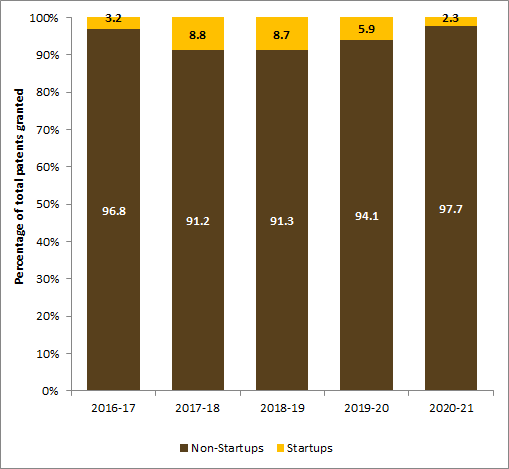
Disproportionately fewer startups were granted patents: The share of patents granted to startups peaked at 8.8 per cent during 2017-18, remained the same the following year and has declined since then. One reason for this could be that startups were obliged to file for a patent to receive registration under DPIIT as well as for applying for IT exemption. The reason for the drop in shares of both patents filed and granted during 2020-21 could be the removal of patents as a condition for registration of a startup and for IT exemption (in May 2017). We also believe that there could be an overall decline in the quality of patents filed. It appears that while the current policy has incentivised firms to file patents, their applications do not pass the more stringent test of proving innovation and hence they fail. The threshold required to grant a patent is strict and requires a firm to prove novelty, which is not the case at the application stage where anyone may file for a patent.

Figure 2: Fraction of patents granted to startups over non-startups (2016-17 to 2020-21)

Source: Annual reports of Indian Patents Office

Figure 1 showed that the share of patents filed by startups in total patents filed was rising during the period 2016-17 to 2019-20. This is not the case for the share of patents granted (Figure 2).

Less than two-fifths of startups registered with DPIIT qualify for benefits: We find that since 2016, the number of companies registered as startups under the Startup India Policy with the DPIIT has increased in absolute terms. However, the growth rate over time has reduced. We further find that out of all the startups that exist in India, only a percentage of them qualify as "startups" under the Startup India Policy and have been registered as such. For instance, there are 2,49,107 startups in India (as on February 2023) out of which only 90,939 (36.5 per cent) are registered by the DPIIT as startups. It is possible that the unregistered startups have either not applied to be registered or have not qualified as startups as per the definitions. This raises the question: is our current definition of a startup under the Startup India Policy the right one? Should we rethink the definition to extend the benefits of the policy to more startups on the ground?

Low grant percentage of IT exemptions for startups: We found that out of the total number of registered startups, less than 2 per cent of startups have been granted the IT exemption, signifying that few startups have been certified as innovative as described in the Startup Policy on external scrutiny by the IMB. We validated this with data on the number of applications for the IT exemption for the year in which this data is available (2017) and found that 90 per cent of registered startups applied for the IT exemption in that year. This indicates that the low fraction of startups receiving IT exemptions is not for the lack of application on the part of registered startups. This has even prompted questions in Parliament.

To be registered as a startup under DPIIT, a startup has to only declare that they are working towards innovation, whereas to obtain an IT exemption, the fact of innovation is scrutinised by the IMB based on specific criteria because of which a startup may not qualify. It is possible that, at registration under the policy a startup need not demonstrate innovation but only declare it, however, for the IT exemption it must now demonstrate and prove innovation in the manner specified in the policy. It appears that few startups are actually being innovative according to the Startup India Policy. Table 1 summarises our findings.

Table 1: Total startups registered and granted IT exemptions based on whether they are "innovative" (2015-2016 to 2020-21).

Year Number of startups registered Growth rate (%) No of startups granted 80-IAC Fraction of total (%)
2015-16 471 -- 7 1.5
2016-17 5233 1011 69 1.3
2017-18 8775 68 18 0.2
2018-19 11417 30 162 1.4
2019-20 14596 28 83 0.6
2020-21 20160 38 70 0.3

Source: Authors' calculations from DPIIT data

Limitations: (i) We do not have access to consistent yearly data on the number of total startups v. those which are registered. (ii) We do not have data on the pre-policy period. (iii) Our present study is not focused on industry-level features. We intend to pursue this in the next leg of our study.

Discussion

Our findings indicate that both measures --- IT exemption grants based on innovation and patents filings and grants --- suggest that innovation in India does not consistently emerge from startups. Instead, our findings are in line with studies in other jurisdictions which suggest that large firms undertake most innovation on account of their risk appetite and R&D capacity (Cohen and Klepper 1996, Symeonidis 1996). Our findings are also aligned with reports that indicate large firms and universities engage most in innovation if measured by patent filings in India. Is this, however, a true picture of innovation on-ground? And what are the implications of our findings for current innovation policies for startups?

The literature makes the case for government intervention on startup innovation citing the disparity in the ability to compete as a market failure (Wang 2018, Symeonidis 1996). The argument is that startups require a boost to even out the playing field as they are unable to compete with larger firms with more resources. Our findings lend some support to this by demonstrating that (i) startups in India are not innovating as much as large firms, and (ii) patent filings by startups have increased since the Startup India policy came into effect. We also, find that patent grants to startups have not increased. Therefore, despite government intervention in India, startups are not driving innovation. Some explanations for this are as follows:

  • The current set of incentives may not be sufficient to drive startups to innovate more. We find some support for this in the literature that finds that supply-side policies alone (e.g. subsidies) are not sufficient to stimulate innovation (Geroski 1989). Focusing on additional demand-side measures such as public procurement of innovation from startups may trigger greater innovation as it reduces the market risk for innovators (Rothwell et al. 1981; Tiwari 2017).
  • Conventional notions of innovation are linked to "novelty" through patenting which is a very high standard for measuring innovation. In reality, startups in India may be engaging in innovation which is not eligible for conventional patents such as technological improvements or modifications suited to the domestic context. Reports suggest that startups in India adopt rather than innovate in the conventional sense. For instance, India is using the technology adoption route for developing Web3.
    Another reason could be that Indian firms are innovating but are not registering patents in India. Reasons for this range from poor enforcement in India to sector-specific commercial preferences. An example of the latter is the semiconductor sector --- India has a large chip design industry but this work is done on a contract basis for US semiconductor firms which file their patents in the US.
    Therefore, patents may not be the best way to measure innovation in India. Current startup policies in India should re-think the definition of "innovation" and make it more suited for the Indian context.

We gain some insights from the innovation-linked incentives that are offered by other countries. In South Korea, which has the highest per-capita granting of patents in the world, all startups irrespective of how innovative they are qualify for reduced fees in patent filings and certain tax exemptions available to SMEs. South Korean policy appears to focus more on promoting linkage between large and small firms to promote networking and market access. In the Netherlands, which ranks ninth in the world in patent filings, vouchers are given to SMEs for patent filing that cover up to 75% of costs. The Dutch Tax Office evaluates and grants specific tax incentives for "technical-scientific research" and "development projects". Both these countries, considered to be highly innovative, have tax schemes that are targeted at specific outcomes and there are some general exemptions for patent filings. India could perhaps learn from these policies.

Conclusion

We set out to answer two questions in this article: Are startups engaging in innovation? How innovative are startups compared to non-startup firms? Our findings using both measures indicate that startups are not driving "innovation" in the conventional sense of the term in India. However, many Indian startups have scaled up by engaging technology towards creative solutions in many industries such as payments (Paytm), e-commerce (Meesho), credit cards (CRED) and healthcare delivery (PharmEasy). While these firms may not do well on the conventional measures of "innovation", they have played a role in encouraging entrepreneurship to solve everyday challenges, all while benefiting their shareholders.[1] Policy in India must, therefore, be suitably modified to recognise such contributions towards innovation. This is an emerging idea that Indian policymakers are increasingly acknowledging. For instance, the Economic Advisory Council to the Prime Minister of India noted the importance of FDI from tech transfers as a key source of promoting innovation in India. We need to think harder about what "innovation" means in India and what role should the government play in encouraging innovation.

In further research, we will analyse the pattern of patents filed and granted across various industries to understand which sectors are more innovative in the traditional sense. We will also examine the firms that have received the IMB's certification of being "innovative" to (i) study the characteristics of these firms and the industries to which they belong, and (ii) study the trends in the grant of certification by the IMB for innovation to startups. This will help us gain a more nuanced understanding of what drives innovation among startup firms in India.

Footnotes

[1] According to its Red Herring Prospectus filed at the time of its IPO (November 2021), Paytm does not own any patents.

References

  1. Tom Eisenmann, Entrepreneurship: A Working Definition. Harvard Business Review, January 10, 2013.
  2. Stevenson, H. H., and Jarillo, J. C., A Paradigm of Entrepreneurship: Entrepreneurial Management. Strategic Management Journal, 11 (1990), 17-27.
  3. Dobrila Rancic Moogk, Minimum Viable Product and the Importance of Experimentation in Technology Startups, Technology Innovation Management Review, March 2012.
  4. Beck, Thorsten and Demirguc-Kunt, Asli and Maksimovic, Vojislav, Financing patterns around the world: Are small firms different?, Journal of Financial Economics, Volume 89, Issue 3, September 2008, Pages 467-487.
  5. Jue Wang. Innovation and government intervention: A comparison of Singapore and Hong Kong. In: Research Policy 47.2 (Mar. 2018), 399-412.
  6. Wesley M Cohen and Steven Klepper, A Reprise of Size and R&D. In: Economic Journal (1996), 106 (437), pp. 925-51.
  7. Gaetan de Rassenfosse, Adam Jaffe, and Emilio Raiteri. The procurement of innovation by the U.S. government. In: PLOS ONE 14 (Aug. 2019), pp. 1-11.
  8. Katila, R. Measuring innovation performance. In: International Journal of Business Performance Measurement (2000), 2: 180-193.
  9. P. A. Geroski. Entry, Innovation and Productivity Growth. In: The Review of Economics and Statistics 71.4 (1989), 572-578.
  10. R Rothwell and W Zegweld. Industrial Innovation and Public Policy: Preparing for the 1980s and the 1990s. In: London: Francis Pinter Publications (1981).
  11. G. Symeonidis, Innovation, Firm Size and Market Structure: Schumpeterian Hypotheses and Some New Themes, OECD Economics Department Working Papers, 161 (1996).
  12. S.A. Low and M.A. Isserman. Where Are the Innovative Entrepreneurs? Identifying Innovative Industries and Measuring Innovative Entrepreneurship. In: International Regional Science Review 38.2 (2015), 171-201.

Aneesha Chitgupi, Karthik Suresh and Diya Uday are researchers at XKDR Forum. We thank Devendra Damle, Josh Felman, Dr. R. A. Mashelkar, Amey Mashelkar, Megha Patnaik, Arjun Rajagopal, Anjali Sharma and the anonymous referees for their feedback and comments.