Joydeep Mukherji has written a good article titled Economic growth and India's future. It is a balanced treatment which portrays the big picture of where he thinks India is going. Joydeep is unusually clear-headed and this is worth reading. His story may be summarised as saying that India will grow well but will not achieve the `miracle' growth like South Korea's sprint into OECD.
Friday, March 31, 2006

Thursday, March 30, 2006
Political economy of removing capital controls
Ila Patnaik has an article in Indian Express today linking up three themes:
- The political economy of removing capital controls -- exactly as the Ministry of Industry hated the removal of industrial licensing, the RBI unsurprisingly advocates great caution on removing capital controls. Which incumbent agency operating a system of controls has ever been an impartial thinker when it came to liberalisation?
- Convertibility has to inevitably go with a floating exchange rate, because monetary policy autonomy is more precious than a pegged exchange rate. That will make a dent in another function that the RBI performs, that of manipulating the currency market and being the biggest portfolio manager in India. Ila likens this to a shift from a giant State-run portfolio to a million portfolios run by households.
- Larry Summers recently pointed out that the opportunity cost on India's excessive reserves are bigger than State expenditure on health. This problem will also go away when we switch from public sector reserves management to a million portfolios run by households, for each one will diversify across shares, real estate, corporate bonds, etc., while the RBI reserves portfolio only invests in short-dated government bonds of AAA countries.
All in all, a fascinating set of insights into convertibility. I will add one more element to it. Who stands to lose from the removal of controls? The existing permit-holders. Who are they? The big FIIs who sell PNs. If there's a mass of $50 billion of PNs out there, and if this is a revenue stream of 2% per year, then the revenue stream from renting out permits is a cool billion dollars a year.
In addition, FIIs and FDI investors surely like it when India expends over 1% of GDP on giving them free risk management on currency risk. This adds up to two reasons why existing license-holders are going to be unenthusiastic about convertibility, and why so many FII reports praise RBI's handling of capital controls and the currency regime :-)
The picture I'm getting of the political economy of convertibility is that RBI, FIIs and FDI investors stand to lose from removing capital controls, and everyone else benefits. Let's see who is stronger in the political landscape.
Wednesday, March 29, 2006
The RMB currency regime budged!
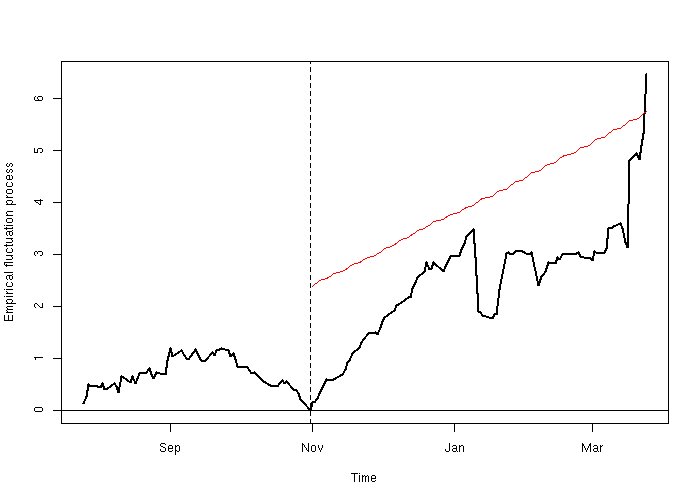
As readers of this blog may know, for almost six months now, Achim Zeileis, Ila Patnaik and myself have been sniffing at the Chinese currency regime. So far, our story was that there was miniscule currency flexibility and no evidence of structural change.
This has changed! Look at our monitoring plot on that web page:
 For the first time now, we can reject the null of an unchanged currency regime when compared with the history period (August, September, October).
We're hard at work on this... stay tuned. :-)
For the first time now, we can reject the null of an unchanged currency regime when compared with the history period (August, September, October).
We're hard at work on this... stay tuned. :-)
 For the first time now, we can reject the null of an unchanged currency regime when compared with the history period (August, September, October).
We're hard at work on this... stay tuned. :-)
For the first time now, we can reject the null of an unchanged currency regime when compared with the history period (August, September, October).
We're hard at work on this... stay tuned. :-)
Tuesday, March 28, 2006
How did the 7 percentage point swing in investment/GDP ratio happen?
One of the most remarkable things about the recent Indian macroeconomic experience has been the rise in the investment rate from 23% in 2001-02 to 30% in 2004-05. This is a huge seven percentage points of GDP of a rise over a mere 3 year period.
Ila Patnaik has an article in FE about how this happened. The pieces appear to be:
- Net capital inflow into the country swung from -0.7% (a current account surplus) to +0.8% (a current account deficit) - a gain of 1.5 percentage points.
- The biggie was the consolidated public sector, which swung from -2% to +2.2% - a gain of 4.2 percentage points.
- Retained profits of the corporate sector went up from 3.6% to 4.8% - a gain of 1.2%.
These three pieces add up to a swing of 6.9% of GDP, and are the bulk of what happened.
As Ila emphasises, these changes are about the tactical evolution of economic policy coupled with the business cycle. They are not about the `demographic dividend', as has been claimed by many people.
A business cycle downturn will affect both the public sector (lower tax revenues, lower PSU profits) and the private sector (lower earnings). So a simple business cycle downturn could lead to a peeling of a lot of these gains. The UPA's exuberant spending programs could generate a deterioration of the public sector numbers.
The 1.5 percentage point swing in the current account surplus was primarily a gift caused by higher oil prices. The currency regime also did improve slightly, but that played second fiddle. RBI basically kept hanging on to the pegged exchange rate regime. It just so happened that an oil shock came along and at the old rate (which RBI was hanging on to) we flipped to a current account deficit. We haven't yet got a currency regime which can deliver a sustained current account deficit.
Monday, March 27, 2006
The 2006 Neemrana conference (NCAER/NBER)
A few days ago I had talked about the 7th Neemrana conference. I now have URL for the program, which has links to papers / slideshows.
Here, you will get Robert Jensen's talk about mobile phones in Kerala, and their impact on market efficiency of the fish market. My talk at Neemrana this year was titled Next steps in financial sector policy.
Saturday, March 25, 2006
Indian exchange-traded derivatives in a global context
Futures Industry magazine has an annual feature tracking the growth of the global exchange-traded derivatives business [pdf]. It is fascinating in terms of tracking what is going on in the global derivatives business. And, India shows up in some of the tables.
When we keep score in terms of the number of transactions or number of derivative contracts traded, India looks good. While that means something in terms of conveying activity, it also exaggerates India's position since the contract size or mean trade size - measured in USD - are unusually small. In the Economic Survey chapter on the securities markets, there was FIBV data showing that NSE and BSE are ranked 3 and 5 in the world by number of transactions.
At page 18, we see the amazing achievement of the Korean KOSPI 200 contract - the biggest contract in the world. We have a long way to go with Nifty, which isn't even in the top 20 contracts. At page 22, Nifty futures show up as the 7th biggest gain of the year.
At page 26, NSE shows up at rank 7 in the biggest futures exchanges of the world. Not bad - rank 3 in the world by number of transactions on the spot market, and number 7 in the world by number of contracts on the futures market. But on the next page, when we look at the sum of futures and options, Korea again rocks. NSE shows up at rank 14. This reminds us that lacking Direct Market Access (DMA), India is very weak on options trading when compared with where we are on futures trading.
At page 18 they also show a modest revival for currency futures, which saw growth of 57% compared with overall growth of 12%. When I was in Chicago last year, Leo Melamed was telling stories about how the key device was to get the realtime terminals like Reuters to show the currency futures bid/offer spread alongside the bid/offer spread on the currency forward market. That was apparently the decisive thing which turned things around for currency futures. Customers could see the superior spreads on currency futures juxtaposed against those of the OTC market, and the 25-year slide of currency futures was reversed.
On a related note, you might like to read the latest NSE Derivatives Update (February 2006) which just came out.
Friday, March 24, 2006
What changed in Indian finance, and why
Few parts of India have changed as much in the last decade as finance. Susan Thomas has done a cool paper for S. Narayan's forthcoming edited book titled How the financial sector in India was reformed [pdf] Dr. Narayan's forthcoming book is titled Case studies in reforms. I have previously blogged about some other chapters. It's going to be a cool book.
Subscribe to:
Posts (Atom)