| Position | Date | Outcome |
| Comptroller and Auditor-General | January 2008 | Vinod Rai, 17 December 2007 |
| Secretary, Dept. Financial Services, MOF | December 2007 | |
| Chairman, SEBI | February 2008 | |
| Two members of SEBI | ||
| Chairman, IRDA | May 2008 | |
| Governor, RBI | September 2008 | |
| Chairman and members of Competition Commission |
Tuesday, December 18, 2007
Critical appointments over the next year

Sunday, December 16, 2007
Never saw a club that I liked
In my experience in doing finance in the period after the IT revolution, one thumb-rule that has reliably worked for me is this: anytime you see a small club that was created through government fiat, there's merit in asking first principles questions about why that club exists.
An example is the `primary dealer' institution as it existed in the US. When California was very far away, it made sense for the treasury to sell bonds to primary dealers on East Coast, who would then farm them out to customers all over the country. But in this electronic age, we only introduce frictions by introducing one more layer of intermediaries. A better market design would involve direct auctions open to the world at large.
On 12th December, the US Fed announced a new animal called the Term Auction Facility (TAF). Stephen Cecchetti has an excellent summary of the efforts that are presently underway, in resolving the difficulties of monetary plumbing.
The quick summary is this. Temporary liquidity injections by the US Fed were done through repos against the 20-odd primary dealers. This broke down because these 20 banks are in the eye of the storm themselves. In response, as Cecchetti says: the Fed announced that they are going to auction off reserves for terms of up to 35 days, allowing all banks to participate and accept the same collateral that is accepted in discount lending. This is different from open market operations because it involves all 7000+ banks, not just the 20 primary dealers.
Now, in this computer age, an auction with 7000 or 7 million players is not hard to organise. What I found really funny is footnote 9 of the article, which points out that the US Fed will not use computer systems for any of this! The 7000+ banks are going to bid by phone!
Well before this crisis erupted, my policy instincts would have been to break open clubs. The right way to sell securities is through the massive distribution networks of the securities industry, where auctions can reach millions of screens worldwide. There is no need to have select clubs like primary dealers or investment bankers in this modern IT-enabled world. At best, enshrining a club introduces frictions. At worst, it could lead to serious policy difficulties when the select club is in trouble, as has happened in the US.
As an aside, India was a pioneer in using NSE/BSE screens to sell IPOs. This was done well before google made it famous. See World's biggest democracy can show Google how to conduct an online IPO by Francesco Guerrera in Financial Times, 31 Jul 2004. However, the present state of the IPO process in India is highly unsatisfactory; it is far, far from a state where securities are auctioned off, with bids emanating from every NSE/BSE screen, at a market-determined price, without an investment banker. The SMILE report had walked in the right direction, but after that there was no follow through. The full transformation of the primary market should be on the agenda for the next SEBI chairman, and when it's done, this would be the vehicle of choice for the Debt Management Office in selling securities, and the central bank for conducting monetary policy.
Friday, December 14, 2007
Finally, good airports
T. N. Ninan has good news from the airport that's being constructed at Delhi. Right now, Delhi is probably the worst airport in the world (e.g. see a list of the world's worst airports in Foreign Policy). It will be an interesting contrast to see the existing mess being replaced by a new airport. The glass is half full on infrastructure, given the transformation of policies - politics - administration that has taken place with telecom, roads, ports and aviation. With electricity, railways and urban infrastructure, we continue to be mired in an unreconstructed and dysfunctional institutional framework.
Fiscal discipline at the state level
A few days ago, I had posted a blog entry pointing to my paper New issues in Indian macro policy which is forthcoming in T. N. Ninan's edited book. In that paper, I suggest that the glass is half full on fiscal consolidation. India has made important institutional changes (e.g. tied down fiscal policy with the FRBM Act) and administrative changes (e.g. the Tax Information Network) which have given significant progress on public finance. In connection with that, I noticed an RBI document which looks at state budget data for 2007-08. The press release summarises the important achievement: "The consolidated fiscal position of State Governments in 2007-08 indicates that the States have budgeted to achieve revenue surplus (0.3 per cent of GDP) during 2007-08 after a gap of two decades. As a consequence of the budgeted revenue surplus, the GFD is budgeted to decline to 2.3 per cent of GDP in 2007-08."
Do IIT grads lack a conscience?
The renowned academic Martha Nussbaum gave an interview in Tehelka magazine two weeks ago, in which she said: "This IIT mentality - become technically competent engineers, forget about human values - is very dangerous, particularly for a country like India." In response, Salil Tripathi wrote an interesting piece, which appears in Tehelka today. As Salil says, "No, I didn't go to the IIT, but some of my friends are IITans :-)".
What should you do when you're stuck with a pegged exchange rate
On 12th, SBI cut deposit rates by 25 bps. Many newspapers thought this was partly a response to the liquidity conditions that have shaped up after the rate cuts of the US Fed. When asked by reporters, Y. V. Reddy said that he does have monetary policy autonomy. An edit in Financial Express titled Rewrite the RBI Act interprets SBI's decisions as reflecting a loss of monetary policy autonomy in India.
In an excellent article in Indian Express today, Ila Patnaik makes an argument that runs roughly like this:
- In the short term, the reforms to financial and monetary policy institutions that are required `to do the right thing' are not forthcoming. The present RBI leadership has repeatedly articulated a lack of interest in reform. In any case, even if there was an interest in reform, it would take time to do the institutional transformation of finance and monetary economics as described in the MIFC report.
- In the short term, the political situation is unfavourable for exchange rate flexibility, particularly given the difficulties that exporters will face selling into a slowing world economy.
- Hence, in the short term, we are stuck with a pegged exchange rate.
- That leaves two choices: capital controls or loss of monetary policy autonomy.
- Capital controls are ineffective; India has gone too far along the route of modernising the external sector, and the political appetite for draconian controls (that are required in order to be effective) is absent. In addition, capital controls represent a step backwards compared with where India has to go. When financial firms and markets are damaged by controls, it will take time and effort to rebuild these things to get back to where we were.
- Hence, the best path forward in this trap that we are in is: To give up monetary policy autonomy, and cut rates.
- That might not be such a bad idea given the growing gloom in the global economy; lower interest rates would boost consumption and investment, and thus offset some of the impact of slowing exports [link].
Also see this review of the difficulties of India's pegged exchange rate regime in The Economist.
Wednesday, December 12, 2007
Outsourcing and the backlash against it
A. J. Jacobs has a really funny and interesting article My Outsourced Life (in Esquire Magazine in 2005) about his experiences with using support staff in India while living and working in America. While on this subject, you might like to glance at the frontiers of outsourcing (hat tip).
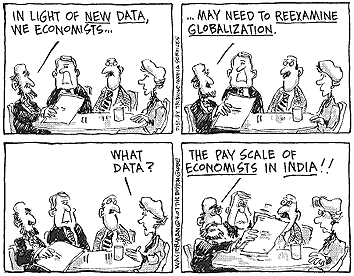
While on this subject, S. G. Badrinath had pointed me to an interesting article The establishment rethinks globalisation by William Greider, in The Nation about people who are skeptical about the benefits to the US of the way telecom has made many things that were formerly non-tradeable into things that are tradeable.
I feel this is no different from all the previous stories about gains from trade. New technologies spring up; the purveyors of old technology get hurt; there's nothing surprising in it (to me) while there are benefits in the large. When cheap computer hardware started coming into India because of the lowering of trade barriers, it was very painful for thousands of workers employed in those sectors. Their human capital was obsoleted; they were mostly forced to shift into new sectors; their lifetime wage trajectory was pushed down to a lower level. In similar fashion, there is nothing new, in my eyes, when there are parts of the US economy which are hurt when one more new kind of trade a.k.a. technology springs up.
I am also optimistic when it comes to fears of protectionism. I am skeptical about whether the industrial countries will really go back to tariff or non-tariff barriers when it comes to goods. With goods, it's possible to have barriers, even though it would be really unwise to have them. In contrast, with services, I think it is not even possible for a State to come in the way without seriously interfering with personal freedoms and open telecom systems. Even if the worst politicians get their act together, and whip up a lynch mob, I don't see how they can block outsourcing of services jobs.
Subscribe to:
Posts (Atom)