Search interesting materials

Showing posts with label monetary policy. Show all posts

Tuesday, September 23, 2025

Reinforcing the Anchor: The Next Five Years of Inflation Targeting in India

by Rajeswari Sengupta and Ajay Shah.

The adoption of inflation targeting (IT) in 2015 marked a watershed in India's monetary policy. It is a delight to look back to those dramatic weeks. For the first time since its establishment in 1934, the Reserve Bank of India (RBI) graduated from being a `temporary provision', to a clear legal mandate to maintain consumer price index (CPI) inflation at 4 percent. This shift to a rule-based and transparent framework, with price stability as the explicit objective, strengthened the RBI's credibility, and helped anchor household inflation expectations by reducing the importance of extraneous objectives.

After the Monetary Policy Framework Agreement, the statutory basis for IT was provided by the Reserve Bank of India Amendment Act (2016). In this, the government, in consultation with the RBI, must review the inflation target every five years. The precise text of this section is:

45ZA. Inflation target - (1) The Central Government shall, in consultation with the Bank, determine the inflation target in terms of the Consumer Price Index, once in every five years.

The next review is scheduled for March 2026. In preparation for this process that would be led by the government, the RBI has released a discussion paper seeking public feedback on four specific questions:

  1. Whether headline inflation or core inflation would best guide the conduct of monetary policy, given evolving relative dynamics of food and core inflation and the continuing high weight of food in the CPI basket?
  2. Whether the 4 per cent inflation target continues to remain optimal for balancing growth with stability in a fast growing, large emerging economy like India?
  3. Should the tolerance band around the target be revised in any way including whether the tolerance band be narrowed or widened or fully done away with?
  4. Should the target inflation level be removed, and only a range be maintained within the overall ambit of maintaining flexibility without undermining credibility?

Targeting headline vs. core inflation

A substantial body of academic research and cross-country evidence informs the debate on whether central banks should target headline or core (excluding food and energy) inflation (Pandey and Patnaik, 2020). Walsh (2011) shows that in low-income economies, food inflation is more persistent than non-food inflation, with shocks to food prices spilling over into non-food prices. In such contexts, an exclusive focus on core inflation risks mis-specification. Empirical studies further document sizeable second-round effects from headline to core inflation, driven by the high share of food in household expenditure and the role of food inflation in shaping expectations and wage-setting (Anand, Ding, and Tulin, 2014).

The core function of monetary policy in this context is not to control the first-round effects of a supply shock (e.g., a poor monsoon), but to prevent them from propagating into generalised inflation through second-round effects on wages and expectations. This would be best achieved by having a credible central bank that fully devotes all the power of monetary policy to the pursuit of one transparent objective, headline inflation.

The Indian case illustrates these dynamics clearly. Food and fuel account for half of the household consumption basket, so excluding these components would eliminate a large share of relevant prices from the inflation measure. The Urjit Patel Committee Report (RBI, 2014) underscored that elevated food and energy inflation typically translates into higher inflation expectations, with lagged effects visible in services and other components. Moreover, shocks to food and fuel prices have larger and more persistent effects on inflation expectations than shocks to non-food, non-fuel items. Since anchoring expectations is central to the success of inflation targeting, a framework that sidelines food and fuel inflation would be incomplete.

The cross-country evidence reinforces this conclusion. As documented by Pandey and Patnaik (2020), most inflation-targeting economies use headline inflation as their target. A few, such as Thailand, initially targeted core inflation but later shifted to headline inflation in recognition of its greater relevance for households and firms.

Headline inflation has further advantages. It reflects the cost of living most relevant to households, shaping both their consumption and investment decisions (including choices between financial assets, gold, and real estate). It also serves as the benchmark for firms' price-setting behavior. Since monetary policy ultimately seeks to anchor public expectations, and central bank accountability operates through the political system, credibility depends on targeting the measure most salient to the public.

For these reasons, despite the argument that much of CPI inflation lies outside the direct influence of monetary policy, excluding food and energy would not yield a meaningful measure of inflation for policy purposes. While monetary policy cannot influence a poor monsoon, it is the only tool capable of preventing the resulting food price shock from de-anchoring inflation expectations and triggering a wage-price spiral. Targeting headline inflation forces the Monetary Policy Committee to remain vigilant against these second-round effects, which is the essence of a credible IT framework. Therefore, headline inflation remains the most feasible and appropriate target for the conduct of monetary policy in India.

The 4 percent inflation target

The inflation target should remain at 4 percent. Raising it would risk eroding public confidence in the RBI's ability to control inflation, un-anchoring expectations and undermining the credibility of the framework. From a public debt management point of view, an unanticipated increase in the inflation target is tantamount to a partial debt default. Indeed, higher targets and wider bands are associated with greater output and inflation volatility (Horvath and Mateju, 2011).

Conversely, a reduction to 2 percent would only be feasible once India's financial system is sufficiently developed to operate with limited policy space near the zero lower bound - a condition still many decades away. The sequencing there lies in first getting up to FSLRC level financial economic policy, having it stabilise for about a decade, and then examining the possibility of going down to a 2% target. This is perhaps 25 years away.

Tolerance band around the 4 percent target

The literature broadly agrees that price stability corresponds to an inflation of 1-3 percent in advanced economies, while for emerging economies the relevant range is 4-5 percent (RBI, 2014). Empirical estimates for India place the growth-impeding threshold of CPI inflation at 6 percent. Accordingly, the 1-3 percent benchmark for advanced economies provides a lower bound, while 6 percent marks an upper bound for India. As explained in the Urjit Patel Committee Report, this rationale underpinned the adoption of a 2-6 percent tolerance band under India's inflation-targeting regime.

The principal merit of a band is that it allows a central bank that possesses a weak monetary policy transmission to have failures on meeting the inflation target without a loss of credibility. Back in the 2013-2015 period, there was a `learn to walk before you can run' reasoning around this: it was a fully new idea, that RBI should target inflation, so it was better to start with an easier objective.

Having operated within this framework for a decade, the RBI has established a minimally viable inflation-targeting regime. The logical next step would now be to narrow the band to 3-5 percent, which would strengthen credibility and inspire greater public confidence than the relatively wide 2-6 percent range. Critics may argue that a narrower band increases the risk of a technical breach, potentially harming the RBI's credibility. However, after nearly a decade of experience, the institution should possess the maturity to manage this tighter constraint and, if a breach occurs, to communicate its causes effectively to the public. The credibility gains from signaling a stronger, more precise commitment to the 4 percent target outweigh the communication challenges of a potential supply-shock-driven breach. It shows progress; it signals a move from a nascent to a mature IT regime; it enhances respect for India's continued progress towards better institutions.

Range vs. Point target

Point targets with tolerance bands provide clarity and precision, while their symmetry conveys that the central bank seeks to avoid both deflation and inflation (Hammond, 2012). By contrast, pure range targets risk signaling weaker control over inflation. Consistent with this, most inflation-targeting countries adopt a point target with a tolerance band (Pandey and Patnaik, 2020). For households, moreover, a single, well-communicated number aids planning and decision-making, reinforcing the value of a widely recognized 4 percent target. When wage raises are being planned, we need for decision makers to not look at current and future inflation, but instead think that a 4% nominal wage hike is a 0% real wage hike.

Conclusion

Since its adoption in 2016, inflation targeting has enhanced the RBI's monetary policy credibility (Garga, Lakdawala and Sengupta, 2024). Since its adoption, the IT framework has been a crucial institutional anchor for India's macroeconomic stability. The forthcoming review is an opportunity not to question its fundamental design, but to reinforce it. Maintaining the 4 percent headline target while narrowing the tolerance band to ±1% would signal a confident evolution towards a more mature and credible monetary policy, safeguarding the hard-won gains in anchoring public expectations.

References

Anand, Rahul, Ding Ding, and Volodymyr Tulin (2014) Food Inflation in India: The Role for Monetary Policy, IMF Working Papers 14/178; International Monetary Fund.

Garga, Vaishali, Aeimit Lakdawala and Rajeswari Sengupta (2024) Assessing Central Bank Commitment to Inflation Targeting in Emerging Economies: Evidence From India,Working Papers 107, Wake Forest University, Economics Department.

Hammond, Gill (2012) State of the art of inflation targeting,Handbooks 29; Centre for Central Banking Studies, Bank of England.

Horvath, Roman and Jakub Mateju (2011) How Are Inflation Targets Set?In: International Finance 14.2, pp. 265-300.

Pandey, Radhika and Ila Patnaik (2020) Moving to Inflation Targeting NIPFP Working paper 316, August 2020.

Walsh, James P (2011) Reconsidering the Role of Food Prices in InflationIMF Working Papers 11/71; International Monetary Fund.


The authors are researchers at IGIDR, Bombay and XKDR Forum, Bombay, respectively.

Friday, June 03, 2022

How "Orderly" is the Evolution of the Indian Yield Curve?

by Harsh Vardhan.

"Financial market stability and the orderly evolution of the yield curve are public goods and both market participants and the RBI have a shared responsibility in this regard."

Shaktikanta Das, Governor, RBI, October 2020

"Right from October 2020, we have given explicit guidance to the bond market. We expect an orderly evolution of the yield curve, it cannot be otherwise,"

Shaktikanta Das, Governor, RBI, February 2021

As the Covid pandemic has ebbed, central banks across the world are withdrawing the extra-ordinary easy monetary policy that was followed by them since the onset of the pandemic. Reserve Bank in India (RBI) is no exception. A week ago, it took the extra ordinary step of convening an ad-hoc meeting of the monetary policy committee (MOC) to hike the policy interest rates by 40 basis points and also increase the cash reserve ratio (CRR) for banks to take out liquidity from the banking system.

As this “normalisation” of the monetary policy unfolds, its impact on the financial stability has become a matter of concern. The statements of the RBI Governor quoted above, reflect the concern RBI has on financial stability and the evolution of the yield curve. While financial stability is a broad, all encompassing term, evolution of the yield curve is a much more specific idea that can potentially be objectively assessed. In this article I try to assess the orderliness of the evolution of the yield curve over the last four years.

Yield curve describes the basis interest structure in the economy. As the central bank takes policy actions bonds markets reprice the yields and the shape of the yield curve changes. As a fundamental input to pricing of a wide array of assets, predictable and orderly evolution of the yield curve is indeed desirable. High volatility and unpredictability in the evolution of the yield curve, especially when the policy actions taken to normalise monetary policy and regain the GDP growth trajectory post the pandemic, could result in mispricing of financial assets. RBIs concerns and expectation of such orderly evolution are understandable.

In this article, I try to assess the orderliness of evolution of the yield curve. I use data on the yield curve for the 4-year period of 1 April 2018 to 10 May 2022 to empirically assess how the yield curve has changed during this period. To be clear, this article does not evaluate the merits of the RBI’s intent or efforts at managing the yield curve; it only attempts to empirically assess how the yield curve has behaved over this period.

Assessing the evolution of the yield curve:

While it is easy to understand why policy makers would want the yield to evolve in an “orderly” manner in response to policy actions, it is not very easy to define what exactly an orderly evolution means. Trading in government securities takes place every day where all types of financial institutions participate. Even the RBI, through its treasury operations and open market operations participates in the government bond market. The collective actions of all these players determine the prices of government bonds and hence the yield on them.

We could hypothesise orderly evolution to mean that the daily changes in the yields across the curve are smooth and stable. There are two parameters we can look at the describe such smooth and orderly evolution – the volatility of daily yield change and the correlation of changes in yields across varying maturities. If the volatility of daily change in yields remains low and the correlation of yield changes across maturities is high, then it would mean that the yield curve is moving with the policy rates, in a non-disruptive and predictable manner. Such a yield curve can be considered as evolving orderly. On the other hand, increased volatility of daily change and reduced correlation would signal increase in the “disorder” in the evolution of the yield curve.

Data and analysis:

The data for this analysis is the daily yields data on the 3 month treasury bills (T Bills), 1 year, 3, year, 5 year, and 10 year maturity government securities (GoI securities) from 01 April 2018 to 10 May 2022, a total of 993 trading days of data obtained from Bloomberg. Of these maturities the 10-year securities are the most liquid and provide data for every trading day. For the other securities there are days where there would be no trading and hence no data would be available. We consider the previous days yield to continue for such non trading days which means that the change in yields for such days is considered to be zero.

For the purpose of my analysis, I divide the data into 4 time periods as follows:

The first period is from 1 April 2018 to 11 February 2019 which can be called the "pre low interest rate" period. RBI started cutting policy rates from February 19 up until May of 2020. Hence this is the period of stable policy rates. This period has data for 215 trading days.

The second period is from 19 February 2019 to 31 October 2020 is the "downward policy rates and pandemic period" when policy rates were reduced regularly to hit the lowest rate of 4% of repo by May 2020. I extend the period to Oct 31,2020 as RBI clearly started focusing on orderly evolution from October onwards. This period gives us data on 411 trading days.

The third period is from 01 November 2020 to 31 December 2021 which starts with the date of RBI publicly announced its focus on orderly evolution of the yield curve and ends with roughly the end of the pandemic and the reopening of the economy. While the end date is admittedly somewhat arbitrary it coincides with global trend towards rising rates that started in January 2022. This period gives us data on 282 trading days.

The fourth and the shorted period is from 01 January 2022 to 10 May 2022 is the last period where Indian interest rates started inching up (along with interest rates across the world). It includes a few days of data post the surprise, out of turn policy rate hike in May 2022. This period has data on 85 trading days.

For each of these four periods, I compute the following:

  • Daily change in the yields of each of the four maturity GoI securities.
  • Average daily yield change and the standard deviation of the change in the daily yield which I use as the measure of volatility of the daily change.
  • Correlation between yield changes of these 4 GoI securities.

Results:

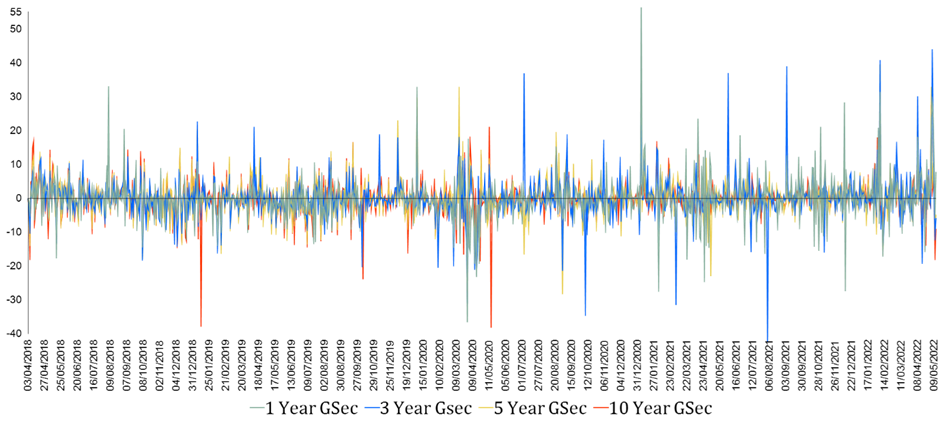
Figure 1 below presents a chart of the daily yield change in these 4 securities over this entire period of little over 4 years and 993 trading days.

Figure 1: Daily Change in Yields on GoI Securities in Basis Points

Source: Bloomberg, author’s analysis

Overall, the chart shows that the volatility of the daily change seems to go up with the onset of Covid in March 2020 with larger and more frequent spikes. This is especially true for the lower maturity; the 3 year and the 1 year maturity securities.

In order to understand the trends in the pattern of the daily change in yield, I plot the 30-day moving average of the daily change in yield as presented in Figure 2 below.

Figure 2: 30 Day Moving Average of Daily Change in Yields on GoI Securities in Basis Points

Source: Bloomberg, author’s analysis

Figure 2 clearly shows a pattern in the changes in the yield curve. The first period has much smaller change daily change in the curve and the changes across maturities are fairly highly correlated. The second period shows much more volatility in the daily change and a significant reduction in the correlation between yield change across maturity. This volatility comes down in the third period and the correlation improves, probably as an outcome of RBIs repeated exhortations and possibly actions in the bond market. The last period shows further reduction in volatility but the correlation is still lower than in the first period indicating that RBIs notices to the bond market and actions have had some success.

In order to more concretely understand the volatility and correlations across these periods, next two charts present the mean daily change in yields and the volatility of the daily change measured as the standard deviation of the daily change in yield.

Figure 3: Mean Daily Change in Yields on GoI Securities

Source: Bloomberg, author’s analysis

This chart clearly describes the interest rate trends in these four periods. The first period had, by and large, stable yield curve with very small changes in yields. The second period shows a secular decline in interest rates across all maturities in response to policy rate changes. The third period shows a reversal of trends and modest rise of interest rates ie the upward movement of the yield curve which becomes much more pronounced and sharper in the fourth period.

Figure 4: Volatility of Daily Change in Yields on GoI Securities

Source: Bloomberg, author’s analysis

This chart shows that the volatility of yield changes has indeed gone up noticeably in the third period when the overall rates showed an increase. The volatility increased especially for the shorter maturity papers – 1 year and 3-year maturity. This probably is the basis of the RBIs focus on ‘orderly’ evolution and hints to the bond market of its discomfort with high volatility. The fourth period shows that the elevated volatility has persisted which means that the bond market has responded only modestly to the RBI’s exhortations. Another important feature to note is that the volatility of the 10 year and the 5 year maturity securities has been contained in the third and the fourth period while that of the shorter maturity securities has continued to remain high. This possibly could also be due to RBI’s targeted interventionsh in the bond market to contain the rise and volatility of yields on long term securities.

Finally, I look at the correlations of yield changes across these maturities. Table below presents the correlation matrix of the four periods.

Table: Correlation Matrix for Yield Change in GoI Securities of Varying Maturities

Source: Bloomberg, author’s analysis

The correlation matrix shows high correlations between yield changes in the first period that start going down in the second period and decline precipitously in the third period. While they improve in the fourth period, they are still below the high levels of the first period. Clearly, the yield curve moved more haphazardly in the third period with high volatility and low correlation between yield changes across maturities. The fourth period shows improvement in correlations probably due to RBIs constant notices to the bond market (and its possible interventions in the market), they do not reach the levels of the first halcyon period.

Conclusion:

This data shows that RBI concern on orderly evolution of yield curve is well placed. The data clearly shows that in period 2, as the policy rates came down, the yield curve volatility shot up. It may well be that the RBI’s focus during this time was on keeping the long-term interest rates low to facilitate economic recovery during the pandemic. The bond market, on the other hand, was concerned about the economic impact of the pandemic and resulting tussle between the RBI and bond market participants actions resulted in increased volatility and break down of correlations in yield movements across maturity. RBI became aware of this volatility towards the third quarter of fiscal 2022 and realised that low rates will not be enough for economic recovery and the excess volatility must be curbed. As it started expressing its desire of an orderly evolution (accompanied possibly by market interventions) there was a modest decline in volatility and improvement in correlations. However, the markets are still not anywhere close to the halcyon pre-pandemic period.


Harsh Vardhan is an independent management consultant and researcher based in Mumbai. The author thanks Surbhi Bhatia for research assistance, and Josh Felman and anonymous referees for very useful comments

Monday, August 09, 2021

Sudden Rise of the Floaters

by Rajeswari Sengupta and Harsh Vardhan.

The first two months of 2021-22 have witnessed a remarkable new trend in the corporate bond market—a sudden rise in the issuance of floating rate bonds or “floaters” and the use of the 91-day treasury bill yield as the reference rate in these bonds, instead of the yields on dated government securities (G-Secs).

We conjecture that one possible reason behind this new development could be an increase in the perception of interest risk on the part of the bond market participants. This in turn may have been a result of the active yield curve management undertaken by the Reserve Bank of India (RBI). If indeed dated government bonds such as the 10-year G-Secs have lost relevance as benchmark securities then this can lead to serious mispricing of risk in the economy, an unintended consequence of the RBI’s bond market intervention.

An interesting development in the bond market

Over the three-month period from April to June 2021, about 7 percent of the total corporate bond issuance of Rs 1.02 trillion consisted of floating rate bonds. While this percentage looks small, it is important to keep in mind that for the previous ten years or more, the share of floating rate bonds in the total issuance of corporate bonds has been less than 1 percent.

It is also important to note that the firms issuing these bonds and the investors investing in them are not a new class of issuers and investors. They are the same issuers and investors who were issuing and buying fixed-rate bonds until recently. In particular, 100 percent of the floating rate bond issuers now are non-banking finance companies (NBFCs) who were earlier issuing fixed rate bonds, and the investors are the same mutual funds and banks who were investing in fixed rate bonds earlier. This could imply that their behaviour has now changed due to external developments. It is as if the bond issuers and investors have suddenly developed a taste for floaters.

Corporate bonds are typically issued with a maturity of more than one year, along with a coupon, which is the rate of interest to be paid on the bond. Most bonds have a ‘fixed’ coupon—the rate of interest on the bond is decided at the time of issuance of the bond and remains fixed over the life of the bond.

This rate is a function of two factors – (i) the prevailing risk-free interest rate for the maturity matching that of the bond, and (ii) the credit risk spread that is added to compensate the investors for the default risk associated with the issuer.

The risk-free reference rate is ideally the interest rate on the government security of similar maturity. The credit spread is the function of the credit rating of the issuer. For example, if a AAA-rated issuer wants to issue a 5-year maturity corporate bond, then the risk-free reference rate will be the rate for a 5-year government security (let’s say 5.7 percent). If the credit spread of the AAA-rated issuer is an additional 100 basis points (1 percent), then the bond will be issued with a fixed coupon of roughly 6.7 percent. Note that this rate will apply to all the future interest payments by the issuer until the bond matures even if the underlying risk-free rate changes. This means that the investor in this bond is taking the interest rate risk. The secondary market price of these bonds reacts to changes in the underlying interest rates – the bond prices fall if the risk-free interest rate increases and bond prices go up if the risk-free rate decreases.

In the case of a floating rate bond, the main components of determining the coupon remain the same—a reference rate and a credit risk premium. The crucial difference is that the reference rate is no longer fixed but changes over time. Hence, these bonds are referred to as ‘floating’. The coupon on these bonds clearly specifies the reference-floating rate.

If the bond in the example cited above were a floating rate bond, then the coupon on it will not be a fixed rate of 6.7 percent. Instead, it will be the rate on 5-year government security at the time of interest payment plus 1 percent. In other words, for a floating bond, the applicable interest is computed at the time of payment of interest. If the 5-year government security rate moves up by 0.5 percent in a year then the interest rate payable will become 7.2 percent. The investor in such a bond is more protected from interest rate risk and the prices of these bonds in the secondary market fluctuate much less with movements in interest rates.

In the last two months, floating rate bonds worth Rs 70 billion have been issued in the corporate bond market, almost entirely by private companies. Overall, bonds worth Rs 793 billion have been issued by the private sector including NBFCs. The floating rate bond issues in these two months thus represent around 10 percent of private sector bond issuance.

An interesting feature of these floaters issued in the last two months is that all of them have used the yield on 91-day treasury bills (T Bills) as the reference rate. Notwithstanding the fact that these corporate bonds have maturities ranging from 2 to 4 years, yields on dated government securities (i.e., G-Secs with maturity of more than 1 year) have not been used as a reference.

What might explain this sudden preference on the part of the issuers and investors for these floating bonds?

What might be going on?

One possibility could be a heightened perception of interest rate risk. Bond investors might be harbouring the belief that the interest rates on dated G-Secs are unlikely to remain at their current levels. As discussed earlier, issuing floating rate bonds is one way to mitigate interest rate risk. This raises the next question – why would the perception of interest rate risk suddenly go up now?

We conjecture that this could be a result of the manner in which the RBI has been managing interest rates in the government bond market. The Covid-19 pandemic presented the Indian economy with an unprecedented challenge. A combination of falling tax revenues and rising expenditure on account of fiscal stimulus resulted in a massive increase in the fiscal deficit of the government, and a corresponding rise in government borrowing from the bond market. In 2020-21 the consolidated government borrowing was a whopping Rs 21.5 trillion and the planned borrowing for 2021-22 is roughly Rs 19.6 trillion. The overall government debt to GDP ratio is roughly 90 percent, the highest ever.

The RBI on its part has taken multiple steps to ensure that interest rates are kept low in the bond market so that the government’s cost of borrowing remains under control. It has allowed several primary auctions of G-Secs to devolve on primary dealers and has even canceled auctions when it did not receive bids at rates that were low enough. In addition to its standard open market operations (OMOs), it initiated the Operation Twist program whose objective was to bring down interest rates at the long end of the yield curve and push up rates at the short end. This meant that the RBI was buying long-dated G-Secs and selling shorter maturity bonds.

In March 2021 the RBI launched a program called the G-SAP wherein for the first time it pre-committed to buying a specific amount of G-Secs. These bond market interventions are mostly aimed at capping the interest rate on the benchmark 10-year G-Sec at 6 percent. As a consequence of these actions, the RBI has ended up owning a substantial amount of the 10 year benchmark government bonds (link).

It is possible that bond investors believe that the RBI will not be able to suppress the interest rates for too long, and the rates will rise sharply and suddenly. This could be either because of the large volume of G-Secs the government needs to issue to finance its deficit or because of growing inflationary concerns in the Indian economy (CPI inflation has exceeded the upper limit of 6 percent of the RBI’s targeted inflation band in both May and June 2021), or because of external factors such as rising inflation in the US.

This is akin to a spring that has been forcefully compressed but can bounce back anytime. If the rates suddenly go up, holding fixed coupon bonds will lead to losses, as explained earlier. This increased risk perception might be one possible explanation as to why the investors now prefer floating rate bonds.

Arguably, another unintended consequence of the steps taken by the RBI to lower the long-term G-Sec yields and suppress the organic evolution of the yield curve in response to market forces may have been that the bond market participants have lost confidence in the yield curve.

In the past whenever inflation went up, 10-year G-Sec yields would also go up, implying a positive correlation between the two variables. The underlying idea is that rising inflation is usually followed by a tightening of the monetary policy stance which in turn leads to higher long term bond yields.

For instance, figure 1 below plots the 10-year G-Sec yield alongside CPI (consumer price index) inflation from 2004-05 to 2013-14. This was a period of high and rising inflation. CPI inflation went up from 3.8 percent in 2004-05 to more than 10 percent in 2012-13. Concomitantly, the 10- year rate went up from 6.6 percent in 2004-05 to more than 8 percent by 2012-13.

Figure 1: CPI Inflation and 10year G-Sec yield, 2004-05 to 2013-14

But recently this correlation seems to have broken down. We can see this clearly in figure 2, which plots the two series using monthly data, focusing on the period from March 2020 to June 2021. CPI inflation began rising from May 2020 onward. It consistently breached the 6 percent upper limit of the RBI’s targeted inflation band during the period April-October 2020, increasing from 5.8 percent in March to 7.6 percent in October. More recently it went up from 4.2 percent in April 2021 to 6.3 percent in June 2021.

Figure 2: CPI Inflation and 10year G-Sec yield, March 2020 to June 2021

However, this time around, rather than increasing, the 10-year G-Sec yield actually fell from 7.5 percent in April 2020 to 5.8 percent in May, since then holding more or less steady around 6 percent. These developments suggest that G-Sec rate might be distorted by the RBI’s interventions, which in turn might explain why some investors are turning to the T Bill rate as a preferred reference rate.

Other explanations are, of course, possible. The rise of floaters could also be a result of companies expecting interest rates to come down, in which case they would not want to issue long-term debt at higher rates. This however seems unlikely. Given that inflation continues to be a concern, interest rates are more likely to go up rather than down, and sooner or later RBI would need to start normalising the surplus liquidity situation that the financial system is currently in.

Alternatively, floaters could be issued if the private sector is tapping a new class of investors, who are interested in buying bonds but do not want to run any interest rate risk. But the issuers of and the investors in the floaters are exactly the same entities that were participating in fixed-rate bond transactions earlier.

Finally, it is also possible that the funding requirements of the NBFCs (the sole issuers of floating rate bonds right now) have undergone some changes which might have increased their preference for these bonds.

Conclusion

We are observing an interesting new development in the corporate bond market. The rise of floating rate bond issuances by private NBFCs, and the use of the 91day T Bill rate as the reference rate seem to indicate a change in the preferences on the part of both issuers and investors.

We conjecture that one reason that might explain this development is the intervention in the bond market by the RBI to control G-Sec yields. Specifically, it is possible that the RBI’s persistent interventions have caused some market participants to lose trust in the yield curve. This possibility needs to be explored further in the future.

If there has indeed been an erosion of credibility in the yield curve, then this would be a serious problem. The yield curve is a fundamental construct in a market economy, as it defines the interest rate structure that is used to price debt. As a result, if the yield curve is distorted, then interest rate risk is being mispriced. The associated misallocation of resources could prove to be costly, damaging the economy just as it struggles to recover from the Covid crisis.


Harsh Vardhan is Executive in Residence at the Center for Financial Studies (CFS) at the SP Jain Institute of Management and Research. Rajeswari Sengupta is an Assistant Professor of Economics at the Indira Gandhi Institute of Development Research (IGIDR). The authors thank Josh Felman and an anonymous referee for their useful suggestions.

Friday, January 15, 2021

Inflation got back into the target zone

by Ajay Shah.

On 20 February 2015, MOF and RBI signed the `Monetary Policy Framework Agreement', and the power of monetary policy (i.e. setting the short term rate) got connected to an objective (get y-o-y CPI inflation to 4%, with a permissible range from 2 to 6 per cent). For some time thereafter, it worked rather well.

From late 2019, we have had problems with inflation. In December 2019, the bound was breached, when inflation reached 7.36 per cent. In the 12 months from December 2019 to November 2020, there was only 1 month (March 2020) where the value at 5.84 was within the 2-to-6 range.

There was considerable angst about this. For many people, aggregate demand was clearly adversely affected by social distancing, and the task of monetary policy was to stimulate demand. In this period, headline inflation being above 6 per cent was an irritant. It even proved, to some, that the very concept of inflation targeting was flawed. There was the angst that is often heard in India, about supply constraints that shape inflation.

RBI eased monetary policy using the many instruments that it possesses, including the repo / reverse repo rates where the votes of 3 external members of the MPC also count.

In my research network, we felt comfortable about this stance of monetary policy:

  • Our models, which work with seasonally adjusted data, suggested that headline inflation would drop in December. 
  • We expected that the easing of supply restrictions that comes with post-pandemic normalisation would help address glitches in the price system.
  • Our macroeconomic common sense suggested that at a time of weak aggregate demand, inflationary pressure was going to be low. 
  •  In any case, monetary policy acts with a long delay. Headline inflation (a moving average of the point-on-point inflation of the latest 12 months) is a poor guide for anticipating headline inflation about one to two years out.

These arguments fed into our writings of this period: 7 Apr, 24 Jul, 24 Aug, 4 Dec, 11 Jan (the day before the December CPI release). 

We now have a data release for December 2020 and headline inflation was reported at 4.59 per cent, which is close to the target of 4 per cent, and well below the upper bound of the target range, of 6 per cent:

Headline inflation, in the inflation targeting period


I am reminded of Ken Rogoff who once said "Those who think inflation is caused by too little pork rather than too much money are wrong" (in the Financial Times, 4 February 2008). It speaks well for the Indian economic policy process, that the Ministry of Finance and RBI stayed the course through this period, and protected the inflation targeting system.

Friday, August 07, 2020

The Indian corporate bond market: From the IL&FS default to the pandemic

by Rajeswari Sengupta and Harsh Vardhan.

The banking sector is the most important financial intermediary in India's debt market. Over the last few years the bond market has emerged as an alternative to the banking sector especially for the top rated firms. This trend has been pronounced ever since the banking sector started reporting high levels of non performing assets. Figure 1 below shows the flow of commercial credit in India from various sources and highlights the growing relative importance of bond issuance especially from 2015 onwards.

The bond market has faced two big shocks in recent years: (i) the default by IL&FS (Infrastructure Leasing and Financial Services Limited) in September 2018, followed by other relatively low-impact shocks due to problems in companies such as DHFL (Dewan Housing and Finance Limited) and IndiaBulls Housing Finance as well as Yes Bank, and (ii) the outbreak of the Covid-19 pandemic in India since March 2020. As a result of these shocks the risk perceptions in the bond market have gone up. In this article, we take a look at changes in the risk perceptions in the corporate bond market especially in the ongoing context of the pandemic and ensuing economic slowdown. We also highlight the asymmetry in the risk perceptions of the markets towards private sector corporate bonds vis-a-vis public sector unit (PSU) bonds and discuss the likely implications of changes in the risk perceptions, for the future funding model of non-banking finance companies (NBFCs).

Figure 1: Flow of Commercial Credit in India (Source: RBI)

Measuring risk perception

The most important metric for assessing risk perception in the bond market is the credit spread which is the difference between the yield of a corporate bond and of a government security of comparable maturity. Highly rated bonds (with ratings of AAA and AA) are traded relatively actively and their yields reflect changing perceptions of investors regarding the riskiness of these bonds. Movement over time of credit spreads on corporate bonds is therefore a good indicator of the bond market's perception of risk.

We look at the credit spreads of AAA rated bonds of 3 years and 5 years maturity from April 2018 to June 2020. The data is sourced from Bloomberg. The bonds in our data are separated into 3 categories - NBFCs (non-banking finance companies) and HFCs (housing finance companies), private corporations and public sector undertakings (PSUs), which may include public sector NBFCs such as Power Finance Corporation (PFC) and Rural Electrification Corporation (REC). The figures 2 and 3 below show the evolution of credit spreads for these three categories of bonds for the two specific maturities.

The IL&FS default

Figure 2: Credit Spreads on 5 Year AAA Paper (Source: Bloomberg)

As we see from figure 2 above, prior to September 2018, the credit spreads on the NBFC, private corporate and PSU bonds were fairly stable, between 50 and 100 basis points for the 3 year paper and between 40 and 60 basis points for the 5 year paper. In the rest of our discussion we focus on the credit spreads on the 5 year paper. The pattern is more or less the same for the 3 year paper, only the absolute levels of credit spreads are different.

Figure 2 shows that credit spreads on NBFC AAA paper of 5 year maturity nearly doubled between September 2018 and November 2018 and reached 160 basis points by February 2019. This shows that the IL&FS episode that unfolded in the 3rd week of September significantly enhanced the risk perception of the bond market regarding all top rated NBFCs.

After a small dip, the spreads went back to around 140-150 basis points by July 2019 and stayed at this high level, with some fluctuations, till November 2019. During this period, crisis in other NBFCs (such as the Dewan Housing and Finance Limited (DHFL)) as well as in Yes bank, added to the overall risk perception of the bond market. This is reflected in the credit spreads remaining high one year after the IL&FS default.

Private corporate and PSU bonds' credit spreads also widened in the aftermath of the IL&FS default, but not by the same magnitude as the NBFCs. The IL&FS default triggered a liquidity crunch primarily for the NBFC sector. The corporate sector experienced spill over effects owing to a rise in risk aversion in the bond market.

While in the pre IL&FS default period the spreads of all three categories of bonds were closely bunched together, the difference between them began increasing from October 2018 onwards. The difference was particularly acute between the NBFC and private corporate bond spreads on one hand and the PSU bond spreads on the other hand especially in the second half of 2019. This is despite the fact that these bonds were all rated AAA. This reflects the implicit government guarantee enjoyed by the PSU bonds.

The government and the RBI took several actions to deal with the ensuing crisis in the NBFC sector. Government appointed a new Board for IL&FS. RBI took several steps including open market operations to inject liquidity into the system, reducing the risk weights on bank lending to NBFCs, instructing banks to disburse sanctioned but undisbursed credit to NBFCs etc.

These eventually resulted in enhanced credit flow to the NBFCs which reduced the credit spreads in the later part of 2019. For both NBFCs and private corporate sector, the spreads declined by about 50 basis points to settle at about 100 and 50 basis points respectively. These spreads, especially for the NBFCs, were still higher than pre-IL&FS episode but much lower than their peak. We see a similar dynamic with the 3 year maturity bonds as well as shown in figure 3 below, except the absolute levels of the spreads were different.

Figure 3: Credit Spreads on 3 Year AAA Paper (Source: Bloomberg)

The Covid-19 outbreak

Just as the bond market was recovering from the shock of IL&FS default followed by crises in DHFL and Yes bank, the Indian economy got hit by another massive shock in the form of the ongoing Covid-19 pandemic. Credit spreads in the bond market began rising sharply from the middle of March once again reflecting growing risk perceptions. Figure 2 shows the increase in the spreads around the time when the nationwide lockdown was announced on 24 March.

For both NBFC and corporate bonds, the spreads rose by about 30-40 basis points between February 2020 and April 2020. For both categories of bonds the credit spreads reached their peak in the first half of May, close to 180 basis points for NBFCs and 170 basis points for the corporate bonds. The peak of the credit spreads during the pandemic has so far been higher than the peak reached in the aftermath of the IL&FS default episode.

Spreads on PSU paper also went up, but by a smaller amount. The average spread on these bonds in March and April was only 30-35 basis points. The difference between the credit spreads on NBFC and corporate bonds on one hand and PSU bonds on the other widened significantly to about 100 basis points. The large gap in spreads for bonds of the same ratings is worth noting. Similar to the post-IL&FS period, this too is a reflection of the market's perception of implicit government guarantee to the public sector units.

The impact of policy actions on credit spreads

The sharp rise in credit spreads of NBFC and corporate bonds in April 2020 could be attributed to the announcement by the RBI to grant moratorium on loan repayments for all borrowers in order to alleviate the financial stress triggered by the pandemic and the lockdown. Following this announcement, NBFCs had to offer moratorium to their borrowers but at the time it was not clear whether they themselves would also receive a moratorium from banks on their repayment obligations.

In the second half of May, the government announced a package to boost the economy. This included Rs 20 lakh crore of 'benefits' and effectively entailed an outlay of around Rs 3 lakh crore for 2020-21. RBI also adopted several policy initiatives such as cutting the policy interest rates aggressively and establishing new long term targeted repo operations (T-LTRO) that would provide 3 year funding to banks under a repo arrangement. RBI made the repo arrangement `targeted' so as to ensure that the funds raised by the banks were made available to the NBFCs.

These policy actions increased the credit supply to all issuers. Consequently, by the 3rd week of June, the credit spreads on both NBFC and corporate bonds came down from their respective peak levels of mid May by about 50 basis points.

However, the RBI and government actions notwithstanding, the credit spreads for NBFCs and private corporate sector continue to be substantially high. In fact the spreads in June 2020 were similar to the spreads in December 2018 in the aftermath of the IL&FS default. For PSUs the spreads have come down to around the same levels that prevailed before the IL&FS crisis.

This shows that the bond market remains concerned about the riskiness of the corporate sector and the NBFCs. PSUs on the other hand, benefit from implicit government guarantee. The significantly lower credit spreads they are experiencing in the time of the pandemic reflect a `flight to safety' by the bond investors.

Credit spreads and funding costs

As we interpret the bond market data, it is important to understand the difference between credit spreads and funding costs. Credit spreads going up does not necessarily mean that the cost of funding for the issuer is going up. Cost of funding for a company that raises capital in the debt market depends on the market determined yield on the security it issues This yield on debt consists of two components: risk free rate and credit spreads. RBI's monetary policy impacts the risk free rate but not the credit spreads. Credit spreads reflect the premium that the investor charges over and above the risk free rate, taking into account the inherent riskiness of the underlying bond.

Since the IL&FS episode, the risk free rate has been coming down steadily due to the actions by the RBI such as reduction in the policy interest rates (repo and reverse repo rate) and large scale open market operations to inject liquidity in the financial system. Figure 4 below depicts the yield on 5 year and 3 year government securities from the April 2018 to June 2020 period.

Figure 4: Government Securities Yield

The 5 year risk free interest rate has come down from about 8.4% in September 2018 (before the IL&FS episode) to about 5.5% in June 2020 indicating a decline of 300 basis points. The 3 year risk free interest rate has declined even more to about 4.5% over this period, a decline of nearly 350 basis points.

Since RBI's monetary policy does not affect the credit spreads, the impact of policy action on the actual cost of funding will not be the same as the reduction in the risk free rate. If risk aversion in the market goes up, then investors will demand higher price for the credit risk which will result in rising credit spreads. Thus, the net cost of funding for an issuer may decline to a lower extent compared to the reduction in the policy rates.

This is what has been happening since the IL&FS episode. Risk free rate has been declining but owing to high risk aversion, credit spreads have remained elevated. As a result, funding costs of companies have not come down by as much as the risk free rate. This implies that in an environment of high and rising risk perception such as the ongoing Covid-19 period, the effectiveness of policy rate cuts will be constrained.

The widening gap between the credit spreads on PSU debt versus private sector points to lower risk perception for PSU entities which are perceived to have implicit sovereign guarantees. The combined effects of rising risk perception, widening gap between credit spreads of identically rated issuances and reduction in the policy interest rates would mean that the debt market will skew towards government owned issuers who might experience the greatest reduction in funding cost.

Conclusion

Bond market credit spreads provide important information about the risk perception of an important class of investors. Sustained high credit spreads (compared to long term average levels) suggest elevated risk perception and imply heightened risk aversion. Specifically, it also points to the role that individual episodes of corporate defaults and the associated policy responses (or lack thereof) play in shaping risk perceptions.

Wide spreads between bonds of the same ratings issued by private companies and those owned by the government clearly indicates a strong perception of the implicit government guarantee enjoyed by public sector companies. This raises important questions as to whether the debt of government owned companies should be treated as a part of government's debt.

Finally, economic recovery in India in the post Covid-19 period will depend crucially on the flow of credit in the economy. The economic package recently announced by the government depends largely on the financial sector. Nearly 70% of the 'benefits' of Rs 20 lakh crore in the package are expected to be routed through the financial sector. In a recent article we discussed the rise in risk aversion in the banking sector. With both the banks and the bonds markets showing high levels of risk aversion, growth of credit may be less than envisaged in the package. This may dilute the overall effectiveness of government's monetary and fiscal policy actions.


Harsh Vardhan is an Executive-in-Residence at the Center for Financial Studies and an Adjunct Faculty at the SP Jain Institute of Management and Research, Mumbai. Rajeswari Sengupta is an Assistant Professor of Economics at IGIDR, Mumbai.

Tuesday, April 07, 2020

RBI vs. Covid-19: Understanding the announcements of March 27

by Rajeswari Sengupta and Josh Felman.

When the first cases of Covid-19 started getting reported in India, the economy was already in a precarious situation and the space for a macroeconomic policy response was limited. Even so, the Reserve Bank of India has come up with a number of initiatives to combat the crisis. In this article, we consider the broad principles that should guide the macro policy response, summarise the RBI announcements of March 27, and assess the announcements against the principles.

Background


The "corona crisis" consists of three interlinked problems: a health shock, an economic shock following from the lockdown, and a global economic downturn. Each one of these shocks on its own is significant. Put together, they have created considerable pressure upon policy makers to act quickly and decisively.

Coming up with an effective policy response is not an easy task. For one thing, the corona crisis poses some exceptional difficulties. It is clear that the human and economic toll will be serious, but it is unclear how long the crisis will last or how deep the damage will be. And without a clear understanding of the size and duration of the problem, it is difficult to know how to calibrate the policy response. For example, monetary easing could take a year to have a significant effect. By then the problem might be over, and inflation might have re-emerged, at which point painful measures would be required to bring it down. This is not just a theoretical possibility, it is precisely what happened in the aftermath of the Global Financial Crisis in 2009-13.

Principles of policy response


Policy making is difficult in the best of times. It is harder in exceptional times, when there is pressure for quick actions, grounded in reduced analysis. It is in exceptional times that the toolkit of good governance becomes even more important:

  • The lowest cost actions are those which are grounded in root cause analysis.
  • Each action needs to be carefully weighed in terms of the costs and benefits imposed upon society.
  • As much as possible, policy responses should be fitted into existing rules and frameworks.
  • All state actions should be preceded by public debate and consultation.

This toolkit is a valuable discipline, an institutionalised application of mind. Why is root cause analysis important? Consider the problem of weak banks lending to firms in recent years. From 2018 onwards, RBI has been trying to address this problem by injecting more and more liquidity into the banking system, in the hope that banks would deploy these resources and lend more (link, link, link). But liquidity issues were not at the root of the problem, the twin balance sheet (TBS) stresses at firms and banks were the real issue. Bank lending has also been discouraged by the government’s measures to investigate and prosecute bank officials for their lending decisions. As a result of these factors, banks have remained reluctant to lend to the private corporate sector, curtailing credit to industry to a year-on-year growth rate of just 0.67 percent in February 2020.

As an example of poor cost-benefit analysis, consider the regulatory decisions after the Global Financial Crisis. At the time, it was felt that exceptional times called for exceptional deviation from prudent financial regulation. A series of restructuring schemes followed, allowing banks to postpone NPA recognition and hide bad news. With the benefit of hindsight, we know that this restructuring worked poorly, and helped prepare the ground for the twin balance sheet crisis of 2011-2020.

As for respecting frameworks, there is a temptation during crises to abandon rules and resort to discretion. But recent experience warns us that "temporary measures" are often difficult to reverse (consider the 2010 fiscal stimulus), while inadvertent consequences (such as NPAs) are difficult to resolve. More fundamentally, temporary measures disrupt the stable configuration of expectations of economic agents, which hamper the recovery. It takes many decades of consistent behaviour in a rules-based framework to shape the rhythm of the working of state institutions, to build up policy credibility. This credibility can be rapidly dissipated.

Hence, policy makers need to proceed cautiously.

The March 27 announcements


It is in this context that we need to examine the March 27 announcements. Four bold actions were taken, following an "out of cycle" i.e., unscheduled Monetary Policy Committee (MPC) meeting:

  • The repo/reverse repo rates were cut by sizeable amounts, to 4.40/4.00 percent from 5.15/4.90 percent. The 91-day treasury bill rate, which measures the de facto stance of monetary policy, dropped to 4.31 percent from 5.09 percent on 26 March.

  • Ordinarily, banks can borrow on a short-term basis from the RBI using the repo window. To supplement this facility, a new `targeted long-term repo operations' (T-LTRO) mechanism, with a limit of Rs.1 trillion, was announced. Banks may find this attractive because they do not have to mark to market the investments made with these borrowed funds for the next three years. However, there is a condition: the money that is borrowed here must be deployed in investment-grade corporate bonds, commercial paper, and non-convertible debentures, over and above the outstanding level of their investments in these bonds as on March 27, 2020.

  • The cash reserve ratio (CRR) was reduced by 1 percentage point, bringing it down to 3% of deposits ("net demand and time liabilities"). This is the first time the CRR has been changed in the last 8 years. RBI's initiatives appear to be motivated by the desire to increase liquidity, as their statement highlights that these measures will free up Rs 3.74 trillion in banks' funds.

  • Banking regulation requires banks to recognise and provide for a loan when there is a delay in payment. According to the Prudential Framework for Resolution of Stressed Assets, banks are required to classify loan accounts in special mention categories in the event of a default. The account is to be classified as SMA-0, SMA-1 and SMA-2, depending on whether the payment is overdue for 1-30 days, 31-60 days or 61-90 days, respectively. RBI has now modified this regulation, so that banks can offer a moratorium of 90days for term loans and working capital facilities for payments falling due between March 1, 2020 and May 31, 2020. However interest on the term loans will continue to accrue during this period. If a firm applies for and receives a moratorium, the loan account in consideration will continue to be recognised as a standard asset and the SMA classifications will no longer apply. Interest on term loans will continue to accrue during this period. 

Analysing the monetary policy announcements


Monetary policy is most effective when economic agents understand and can anticipate the behaviour of the MPC. This process of learning and understanding is still underway, given that India is in the early years of building up the credibility of the inflation targeting framework and the MPC process. So, one would have expected that the MPC statement would go into great details and spell out its macroeconomic forecast, explaining why it believed the 75 basis points rate cut was consistent with its commitment to the 4 percent inflation target.

However, tt did not explain the rate decision in the context of a revised inflation forecast, or any other element of a macroeconomic forecast. It did not offer a justification for the magnitude of rate cut chosen.

Since the rate cut announcement was not couched in the standard IT framework, the public does not have the assurance that the rate cuts will be reversed when inflation begins to rise again. To remedy this problem, monetary policy actions could henceforth be couched in terms of this framework, as a way of assuring the public that the RBI is keeping its eye on this critical objective, and that the mistakes of the past will not be repeated.

Analysing the banking regulation announcements


We know that the corona crisis is a temporary shock. Standard economic theory tells us that the optimal response to a temporary shock is for (viable) firms and households to obtain financing, so that they can tide over the difficult period. Over the next few months, three categories of firms will emerge: a) firms that are able to pay their dues throughout the crisis period, b) firms that are fundamentally viable and can survive provided they are given adequate credit support, and c) firms whose business is faulty and who should become bankrupt as a result of this shock.

It will be important for the banks to distinguish among these firms. Banks should ideally do nothing with firms in category (a), extend credit support to firms in category (b), and take the firms in category (c) to the insolvency and bankruptcy courts as and when that process resumes.

Under the 27 March package, the RBI has given regulatory approval to banks and other lending institutions to decide which of their customers needs a 90-day deferral. This decision, to allow banks but not require them, to grant moratoria is a good one, as it allows banks to distinguish among the three types of firms.

However, the plan is not without drawbacks.

  • No mechanism has been created to classify the loans that will be rescheduled, so transparency has been lost. Investors – already nervous because of accounting surprises at Yes Bank and other financial institutions – will consequently provide capital only at a cost marked up to reflect this information risk premium. And this increase in banks’ costs will be passed on to the borrowing corporate sector.
  • Moratoria will create problems for pass-through certificates, i.e. loans that have been bundled as bonds and sold to mutual funds, because there are no provisions in these certificates for loan rescheduling.
  • Finally, and most importantly, there is no clarity on what happens once the moratorium period is over. How will banks clean up the mess that will be created later, as many of the firms which benefited from the moratorium end up defaulting? There will be a new wave of NPAs, which we know from experience will be difficult to resolve.

There is also a risk: now that a "temporary" moratorium has been introduced, there will be pressure for it to be extended again and again. If the RBI is unable to resist, we will quickly find ourselves back in the 'extend and pretend' era of post-2008. Banks, investors, the RBI, will all be navigating in a fog, since no one will know – and hence, be able to deal with -- the true size of the bad loan problem.

In other words, under the current design, there are risks that the costs of the moratoria could end up exceeding the benefits. Is there an alternative? In fact, two supplementary actions could reduce potential costs, while preserving the benefits.

First, RBI could announce that firms seeking a moratorium would be marked in a separate category. This would give transparency regarding the true financial situation of the banks. There will also have been a bit of a stigma for borrowers, helping to preserve debtor discipline. If a firm has no choice, it will still postpone repayment. But if a firm can afford to pay, it will do so, in order to escape the stigma.

Second, forward planning could help deal with the consequences of the inevitable surge in defaults. Even before the corona crisis, bankruptcy cases were taking far longer than what the law stipulates. Large cases were taking several years to resolve. If this situation is not addressed, there is a risk that large sections of the economy will be tied up in bankruptcy courts, making it impossible for the economy to return to normal, even after the virus abates. To make sure this does not happen, the Insolvency and Bankruptcy Code (IBC) needs to be reformed urgently in order to ensure faster and effective resolution. Such reforms would also have an immediate benefit: banks would be more confident in lending now if they knew the IBC would not be overwhelmed by cases after the crisis is over.

Reviving credit growth


The need of the hour is to revive credit to the private corporate sector. But the marginal benefit of the RBI adding more liquidity to a system that is already in a surplus mode is not clear. This strategy has already been tried, without success. It is unclear why it would work now, especially now that uncertainty about firms' prospects has only increased.

For a proper root cause analysis, let’s go back to economic fundamentals. Consider a loan decision. When a bank decides to approve a loan, it is performing two functions simultaneously: it is assuming risk, and it is allocating capital. In the current circumstances, it is still possible for banks to allocate capital. They can assess which firms are more likely to be hit badly by the crisis and which firms are going to be less affected. That is, banks can figure out the relative risk. The problem for the banks is that right now they cannot assess the absolute level of risk, because they do not have any idea about how long the crisis is going to last, or how deep the crisis is going to be. And this shock has come at a time when banks have already become risk-averse given the last few years of balance sheet problems. Hence, it is difficult for them to lend, especially to new customers.

In these circumstances, giving them liquidity, exhorting them, coming up with any number of subsidy schemes, will not work. But there is a possible solution. The government-- not the RBI -- could relieve the banks of the burden that they cannot manage: the burden of risk.

This can be done through a mechanism as follows. The government can capitalise a fund which will then give loan guarantees. The scheme would have some selection criteria, say MSMEs that have been current on their bank loans. It would also specify the maximum rupee amounts per firm, pegged say to the annual revenues of the company. Once the eligibility criteria are specified by the government, the actual selection of the firms would be done by the banks. They would identify the best firms, originate the loans, and then apply to the fund for guarantee coverage. The banks should be charged a fee for this, to discourage them from using the fund unnecessarily.

In this way, we could use the law of comparative advantage to obtain better economic outcomes: the government would do what it does best in crises, namely bearing risk, while the banks would continue to do what they do best, namely allocating capital.

Conclusion


The RBI’s March 27 announcements were bold and decisive. In particular, the reduction in the repo rate by 75 basis points will provide significant debt service relief to firms and households. This is a welcome measure, at a time when their cash flows are going to be seriously strained. The announcement that banks will be allowed to grant temporary debt moratoria to firms and households could also prove a major help, for exactly the same reasons.

That said, the announcements could have been better grounded in basic principles. The root causes of the banks’ reluctance to lend have not been addressed. At the same time, the way the policy actions were designed and announced run the risks of damaging confidence in the existing frameworks. The public may not be so sure that the authorities remain committed to preserving low inflation or financial stability. Nor is it clear that there is an "exit strategy", to ensure that the defaults will be resolved expeditiously, allowing the economy to return quickly to normal, once the health crisis is over.

There is still time to clear up these ambiguities, and remove any doubts. Initial actions can be followed by supplementary steps, and initial problems can always be remedied. This will take careful root cause analysis, cost-benefit calculations, and a determination to reinforce existing policy frameworks.


Josh Felman is a researcher specialising on India. Rajeswari Sengupta is a researcher at IGIDR.

Monday, April 06, 2020

Release of v2.0 of the Exchange Market Pressure dataset associated with PFM 2017.

by Josh Felman, Madhur Mehta, Ila Patnaik, Ajay Shah, Bhavyaa Sharma.

The idea of Exchange market pressure (EMP) was introduced by Girton and Roper (1977). It suggests measurement of the total pressure on the exchange rate, some part of which is visible as the change in the exchange rate, and the remainder is resisted by currency trading of the central bank. Many researchers have worked on devising EMP estimators, the most prominent of which are Eichengreen et al. (1996), Sachs et al. (1996), and Kaminsky et al. (1998). EMP measures have been utilised in thousands of papers in international finance and macroeconomics.

In Patnaik et al. (2017) we proposed a new method for calculating EMP which attempts to overcome the well known problems of conventional EMP measures. Alongside this paper, a cross-country dataset was released, which ran from January 1996 to May 2017.

We have done a second release of this dataset, which carries these series forward to November 2018. In this dataset, which is numbered as v2.0, we have 135 countries. On the web page, we have a CSV file of the dataset, and also the few lines of R code that get you going on using it. The URL of this web page will be stable, and the next release will come out with further updation of the dataset in a few months.

In the v1.1 dataset, due to lack of annual macroeconomic data for some countries, the rho values were computed with erroneous confidence bands, which consequently affected the EMP values. We have corrected this error.

In the following paragraphs we compare version 2.0 of the new measure of EMP further for four countries, namely, India, China, Russia, and Brazil against the conventional EMP measure of Eichengreen et al. (1996). This helps give intuition about the gains from the new measure.

Example: EMP for China


In the figure above, the two grey rectangles in the conventional EMP measure plot for China are periods where the value of the EMP measure are near infinity. The new EMP measure does not have this problem.

The new EMP measure shows that in years prior to the Lehmann Brother's collapse, there was persistent appreciation pressure on the RMB. After the Lehman default, a sudden shift in the exchange market pressure can be seen. These phenomena are not present in the conventional measure.

A significant event for China occured on 12 June 2015, when a financial crisis began. The new EMP measure shows this depreciation pressure better than the conventional measure.

Example: EMP for India


In India's case, the Lehman default in 2008 brought about a sharp depreciation in the value of indian rupee. This story is nicely told in the new EMP measure. The conventional measure suggests that there was a switch from depreciation to appreciation pressure at that point.

Prior to the taper tantrum of 2013, the entire year of 2012 had high volatility in the rupee exchange rate. In the tantrum, there was high pressure on the rupee value to depreciate. These facts are well-represented in our measure of EMP, and consistent with a detailed understanding of that period, as opposed to the conventional one.

Example: EMP for Russia


In the case of Russia, the conventional measure fails to show the magnitude of the effect of the Lehman default, the taper tantrum and the Russian invasion of Ukraine in 2014. The new EMP measure has the correct features: that these events imposed depreciation pressure on the rouble.

Example: EMP for Brazil


In the case of Brazil, the Lehman default and the taper tantrum of 2013 imposed high depreciation pressure on the Brazilian real, in the new EMP measure, but not in the conventional measure.

References


Eichengreen, B., Rose, A., Wyplosz, C., 1996. Contagious Currency Crises, Technical Report. National Bureau of Economic Research.

Patnaik, I., Felman, J. and Shah, A., 2017. An exchange market pressure measure for cross country analysis. Journal of International Money and Finance, 73, pp.62-77.

Desai, M., Patnaik, I., Felman, J. and Shah, A., 2017. A cross-country Exchange Market Pressure (EMP) Dataset. Data in Brief.

Girton, L., and Roper, D., 1977. A monetary model of exchange market pressure applied to the postwar Canadian experience. American Economic Review, vol. 67, pp.537-538

Sachs, J., Tornell, A., Velasco, A., 1996. Financial crises in emerging markets: The lessons from 1995. National Bureau of Economic Research.

Kaminsky, G.A., Lizondo, S. and Reinhart, C.M., 1998. Leading indicators of currency crises. Staff Papers-Int. Monet. Fund (1998), pp. 1-48.


We thank Shekhar Hari Kumar and Namita Goel for their work on this release.

Thursday, February 16, 2017

Monetary policy strategy for 2017

by Ila Patnaik and Ajay Shah.

India now has an inflation targeting central bank and a monetary policy committee. The first three monetary policy committee meetings have taken place. The first meeting cut the de jure policy rate, and the next two meetings chose to hold.

Winston Churchill once said If you put two economists in a room, you get two opinions, unless one of them is Lord Keynes, in which case you get three opinions. However, all the three meetings of the MPC featured six economists with one opinion.

In this article, we argue that conditions in the economy suggest that it is time to worry about forecasted inflation going closer to the low end of the target range.

Let's start at the measure of inflation that is used in defining RBI's objective, i.e. the year-on-year change of CPI:

Headline inflation, i.e. year-on-year CPI inflation

Y-o-y CPI inflation breached 5% in February 2006. After that, we had a long and painful bout of inflation. A recession began in India in 2012, and by mid-2013, inflation was on the decline. The latest value, for January 2017, shows 3.17%. This is benign when compared against the range from 2 to 6 per cent, which is coded into the RBI Act.

Each reading of year-on-year inflation is the average of twelve changes for the latest twelve months. To understand what is going on in the economy in recent days, it's useful to look at month-on-month changes. This requires seasonal adjustment. We have developed the models for seasonal adjustment at NIPFP, and will use this ahead.

Roughly half the CPI basket is food and food inflation is thus critical for the overall CPI. What is going on with food inflation? We use the WPI Food to look at this:

Month-on-month WPI Food inflation (SA, Annualised)

The values above are annualised month-on-month changes of seasonally adjusted WPI Food. This shows that from July onwards, we have had remarkably low food inflation. The CPI inflation that we have got stems from non-food inflation. Looking forward, the outlook for non-food inflation is limited because of softness in global prices of tradeables.

The poor man's statistical model of y-o-y CPI inflation is to forecast the m-o-m values using univariate time-series methods, and add up the latest 11 facts with 1 forecast to get a one-month ahead forecast. When we do this, the forecasts for February, March and April work out to 3.32%, 3.65% and 3.43%. These benign forecasts use no economic knowledge - they only reflect the time series structure of month-on-month inflation. These should be treated as the baseline on top of which we layer on economic thinking.

What about pressures on aggregate demand? There are four perspectives which suggest that the demand side will be weak in 2017 and 2018.

  1. Exports growth is faring badly, partly owing to the difficulties of the global economy. The outlook for the global economy is poor, given the difficulties in China, Europe and the US.
  2. From November 2016, we have been adversely affected by the demonetisation shock. We estimate that demonetisation induced a median -0.45 sigma shock to month-on-month seasonally adjusted changes in 27 macroeconomic series for November 2016, and a -0.15 sigma shock for 24 macroeconomic series in December 2016. For a comparison, when our surprise measurement methods are applied to 2008, we estimate there was a -0.25 sigma shock in September 2008 and a -0.44 sigma shock in October 2008. Demonetisation has adversely affected optimism of households. We expect that demonetisation will exert a sustained negative impact upon the economy through 2017.
  3. Investment in India is faring poorly. The best measure of investment activity is the stock of projects classified as being `under implementation' in the CMIE Capex database. This stalled -- in nominal rupees! -- in 2012 and has not grown for five years. Things are likely to worsen on this front in the aftermath of demonetisation.
  4. We are in the midst of a banking crisis. In December 2016, non-food credit grew by 5.32% nominal when compared with December 2015, which is 1.91% in real terms. The last time we saw lower values was at the time of the Lehman crisis in late 2008.

These four problems are, of course, inter-related. We overstate the gloom when we think of them as four orthogonal issues. Each of the four is a difficult problem which resists quick solutions. As an example, consider the time series of cash in circulation:


Cash in circulation (Trillion rupees)

If you extrapolate the straight line at the end, it will be many months before cash is back to pre-shock conditions. Similarly, consider the year-on-year changes of imports by the US from China:

Imports by the US from China

It is remarkable to see that the recent low value was as bad as that seen in the 2008 crisis. The sluggish values here bode ill for global demand for Indian exports.

These four difficulties suggest that output and inflation will evolve in a more negative way as compared with the baseline statistical forecasts described above. In this case, CPI inflation outcomes could be knocking on the lower end of the target range.

We feel that these issues will weigh on monetary policy in 2017 and 2018. Monetary policy acts with a long lag, so we have to look ahead when thinking about policy changes today. Further, monetary policy in India is relatively ineffectual, as the monetary policy transmission is weak. Mere 25 bps changes have little impact. When monetary policy in India has to move, large moves are required. We feel that substantial reductions of the short rate are required in 2017 in order to stay at the inflation target of 4%.


The authors are researchers at the National Institute for Public Finance and Policy.