Search interesting materials

Showing posts with label author: Harsh Vardhan. Show all posts

Monday, February 02, 2026

Beyond Syndication: Unlocking the Power of Single-Asset Securitisation

by Amrita Agarwal and Harsh Vardhan.

An overlooked yet transformative pillar of India’s evolving securitisation framework is the newfound empowerment of lenders to undertake the securitisation of a single, standard asset (Master Direction – Reserve Bank of India (Securitisation of Standard Assets) Directions, 2021. RBI/DOR/2021-22/85, September 24, 2021). To appreciate the magnitude of this shift, one must first look at the historical contours of the Indian market. Traditionally, securitisation has been synonymous with "pass-through certificates" (PTCs) backed by granular pools of consumer debt—typically vehicle and personal loans or microfinance receivables. The market has also frequently, if somewhat inaccurately, applied the term to "direct assignments," where loan portfolios are sold outright between lenders.

Indian securitisation has long been a predictable, if somewhat narrow, affair. Historically, the market has been the domain of "pass-through certificates" (PTCs)—complex bundles of granular consumer debt, ranging from tractor loans in Punjab to microfinance receivables in Tamil Nadu. The logic was simple: there is safety in numbers. By pooling thousands of small loans, lenders could hedge against individual defaults, creating a diversified product for investors.

In September 2021, the Reserve Bank of India (RBI) issued a comprehensive new framework. The impact on traditional volumes was immediate. PTC transactions, which languished at a modest ₹0.33tn in the 2021 financial year, surged beyond ₹1tn by 2024. Data from the first half of 2025 suggests the market is reaching critical mass, with volumes already beyond ₹0.7tn.

Yet the true significance of the 2021 guidelines lies not in the scaling of the old model, but in the birth of a new one. In a radical departure from the "diversified pool" orthodoxy, the new regime permits a lender to carve out a single, standard project loan, house it in a bankruptcy-remote trust, and issue securities against that solitary asset.

It is the "securitisation of one" -- a sweet insight that is one pioneer away from becoming a market reality.

Breaking the CLO Mould

Globally, the securitisation of commercial credit is a mature, if occasionally notorious, discipline dominated by Collateralised Loan Obligations (CLOs). But the Indian iteration is a distinct breed. A typical European or American CLO might bundle 150 different corporate loans to achieve the "granularity" required for a triple-A rating.

India’s provision, by contrast, allows for the atomisation of a single, massive exposure. This offers banks unprecedented agility in managing the long-tenure, high-ticket exposures inherent in infrastructure finance.

Until now, such projects were managed through the consortium model: a cumbersome, 20th-century process where a lead bank manages a gaggle of lenders or "down-sells" portions of the debt to stay within internal risk limits. Crucially, under syndication, the loan remains an illiquid fixture on the balance sheet. Single-asset securitisation changes the chemistry of the transaction, turning a private contract into a tradable financial instrument.

Efficiency by design

The single-asset model introduces a surgical approach to capital efficiency. Under RBI rules, a fully disbursed project loan becomes eligible for securitisation after a six-month "minimum holding period." This timing is strategic.

In the volatile world of infrastructure, early-stage risks -- regulatory bottlenecks, environmental clearances, and land acquisition disputes -- are at their most acute during the first shovel-load of dirt. By the time a loan is fully disbursed and has survived its first six months, these foundational uncertainties have typically receded.

Securitising at this juncture allows a bank to capture the higher yields associated with the high-risk inception phase, only to exit and free up capital just as the asset settles into the boring, predictable cash flows of a stable utility.

Beyond individual relief, this mechanism addresses two systemic vulnerabilities that have long haunted the Indian subcontinent:

  1. The Asset-Liability Mismatch: Indian banks are perennially caught in the "borrow short, lend long" trap: using three-year deposits to fund 20-year power plants. Securitisation provides a vital exit valve, moving long-dated assets off the books.
  2. Broadening the Investor Base: By transmuting a private loan into a security, the industry can tap into the deep pockets of institutional liquidity. Insurance companies and pension funds, which crave long-duration cash flows, have historically lacked a direct route to project-level credit without taking on the broader, often messy, corporate risk of the developer.

The friction points

If the advantages are so compelling, why has the market not yet ignited? The answer lies in a combination of dormant private capital expenditure and significant fiscal friction.

For the better part of the last decade, India’s infrastructure story has been a public sector affair, financed largely through the bond markets. As the private sector begins to re-engage, two primary hurdles remain:

The stamp duty trap
The primary hurdle is the prohibitive cost of registration. In many Indian states, transferring a loan to a trust can incur charges of between 3% and 4%. While some states have capped this at 1% for pooled assets (creating regional hubs for securitisation) the single-asset model remains burdened by archaic fees. Analysts argue that state governments must act in their own enlightened self-interest to reduce these frictions if they wish to see infrastructure projects in their backyard funded efficiently.
The Regulatory Glass Ceiling
Current Securities and Exchange Board of India (SEBI) regulations present a barrier. Rules for listed securitised debt instruments require that no single obligor represents more than 25% of the asset pool. This effectively bans single-asset securities from being listed on recognized exchanges.
This lack of listing creates a domino effect. Insurance companies, governed by strict IRDAI mandates, are generally restricted to "approved investments" that must be listed. Without a SEBI carve-out, the senior, high-quality tranches of these deals (precisely what insurers want to buy) remain off-limits. Furthermore, under Minimum Retention Ratio (MRR) rules, the originating bank must keep a 10% "skin in the game," usually the junior "equity" tranche. This leaves the "Senior Tranche" looking for a home that current listing rules effectively block.

How this fits into Indian economic growth

As the private capex cycle begins its long-awaited ascent, the demand for sophisticated financing tools will be immense. The "securitisation of one" is no longer a mere regulatory curiosity or an academic exercise. It is a vital instrument for a banking sector that must fund a nation's growth without choking on the resulting long-term risk. For the pioneer who manages to navigate the stamp duty and the listing hurdles, the rewards and the market share will be substantial.

The framework is there. The assets are coming. All that remains is for the market to move beyond the safety of the pool and embrace the power of the one.


The authors are experts on finance and public policy.

Saturday, August 24, 2024

Who lends to the Indian state?

by Aneesha Chitgupi, Ajay Shah, Manish Kumar Singh, Susan Thomas and Harsh Vardhan.

Public finance researchers in India have paid great attention to debt and deficits. By now, the main messages of the field have started sinking into common knowledge: that it is good to run primary deficits in most years, so as to create space to surge the deficit once in a while when faced with a crisis. There is an adjacent field of public debt management that is equally important. Here, the strategic question is: How should the government borrow? From whom? Debt management strategy has not received the required level of interest.

Strategic thinking in debt management

A sound public debt management strategy must cater to three objectives:

  • The mechanism for borrowing must not induce economic distortions upon the domestic economy.
  • It must create strategic depth of being able to borrow on a very large scale when faced with great challenges, once every few decades.
  • It must induce sustainable mechanisms for reasonably low cost borrowing, at reasonably predictable rates, for the long term.

There are four main pathways to choose from in debt issuance:

  1. Monetisation of the deficit. Here, the central bank distorts the monetary base with `fiscal dominance’ where it buys the bonds issued by the government.
  2. Coerced borrowing from financial firms. These are typically regulated firms, who are coerced using the tools of financial regulation.
  3. Borrowing from voluntary participants (domestic or foreign). This is done through local currency bonds issued domestically, possibly nominal and possibly inflation indexed.
  4. Borrowing abroad using foreign currency denominated bonds. As an example, this could involve Yen denominated bonds issued in London.

As with many other countries, we started out in India with the first method (monetisation of the deficit). This induces an economic distortion: the loss of monetary policy autonomy. A long journey of monetary policy reform took place, from the Ways and means agreement of 1993, to the Monetary policy framework agreement in 2015 that ushered in inflation targeting. This freed up monetary policy from the limitations imposed by debt management. In 2015, there was an attempt at institutional reform, in the form of the establishment of the Public Debt Management Agency (freeing up the Reserve Bank of India of the responsibility of issuing public debt), but this did not come to pass.

From 1993 onward, the main strategy for public debt management in India has involved method 2 in the list: a system of `financial repression’ where the government borrows from coerced financial firms. This is a tax upon financial intermediation. The interest rates discovered through government borrowing are important prices that impinge upon the economy. But these rates are distorted owing to the presence of coerced buyers of government debt. The lack of voluntary lenders creates the lack of strategic depth. The government is limited in how it can expand its borrowing when faced with special situations.

From the late 1990s onwards, economists and thinkers have sought to enhance fiscal prudence in India through the mechanism of fiscal responsibility law. It is increasingly clear that this does not work. In recent work, Datta et. al. 2023 show that the Indian constitutional arrangements frustrate the possibility of Parliamentary law imposing fiscal discipline upon the union government. Once this idea is internalised, there is one main path towards fiscal responsibility: market discipline. This requires removing the system of financial repression.

Who lends to the Indian state?

In this context, the question Who lends to the Indian state? attains importance. A recent paper by Aneesha Chitgupi, Ajay Shah, Manish Singh, Susan Thomas and Harsh Vardhan examines this question. For a period of 10 years, we assemble information from multiple sources, which were all available in the public domain, to examine the nature of lenders to the Indian state. Some discoveries that we make are:

  • The SLR went down in the last decade. This meant that the extent of bank funds mandated for the government decreased. However, the actual investments by banks in government debt securities was higher than what was mandated.
  • Simultaneously, there was major growth in the role of insurance and pension funds lending to the government. While de jure financial repression of banks declined, there has been no such retreat with pensions and insurance.
  • All the three groups of financial firms bought a lot more government bonds as compared with the de jure requirements. Excess ownership went from about 0 in 2011 to Rs.30 trillion in 2021.
  • How did the government increase borrowing over the last decade, while simultaneously elongating the maturity profile? The answer lies in (a) Strong growth in insurance and pensions industries, and (b) Excess ownership of government bonds by coerced industries.
  • The voluntary lenders are the private firms, MFs and FIIs, who are 4.8% of investors in the government debt market for 2021. India (along with China) remains an outlier in having very low borrowing from international debt markets.

Important questions for the future

This field is target rich with interesting questions, some of which are:

  1. Why do financial firms lend so much to the government?
  2. What will the structure of lenders to the government look like, 10 years out into the future?
  3. If a big surge in borrowing is required, where will it come from?
  4. How are households and firms changing their behaviour in response to the financial repression tax?
  5. What is the path to fiscal responsibility?

Conclusion

The field of public finance in India has studied deficits and debt. There has been work on the institutional arrangements for debt management (i.e. the establishment of the Public Debt Management Agency). There has been relatively little work on the economic reasoning, the strategic thinking for debt management. In this paper, we offer novel insights and facts for this journey. More research is required, at the interfaces between public finance, finance and public administration, to grow knowledge on the important field of debt management strategy.

Tuesday, April 18, 2023

The place of short selling in the financial markets

by K. P. Krishnan, Renuka Sane, Ajay Shah, Anjali Sharma, Harsh Vardhan, Bhargavi Zaveri-Shah.

The Hindenburg report has reopened the Indian debate on regulatory restrictions on short selling. Is there market failure with activist short selling, that is, the practice of short sellers disseminating information (usually adverse) about the firms whose stocks they have shorted? Activist short sellers have the incentive to release negative information, which may be misleading or even false, aiming for maximal visibility. Does responding to adverse information impose an unreasonable burden of time and effort upon managers of the firm, and consequently higher costs on their customers? Is there a role for financial regulation to proscribe activist short selling or all short selling?

We argue that short seller activism improves market quality. The focus of financial regulation should be upon market abuse, and this includes market-based abuse and information-based abuse. In India, much of the policy discussion on short-selling is moot, given that short-selling, as is widely understood in the financial industry, is largely infeasible. In any case, in this globalised world, there is nothing that an Indian regulator can do about these activities taking place overseas.

Defining short selling

When a person has a negative view about the outlook for a financial price, she wants to sell. What happens when she does not own these shares? Short selling refers to the procedures on the market through which a person with a negative view can achieve a profit from successfully forecasting a price decline, even without directly owning the shares. There are roughly three ways to do this:

  1. Sell stock futures.
  2. Buy put options (or to sell call options).
  3. Borrow shares and sell them.

The #3 is termed “short selling”. This involves (a) Borrowing shares (b) Selling them (c) Waiting (d) Buying back the shares from the market (at a hoped-for lower price) and (e) Returning the shares with interest.

In India, for all practical purposes, short selling is infeasible. While the institutional mechanisms for borrowing shares exist on websites of exchanges (such as the `Securities Lending and Borrowing Mechanism’ (SLBM) which was first operationalised in 2008), the liquidity available is negligible.

Methods #1 and #2 are constrained by a variety of regulatory restrictions, such as small position limits and high margin requirements. As an example, the position limit on the stock futures for Infosys (which has a market capitalisation of Rs.5.86 trillion) is Rs.30.8 million. This is 0.000526% of its market capitalisation. If a person successfully predicts a 50% stock price decline in Infosys, but is only permitted to have a position of Rs.30.8 million, the profit from a correct prediction is just Rs.15.4 million. This maximal profit (under extreme assumptions) is not large enough for professionals such as Hindenburg. One can only do such India-linked financial activities outside India.

The symmetry between longs and shorts

Everything that has been said above about short selling is true in reverse. When a person has a positive view about the outlook for a financial price, she wants to buy. Here too, the person can choose to act on her information in three ways: (1) Buy stock futures, (2) Buy call/Sell put options, and (3) Borrow money and buy shares.

The freedom to transact in the securities markets is analogous to the freedom to speak. A healthy arrangement is one where both positive and negative views are expressed. The market price is the outcome of both kinds of persons transacting with each other, and financial policy should be neutral between these two kinds. One has a long position, who may speak in the public domain about the stock being undervalued and likely doing well in the future. The other has a short position, who may speak in the public domain claiming that a stock is overvalued.

At present, in India, there is full symmetry between longs and shorts when it comes to expressing views through the futures and options (in that both optimists and pessimists have limited possibilities to put their money where their mouth is). On the #3 path, however, it is easier to borrow money when compared with borrowing shares.

A marketplace of ideas

The securities market is a classic example of a ‘marketplace of ideas’. There are many lines of reasoning which lead to diverse predictions about whether prices will go up or down. Each trader chooses an information set and an analytical strategy which makes sense to her. As Milton Friedman emphasised, there is a Darwinian process where those who forecast poorly lose their capital and end up having a lower influence on prices, and vice versa.

Sometimes, the phrase “market efficiency” is overstated to expect perfect forecasts. It is more useful to think of the market as a human construct, as an aggregation mechanism where multiple individuals, each with different sets of incomplete information, try to forecast better than each other. If this process is to deliver efficiency, it requires an environment of freedom: freedom to enter the market, to obtain and process information, to express views through trades, and through speech.

Current regulatory approach

The present Indian thinking on the role of having skin-in-the-game is confusing. On some occasions, the Indian state has held the lack of skin-in-the-game against market participants. In fact, if the person had no skin in the game, then she could say anything, and face no consequences. When she can lose money if she is wrong, the quality of the forecasts backing the speech is likely to be higher.

The Indian debate on government control upon short selling also needs to recognise that in the globalised world, the constraints on this activity in India have helped push it overseas, beyond the reach of Indian regulators.

Benefits for society from short selling

The resource allocation of the market economy is controlled by financial prices. As the old saying goes “finance is the brain of the economy”. When this brain works better, the scarce resources of the society get put into better use, thus improving the translation of savings/investment into growth.

Prices constantly fluctuate, frequently becoming a bit too high or a bit too low. The job of continuously correcting them is done by traders, who constantly look at these prices, and who form a judgement about whether a certain price is too high or too low. The people with forecasts are often not the people with the securities or money. It is efficient for society to create mechanisms through which people with forecasts are able to take buy or sell positions, thus feeding their information into prices. These activities continuously push prices towards fair value. It is best for these activities to be symmetric: buying and selling are both equally legitimate as both over-priced and under-priced securities are equally a problem.

Consider a share with a fair value of Rs.100. When mispricing takes place in the lower direction, i.e. the market is underpricing the share, the price can go as low as Rs.0. On the other side, however, the mispricing can go up without constraints. There is no arithmetic limit on how high prices can go, to Rs.1,000 or Rs.10,000 or beyond. Some entrepreneurs have pursued get-rich-quick schemes, where over-pricing of share leads to benefits such as achieving power in a society that glorifies financial success, obtaining enlarged loans against overvalued shares as collateral, and raising capital through primary issuance at elevated securities prices.

In advanced economies, the gains from short sellers are well established in the research literature and in policy thinking. Short sellers played a key role in calling out Enron’s accounting fraud, the Wirecard fraud and several other such situations with falsified financial statements. Researchers have found that short selling activity helps uncover firms that misreport financials faster. There is a well-known bias in favour of buy recommendations by stock analysts. Short sellers have often countered these over-optimistic valuations and often won the debate. Investigative reports by short sellers have often acted as cues for enforcement authorities to commence investigations into potential wrongdoing. For example, after Hindenburg’s 2020 report into the E.V. Maker Nikola, the SEC began an investigation into the company that led to conviction of the CEO of Nikola for fraud.

Every society suffers from problems of fake it until you make it. In the Indian institutional environment, there is certain appeal of schemes which generate meteoric financial success, which can help create financial and political capital for use in intimidation and fending off future investigations. Short selling is, then, particularly valuable in India given the limitations of state capacity in financial market regulation: the optimal space for short selling in India should be greater than that seen in advanced economies.

How does this connect up into financial markets regulation?

In the standard toolkit of financial markets regulation, e.g. as is done by the Financial Sector Legislative Reforms Commission (FSLRC), there are three classes of interventions by the state that address market failure:

  • Market-based abuse: The use of market power on the market to force the price away from fundamentals.
  • Information-based abuse: Falsification of the information set of the market so as to force the price away from fundamentals.
  • Insider trading regulation: The use of insider information for profitable trades by insiders (which bring the price closer to fundamentals).

Regulators should enforce against all these three problems, regardless of whether short selling (or long buying) is in the picture. However, if it is felt that short selling (or long buying) always involves one or more of these three classes of problems, this is incorrect. There are many short selling (and long buying) transactions in this world which are free of these three problems.

In India, the `Prohibition of Fraudulent and Unfair Trading Practices’ (PFUTP) Regulations are designed to deal with market abuse of both kinds (market-based abuse and information-based abuse). PFUTP regulations have been one of the most frequently enforced regulations in the Indian securities market with a reasonably high conviction rate (Damle and Zaveri-Shah, 2022). SEBI may issue directions to pre-empt such conduct and impose sanctions in the form of monetary penalties, with the directions often having a punitive effect as well.

Finally, under present Indian law, defamation, including corporate defamation, is a civil and a criminal wrong. For instance, recently, Edelweiss sued Moody’s for defamation for misrepresenting the former’s financials, demanding exemplary damages. An analyst went to jail for writing about Indiabulls. A firm could choose to act against an activist short seller through these tools also. In these threats also, the Indian setting is different from that in advanced economies.

We enumerate these features of the Indian legal system to shine a light on the existing methods through which state power can be brought down upon behaviours adjacent to the short selling debate, and not to endorse them. The present frameworks need much improvement. The PFUTP regulations have imprecise drafting and leave ample scope for discretion. The economic logic of harsh penalties against insider trading is questionable, as insider trading takes the market price closer to fair value. The Indian limitations on freedom of speech -- all the way to the 1st amendment -- need to give way to the blossoming of enlightenment values. For the present discussion, however, we wish to point out that when we think of bad behaviour that might go alongside short selling (or long buying), there is an institutional apparatus (that needs much improvement) which addresses these. There is nothing special about short selling (or long buying) that calls for new work by way of state coercion.

What should managers do in the information space?

Finally, we turn to the burden upon managers to respond to rumours / allegations in the information space. Firms release a set of regulated disclosures into the public domain, and are held accountable for the veracity of these claims. It is the responsibility of the managers of listed companies to operate the information process through which these facts are created and disseminated. Firms with listed securities are coerced by the state to release a certain set of correct facts about the firm, into the public domain, to enable and assist the process of speculative price discovery that creates the public goods of an efficient price and market liquidity. Such firms are also coerced on not speaking publicly, in ways which release information, outside of the regulated processes for information release.

There is, however, no role for state coercion in favour of public release of facts about market participants. As there is no market failure, they should be free to trade and speak as they please, other than the rules about disclosure of insider trades.

The information space that shapes the stock price is populated with numerous elements outside the firm:

  1. The full information space is vastly greater than the set of mandatory disclosures. There is an important information space of unregulated facts. Third parties can and do construct facts about the firm with no involvement of the firm, and outside of the regulated facts overseen by SEBI. For example, a private person can obtain private satellite imagery and count the number of cars parked at DMart locations, and thus estimate revenues of DMart. It should be the privilege of such a person to compute and/or release such estimates, and be fully free on using precise or imprecise methods in the computation.
  2. Third parties knowingly or unknowingly do create false facts about the firm. This is a normal and healthy part of the information space. Freedom of speech contains the freedom to utter sentences that are wrong. Obtaining precise facts is difficult and should not be crushed under state coercion where persons are punished for uncovering or speaking false facts.
  3. Third parties can apply diverse analytical techniques based on which forecasts are made about the operating performance or future stock price movements of the firm. These forecasts are subjective and (in a healthy society) will diverge greatly. All these are inputs for speculators who then come together into the process of price discovery on the financial markets.
  4. In this rich landscape, the state cannot be the arbiter of what is true vs. what is false. The state does not have such institutional capacity -- this is the work of market participants -- and it would constitute censorship.

What should managers of firms do about this information space? Most firms voluntarily choose to have an investor relations capability, through which they are able to engage with some institutional investors and communicate the state of the firm to them. These conversations are, of course, limited by concerns about leaking non-public information to some investors and thereby giving them an edge.

Should managers do anything else, over and beyond these traditional investor-relations activities? Should managers monitor blogs and social media, and scotch false rumours about the firm? Once there is ample trading by diverse kinds of persons on the financial market, there will be reasonable levels of market efficiency. The astrologers and technical traders and econometricians will sort out their differences -- on the market. Liquid and efficient markets are quite able to absorb all manner of influences. The difficulties of information space reiterate the prime objective of financial economic policy as creating conditions for market liquidity - by having a stock lending mechanism that works, by not having tiny position limits, by freeing up capital controls, by not reducing exchanges into arms of the state, etc.

It is not the job of a cricket team to influence the speech or bets of spectators. We think that managers competing in the information space is a bad use of managerial time and energy. If we were members of the board of a company, we would generally favour the application of the resources of the firm towards strengthening the operations and the outputs of the firm. SEBI recently proposed amending its Listing Obligations and Disclosure Regulations to require large listed companies to confirm, deny or clarify false rumors in the market. We do not see the market failure that can motivate such state coercion: this should be the prerogative of the board and not forced by the government.

References

Damle, D., & Zaveri, B. (2022). Enforcement of Securities Laws in India: An Empirical Overview. Social Science Research Network.

Friday, June 03, 2022

How "Orderly" is the Evolution of the Indian Yield Curve?

by Harsh Vardhan.

"Financial market stability and the orderly evolution of the yield curve are public goods and both market participants and the RBI have a shared responsibility in this regard."

Shaktikanta Das, Governor, RBI, October 2020

"Right from October 2020, we have given explicit guidance to the bond market. We expect an orderly evolution of the yield curve, it cannot be otherwise,"

Shaktikanta Das, Governor, RBI, February 2021

As the Covid pandemic has ebbed, central banks across the world are withdrawing the extra-ordinary easy monetary policy that was followed by them since the onset of the pandemic. Reserve Bank in India (RBI) is no exception. A week ago, it took the extra ordinary step of convening an ad-hoc meeting of the monetary policy committee (MOC) to hike the policy interest rates by 40 basis points and also increase the cash reserve ratio (CRR) for banks to take out liquidity from the banking system.

As this “normalisation” of the monetary policy unfolds, its impact on the financial stability has become a matter of concern. The statements of the RBI Governor quoted above, reflect the concern RBI has on financial stability and the evolution of the yield curve. While financial stability is a broad, all encompassing term, evolution of the yield curve is a much more specific idea that can potentially be objectively assessed. In this article I try to assess the orderliness of the evolution of the yield curve over the last four years.

Yield curve describes the basis interest structure in the economy. As the central bank takes policy actions bonds markets reprice the yields and the shape of the yield curve changes. As a fundamental input to pricing of a wide array of assets, predictable and orderly evolution of the yield curve is indeed desirable. High volatility and unpredictability in the evolution of the yield curve, especially when the policy actions taken to normalise monetary policy and regain the GDP growth trajectory post the pandemic, could result in mispricing of financial assets. RBIs concerns and expectation of such orderly evolution are understandable.

In this article, I try to assess the orderliness of evolution of the yield curve. I use data on the yield curve for the 4-year period of 1 April 2018 to 10 May 2022 to empirically assess how the yield curve has changed during this period. To be clear, this article does not evaluate the merits of the RBI’s intent or efforts at managing the yield curve; it only attempts to empirically assess how the yield curve has behaved over this period.

Assessing the evolution of the yield curve:

While it is easy to understand why policy makers would want the yield to evolve in an “orderly” manner in response to policy actions, it is not very easy to define what exactly an orderly evolution means. Trading in government securities takes place every day where all types of financial institutions participate. Even the RBI, through its treasury operations and open market operations participates in the government bond market. The collective actions of all these players determine the prices of government bonds and hence the yield on them.

We could hypothesise orderly evolution to mean that the daily changes in the yields across the curve are smooth and stable. There are two parameters we can look at the describe such smooth and orderly evolution – the volatility of daily yield change and the correlation of changes in yields across varying maturities. If the volatility of daily change in yields remains low and the correlation of yield changes across maturities is high, then it would mean that the yield curve is moving with the policy rates, in a non-disruptive and predictable manner. Such a yield curve can be considered as evolving orderly. On the other hand, increased volatility of daily change and reduced correlation would signal increase in the “disorder” in the evolution of the yield curve.

Data and analysis:

The data for this analysis is the daily yields data on the 3 month treasury bills (T Bills), 1 year, 3, year, 5 year, and 10 year maturity government securities (GoI securities) from 01 April 2018 to 10 May 2022, a total of 993 trading days of data obtained from Bloomberg. Of these maturities the 10-year securities are the most liquid and provide data for every trading day. For the other securities there are days where there would be no trading and hence no data would be available. We consider the previous days yield to continue for such non trading days which means that the change in yields for such days is considered to be zero.

For the purpose of my analysis, I divide the data into 4 time periods as follows:

The first period is from 1 April 2018 to 11 February 2019 which can be called the "pre low interest rate" period. RBI started cutting policy rates from February 19 up until May of 2020. Hence this is the period of stable policy rates. This period has data for 215 trading days.

The second period is from 19 February 2019 to 31 October 2020 is the "downward policy rates and pandemic period" when policy rates were reduced regularly to hit the lowest rate of 4% of repo by May 2020. I extend the period to Oct 31,2020 as RBI clearly started focusing on orderly evolution from October onwards. This period gives us data on 411 trading days.

The third period is from 01 November 2020 to 31 December 2021 which starts with the date of RBI publicly announced its focus on orderly evolution of the yield curve and ends with roughly the end of the pandemic and the reopening of the economy. While the end date is admittedly somewhat arbitrary it coincides with global trend towards rising rates that started in January 2022. This period gives us data on 282 trading days.

The fourth and the shorted period is from 01 January 2022 to 10 May 2022 is the last period where Indian interest rates started inching up (along with interest rates across the world). It includes a few days of data post the surprise, out of turn policy rate hike in May 2022. This period has data on 85 trading days.

For each of these four periods, I compute the following:

  • Daily change in the yields of each of the four maturity GoI securities.
  • Average daily yield change and the standard deviation of the change in the daily yield which I use as the measure of volatility of the daily change.
  • Correlation between yield changes of these 4 GoI securities.

Results:

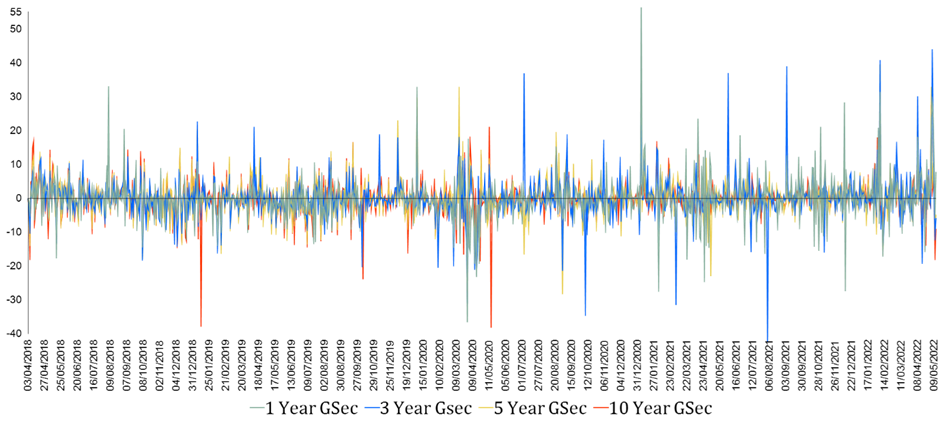
Figure 1 below presents a chart of the daily yield change in these 4 securities over this entire period of little over 4 years and 993 trading days.

Figure 1: Daily Change in Yields on GoI Securities in Basis Points

Source: Bloomberg, author’s analysis

Overall, the chart shows that the volatility of the daily change seems to go up with the onset of Covid in March 2020 with larger and more frequent spikes. This is especially true for the lower maturity; the 3 year and the 1 year maturity securities.

In order to understand the trends in the pattern of the daily change in yield, I plot the 30-day moving average of the daily change in yield as presented in Figure 2 below.

Figure 2: 30 Day Moving Average of Daily Change in Yields on GoI Securities in Basis Points

Source: Bloomberg, author’s analysis

Figure 2 clearly shows a pattern in the changes in the yield curve. The first period has much smaller change daily change in the curve and the changes across maturities are fairly highly correlated. The second period shows much more volatility in the daily change and a significant reduction in the correlation between yield change across maturity. This volatility comes down in the third period and the correlation improves, probably as an outcome of RBIs repeated exhortations and possibly actions in the bond market. The last period shows further reduction in volatility but the correlation is still lower than in the first period indicating that RBIs notices to the bond market and actions have had some success.

In order to more concretely understand the volatility and correlations across these periods, next two charts present the mean daily change in yields and the volatility of the daily change measured as the standard deviation of the daily change in yield.

Figure 3: Mean Daily Change in Yields on GoI Securities

Source: Bloomberg, author’s analysis

This chart clearly describes the interest rate trends in these four periods. The first period had, by and large, stable yield curve with very small changes in yields. The second period shows a secular decline in interest rates across all maturities in response to policy rate changes. The third period shows a reversal of trends and modest rise of interest rates ie the upward movement of the yield curve which becomes much more pronounced and sharper in the fourth period.

Figure 4: Volatility of Daily Change in Yields on GoI Securities

Source: Bloomberg, author’s analysis

This chart shows that the volatility of yield changes has indeed gone up noticeably in the third period when the overall rates showed an increase. The volatility increased especially for the shorter maturity papers – 1 year and 3-year maturity. This probably is the basis of the RBIs focus on ‘orderly’ evolution and hints to the bond market of its discomfort with high volatility. The fourth period shows that the elevated volatility has persisted which means that the bond market has responded only modestly to the RBI’s exhortations. Another important feature to note is that the volatility of the 10 year and the 5 year maturity securities has been contained in the third and the fourth period while that of the shorter maturity securities has continued to remain high. This possibly could also be due to RBI’s targeted interventionsh in the bond market to contain the rise and volatility of yields on long term securities.

Finally, I look at the correlations of yield changes across these maturities. Table below presents the correlation matrix of the four periods.

Table: Correlation Matrix for Yield Change in GoI Securities of Varying Maturities

Source: Bloomberg, author’s analysis

The correlation matrix shows high correlations between yield changes in the first period that start going down in the second period and decline precipitously in the third period. While they improve in the fourth period, they are still below the high levels of the first period. Clearly, the yield curve moved more haphazardly in the third period with high volatility and low correlation between yield changes across maturities. The fourth period shows improvement in correlations probably due to RBIs constant notices to the bond market (and its possible interventions in the market), they do not reach the levels of the first halcyon period.

Conclusion:

This data shows that RBI concern on orderly evolution of yield curve is well placed. The data clearly shows that in period 2, as the policy rates came down, the yield curve volatility shot up. It may well be that the RBI’s focus during this time was on keeping the long-term interest rates low to facilitate economic recovery during the pandemic. The bond market, on the other hand, was concerned about the economic impact of the pandemic and resulting tussle between the RBI and bond market participants actions resulted in increased volatility and break down of correlations in yield movements across maturity. RBI became aware of this volatility towards the third quarter of fiscal 2022 and realised that low rates will not be enough for economic recovery and the excess volatility must be curbed. As it started expressing its desire of an orderly evolution (accompanied possibly by market interventions) there was a modest decline in volatility and improvement in correlations. However, the markets are still not anywhere close to the halcyon pre-pandemic period.


Harsh Vardhan is an independent management consultant and researcher based in Mumbai. The author thanks Surbhi Bhatia for research assistance, and Josh Felman and anonymous referees for very useful comments

Monday, January 10, 2022

A cooperative liquidity window for mutual funds: A debate

by Harsh Vardhan vs. Josh Felman and Ajay Shah.


Problem statement

There is a mismatch between the growth of the mutual fund industry versus the maturation of the financial markets (Shah, 2018). This generated trouble after the IL&FS default of August 2018, and will likely make trouble in the future also. Mutual funds are in an awkward place, promising liquidity to their customers but lacking a liquid bond market. Some years ago, the exchanges were getting better, and there was a path to building the Bond-Currency-Derivatives Nexus, so we could hope that progress on both paths would come along and solve the problem of the mutual funds. Now, both elements (exchanges and bond market reform) have a weak outlook. Is there a way out of this conundrum? Can a liquidity window for mutual funds be created, through which the problem of the mutual funds can be solved?

Why we need this and how it can work, by Harsh Vardhan

Indian debt mutual funds have grown rapidly over the past few years. Debt funds got a strong push after demonetisation. Currently the total assets under management (AuM) of debt funds are ~ Rs 15 Trn. There are individual debt fund schemes with AuMs of over Rs 1 Trn.

Debt funds invest their corpus in debt securities. In India there are two main classes of debt securities – those issued by the government including central and state governments and those issued by companies. Both have very poor liquidity. In the case of government bonds, while there is a somewhat liquid interbank market, a large part of the liquidity is in a single ‘benchmark’ paper which is typically a 10 year bond. When a new 10 year bond is issued, the old one ceases to be the benchmark and its liquidity drops sharply. The lack of liquidity is even worse with corporate bonds.

Most debt mutual funds promise high liquidity to their investors. For liquid and short duration funds, redemption proceeds are credited to the investor on T+1 while for most other debt funds it is T+2. MFs suffer the agony of liquid liabilities and illiquid assets. They manage this challenge through two pathways: (a) holding cash (typically less than 5% of AuM) and (b) having credit lines from banks.

There is considerable systemic risk in the Indian financial system, and situations where these two pathways prove to be inadequate. As an example, Franklin Templeton shut down six debt schemes when redemptions were unusually large and the bond market was unusually illiquid. The redemption pressure that they faced had nothing to do with their money management; it was induced by an episode of systemic risk.

In the anatomy of these recurrent debt market crises, one interesting feature is market failure in the form of a negative externality. Purely at random, when large redemptions show up at any one door, the selling that this induces drives down prices (as the overall market is illiquid and impact cost is high), which adversely impacts the NAV of all other funds. For any rational economic agent that sees the first inkling of higher outflows (either by watching flows or by looking at NAV changes), it is rational to yank all debt investments. This creates a channel through which selling by one fund induces redemptions for others.

Another way to locate these problems in the framework of market failure is to see that market liquidity is a public good. As an example, the liquidity of Nifty futures is non-rival (your consumption of liquidity does not adversely impinge on my access to liquidity) and non-excludable (everyone can access the Nifty futures market). When we build liquid markets, we are creating a public good.

All market failure is ultimately a problem of coordination between economic agents. We should look for collective action through which some of the problems of debt mutual funds can be addressed.

There are two solutions going around, for this problem of bond market illiquidity, which just don’t make sense. One strategy is for regulators to demand that mutual funds hold more capital. Mutual funds are not balance-sheet based entities and the journey of trying to amplify their equity capital requirements is conceptually wrong. Another strategy is for the central bank or the government through any other agency, to run a liquidity window for mutual funds. When the full consequences of this play out for mutual funds, it is likely to leave them worse off.

Is there a way out of this jam? I believe we can establish a Cooperative Liquidity Window (CLW), built by mutual funds for mutual funds -- with a small involvement of the state -- which can help solve this problem. For the people who are too used to state leadership in such things, we should point out that the Bank of England played this kind of function -- liquidity support for distressed banks -- for centuries as a purely private organisation; it was only nationalised in 1946. During the great depression in the US in the 1930s, J P Morgan, founder owner of the eponymous bank, orchestrated a bail-out of the American banking system through co-operative efforts of larger, stronger banks. These experiences are food for thought, and the design proposed here draws on this history.

For such an emergency liquidity support mechanism, we should establish five conceptual objectives:

  • It should use no public money.
  • There should be an extremely low amount of state coercion involved, in getting some MFs to participate in the CLW, and no role for the state in terms of regulation, management, appointments, or rule-making of the CLW.
  • The governance of the mechanism should be within the AMCs that participate in it; it should operate as a self regulatory organisation.
  • The capital to set up and operate the mechanism should be provided by the participants; it should operate as a mutual co-operative; rules of access to the mechanism should be defined by the participants.
  • It should be only an emergency liquidity support system. The criteria for defining an emergency, and the extent of support that can be provided to individual entities, should be defined by members as the by-laws of the mechanism.

How would the proposed CLW work?

  1. The participating AMCs would create a vehicle by contributing to the equity of the vehicle. The vehicle could be set up as a trust or any other legal form that minimizes transaction costs.
  2. Some members would be coerced by SEBI (the largest firms adding up to perhaps 75% of the category AUM) and others would be voluntary participants (those who would like to benefit from its services even if not forced by SEBI). Apart from this, there would be no role for the state power in the CLW, in any fashion.
  3. The equity contribution of each MF should be determined by its debt fund corpus. For example, all MFs with debt fund AuM of over Rs 1 Trn might contribute Rs.5 Billion, those with an AuM of Rs 0.5 Trn to 1 Trn might contribute Rs. 3 Billion, and so on. The CLW governance must write the specific rules of equity contributions.
  4. The CLW would leverage up and create a corpus that supports a securities repurchase (repo) operation in the event of stress.
  5. When a member AMC faces severe redemption pressure (way beyond what is deemed normal by the members collectively as defined by the governance rule of the CLW) it would pledge its eligible debt securities to raise short term liquidity. This would be akin to a bank accessing the repo window in the event of a run.
  6. This window would also accept liquidity from members like a normal repo window.
  7. The rules regarding the extent of liquidity support provided, the tenure, the bid-ask spread, acceptable securities as collateral and hair cuts, etc. would all be defined by the members collectively.
  8. The CLW would operate as a not for profit entity or provide a modest return on equity to the member shareholders.

Currently there are ~45 AMCs in India. If we assume that 40 of them participate, each contributing an average of Rs 1 billion of equity capital, we would have Rs.40 billion of equity capital in hand. Assuming 4x leverage, the resources of the organisation would be Rs.160 billion. It is easy to go to much higher values.

The CLW should support participating MFs only in dealing with liquidity issues and not credit risk issues. This should be enshrined in the governance and operating rules of the CLW. Considering that the CLW will be managed by the AMCs themselves, who are all deeply informed players, it is reasonable to assume that they will be able to differentiate between liquidity and credit issues, Further, at a security level, the CLW will determine eligibility of securities and haircuts applicable. This will ensure that even in providing liquidity support, credit issues are not ignored. The rules of operation of the CLW should be well known, ex ante, so all the participating MFs face a predictable environment.

Let us simulate how the Franklin Templeton crisis might have played out, if this CLW was in place. The issues faced by Franklin Templeton’s shuttered debt funds schemes were purely liquidity issues: Over the last 18 months or so, they have returned upwards of 90% of the AUM at the time of shutting the schemes. Further, the return on these funds during the time was comparable with other funds in the same asset class. As the Franklin Templeton crisis was a liquidity crisis and not a credit crisis, the CLW would have been in play to support the liquidity crisis at Franklin Templeton. With illustrative assets of Rs.160 billion, it would have had the financial depth to deal with this situation, where all six affected funds put together had a total AUM of about Rs. 250 billion.

This design is not a substitute for a deep and developed bond market. A liquid market for securities is always the best solution to deal with any liquidity issues. But we face a problem today: We have a situation where the debt mutual funds corpus has grown very significantly and yet the bond market, especially the corporate bond market, remains very illiquid. The CLW is a mechanism where enlightened self interest can create a cooperative which helps the sector deal with a dangerous liquidity challenge.

In my proposal, there is only one use of state power: I feel SEBI should force large debt funds adding up to (say) 75% of the industry AUM to be members of the CLW, and force non-members to communicate this lack of membership in their customer-facing communications. The justification for this use of state power lies in the extent to which this would help reduce systemic risk (innocent bystanders being adversely affected in the next mutual fund crisis). This coercion addresses the free rider problem, where any one MF may derive benefits from the more stable mutual fund / bond market system, but try to be stingy in not paying for this stabilisation. Apart from this, I propose there should be no state involvement / control / regulation of the analysis, design, staffing, rule-making or operation of the CLW.

All members would have the self interest of making the facility work well -- as they are both owners and customers -- and they would thus exert governance. This is a problem where a cooperative solution works well. There is no market failure in the working of the CLW, and thus no role for regulation or any other involvement of the state.

There is one limitation in this design. The CLW will not be adequate if there is a full fledged financial crisis, such as what was experienced in 2008. In that case, the CLW would become one more element of the financial system that would have to be analysed in the crisis management at MOF.

There is no solution which can cover up for the lack of a bond market, by Josh Felman and Ajay Shah

Bond mutual funds are facing a serious dilemma. On the one hand, they promise investors liquidity, the ability to withdraw money at short notice. But on the other hand, they hold assets that are largely illiquid and difficult to sell. As a result, they face a mismatch between what they promise and what they can actually deliver.

Investors typically pay little attention to this mismatch, because most of the time it isn’t apparent. That’s because on most normal days, the investors who want to withdraw their money are more than counterbalanced by the many investors who are putting their money into the funds. It is only when this balance is disrupted, when a large proportion of investors “run” to take their money out, that mutual funds must sell their assets and the liquidity mismatch is revealed (Sane, Shah, Zaveri 2018).

Of course, banks face a similar mismatch problem. They, too, promise that depositors can withdraw funds easily, even as they hold assets (loans) that are even more illiquid than bonds. But in the case of banks there is a firewall against runs, namely the deposit insurance provided by the Deposit Insurance and Credit Guarantee Corporation. With this insurance, depositors know that their deposits are always safe. Accordingly, they have no incentive to rush to banks to withdraw their money, even if they find out that their bank’s loans have turned bad.

Could a Cooperative Liquidity Window (CLW) provide a similar firewall for debt mutual funds? At first blush, it seems like it would. After all, if the problem is that bonds are illiquid, then it seems logical to create a window that would allow funds to exchange bonds for cash. Moreover, the CLW proposal has some particularly attractive features. It would be a private initiative, involving no public money; and it would be employed only in emergencies, reducing the risk that it would distort financial markets. It avoids state failure by having no state involvement, apart from coercing large mutual funds (MFs) to become members.

But we see difficulties in translating this concept into a working liquidity facility. Consider the following problems with the proposal:

  • The illustrative corpus – Rs 160 billion – is relatively small, about the size of a single mutual fund group (such as Franklin Templeton). So, if several groups get into trouble at once, there won’t be enough liquidity to go around. In our thinking about the CLW proposal, we should think of something more like Rs.0.5 trillion of dry powder.
  • The proposal envisages that lenders will be willing to purchase Rs 120 billion of CLW debt. Would they really be willing to lend so much money to an unknown institution engaged in the risky activity of buying illiquid debt? And even if they did, what interest rate would they charge?
  • Assuming that lenders charge a relatively high rate of interest, how will the economics of every day operation of the CLW work out? In most years, its assets will simply be sitting in safe but low-yielding government securities, so it will suffer from a negative cost of carry. That means it will need to make compensating large profits on its occasional liquidity activities, by buying debt at very low prices and selling at high prices.

Let’s assume optimistically that these problems can somehow be overcome. We think the proposal still won’t work, because it has an important flaw: it is based on the premise that mutual funds facing runs are merely suffering from liquidity problems. But things are usually not this simple. Most runs involve credit risk issues, which means that there is a danger of defaults, which could saddle the CLW with large losses. And this makes all the difference. To be concrete: we don’t agree with Harsh’s relatively sanguine assessment of the Franklin Templeton story.

Runs on mutual funds follow a standard sequence. Initially, investors find out that a large bond-issuing firm is in serious trouble. In response, they start examining the portfolios of their mutual funds. And when they find the funds that are heavily exposed to the teetering firm, they run. This is precisely what happened in the case of Franklin Templeton. This firm invested aggressively in risky assets: even its “safe” Ultra Short mutual fund invested more than one quarter of its portfolio in assets rated A or below, rather than the AAA assets that such funds would normally hold. In addition, Templeton invested heavily in zero coupon bonds issued by Yes Bank. So when financial markets turned risk averse and Yes Bank ran into trouble, investors fled the Templeton funds.

In restrospect, it turns out these investors were correct: there was indeed credit risk. It is now almost two years since Templeton shut six of its funds, and the 300,000 investors in these funds still haven’t received all of their money back. Even if investors are reimbursed eventually for their full nominal amounts, they have suffered an opportunity cost. Inflation will have eaten away at the real value of their money, and they will have lost the opportunity to use the funds to meet last year’s expenses (such as Covid hospital bills) or make other investments. In particular, they were unable to place this money in the stock market, which has nearly doubled since withdrawals were frozen in April 2020.

The complexity of correlations and asymmetric information about credit and liquidity risk means that the proposed CLW will run into three problems:

  1. It could distort the incentives of mutual funds. Right now, mutual funds face market discipline. They know that if they invest in risky, illiquid bonds, they will get into trouble if investors panic and demand their money back. So most mutual funds – unlike Franklin Templeton – try to confine their purchases to safe, relatively liquid bonds. Precisely for this reason, most funds were able to survive the runs on Templeton largely unscathed.

  2. This discipline could disappear if a liquidity window is established. In this case, mutual funds will feel more free to buy risky, illiquid bonds. In fact, they might try to buy as many such bonds as possible. After all, risky bonds carry higher interest rates, so mutual funds that buy them will be able to advertise higher returns. And if things go wrong, these funds will always be able to pass the problem onto the CLW.

    Of course, they will not be able to transfer all their risk, since they have contributed to the equity capital of the CLW. For example, if they own 10 percent of the CLW, they would have to bear 10 percent of any losses faced by the CLW. Still, they might be able to pass on 90 percent of any potential losses. And this is enough to distort incentives.

    So, the CLW will try to stop such behavior, by limiting the types of debt they will buy. But this will not be easy.

  3. The CLW will find it difficult to use rules or discretion to determine what types of debt are eligible for the facility. If the CLW tries to use rules, that is to define the types of debt that they will buy, firms will employ ‘financial engineering’ to create debt that nominally conforms to the rules but in fact remains highly risky. This was how the US wound up in a financial crisis in the mid-2000s: because firms created synthetic bonds that were rated AAA but were actually highly risky. Closer to home, there are also examples of bonds that were deemed safe – like the AAA-rated bonds issued by ILFS – that nonetheless ended up defaulting.

  4. If the CLW consequently eschews rules and says instead that it will handle episodes using case-by-case discretion, users will fear that they cannot rely on the CLW, since such an approach would mean that other members could veto their attempt to unload their bonds to the facility.

    We request the reader to not envision peaceful times, when some trades are taking place and spreads are fine, but instead to think of times when spreads are high, recent trades have stale prices, and a pall of fear hangs over the market. Consider a situation like late 2008, when bond prices were plummeting. At that time, buying bonds was considered a foolhardy act, comparable to ‘catching a falling knife’. Would a consortium of mutual funds really have the courage to intervene in this situation?

    It is important to recall that the shareholders of the CLW are, themselves, bond market traders. They are the ones refusing to buy the bonds at any price on their own books – that is why the bonds are illiquid! So why would they allow their agent (the CLW) to do this? Consider the calculation of the other firms. If the CLW purchases the bonds, and the bonds default, the cost will have to be borne by the members of the cooperative. In contrast, if the CLW doesn’t purchase the bonds and the mutual fund is forced to shut down, the other firms might even benefit. Recall how the rest of the financial system `ganged up’ against LTCM in 1998, as they stood to gain from declining prices of LTCM’s positions.

  5. Even when the CLW is willing to purchase bonds, it will not be easy to agree on a price. When bonds are illiquid, their price is not known to anyone. The distressed mutual fund will plead for a high price – and it will have a say in the running of the CLW. But other shareholders would object, as they would not want to suffer losses. So the Board of the CLW will work themselves into a tizzy trying to agree on a sale price.

  6. Let’s assume the majority on the Board gets to decide the price.They will face an inherently difficult problem. Because the bonds are illiquid, the Board will need to guess the true value of the bonds on offer. And because the CLW would be running with an elevated leverage ratio, the consequences of guessing too high would be disastrous. At a 3:1 debt-equity ratio, a 30 percent fall in the price of the CLW’s assets would wipe out the entire equity capital. So, the CLW will need to offer a low price.

These three problems would haunt the CLW. It might freeze up with decision-making paralysis precisely at the times when decisive action is most required. Alternatively, it might proceed, but with excessive caution. It might purchase only select assets, meaning that many mutual funds facing runs would find the liquidity window closed. And even where the CLW was willing to purchase their assets, it is likely to offer a low price, which would prove ruinous to already-stressed MFs. These features interfere with the stated function of the CLW.

Many people remember stories from the Panic of 1907, where one person -- J.P. Morgan -- was the buyer of the last resort. This mechanism worked because Morgan was a self-interested profit-maximising individual who made a decision to use dry powder. He drove a hard bargain and purchased assets very cheaply, and turned a tremendous profit. He took enormous risk in the process, for he could have gone bankrupt himself. And, it could easily have been that the demand for liquidity insurance was bigger than his balance sheet, in which case his intervention would have gone badly wrong. For each J.P. Morgan who is celebrated for a 1907 event, there are many others who failed at various moments in history. We dream that a CLW will be able to think and act like J.P. Morgan, but its shareholders + board + management would find it impossible to have the entrepreneurial and risk-taking acumen of an individual. This is perhaps why we don’t see such a co-operative liquidity window in the world today.

A final point. We have stayed within the construct of no state intervention other than forcing MFs adding up to 75 percent of category AUM to become members. We fear, however, that when faced with the difficulties described above, the Indian state will not hold back even though there is no market failure. Once this happens, the familiar litany of state failure would commence.

We see this debate as a special case of a general principle. An economic policy strategy that addresses the surface symptoms is unlikely to work; the scope for financial engineering in public policy is very small. For a policy to succeed, it needs to engage in a root cause analysis, to address the underlying economic problem. If the problem is that investors are running from bond funds because they are inherently illiquid, then the only way to solve this problem is by reducing the mismatch between what these funds promise and what they can actually deliver. And that requires some fundamental financial reforms.

Hence, we would argue that the future of Indian finance remains along the strategy of the Financial Sector Legislative Reforms Commission (FSLRC). Once this is done, the need for a liquidity window will gradually fade away.

Bibliography

Mutual funds with feet of clay. Ajay Shah, Business Standard, 22 January 2018.

Runs on mutual funds. Renuka Sane, Ajay Shah, Bhargavi Zaveri. The Leap Blog, 12 October 2018.

Monday, August 09, 2021

Sudden Rise of the Floaters

by Rajeswari Sengupta and Harsh Vardhan.

The first two months of 2021-22 have witnessed a remarkable new trend in the corporate bond market—a sudden rise in the issuance of floating rate bonds or “floaters” and the use of the 91-day treasury bill yield as the reference rate in these bonds, instead of the yields on dated government securities (G-Secs).

We conjecture that one possible reason behind this new development could be an increase in the perception of interest risk on the part of the bond market participants. This in turn may have been a result of the active yield curve management undertaken by the Reserve Bank of India (RBI). If indeed dated government bonds such as the 10-year G-Secs have lost relevance as benchmark securities then this can lead to serious mispricing of risk in the economy, an unintended consequence of the RBI’s bond market intervention.

An interesting development in the bond market

Over the three-month period from April to June 2021, about 7 percent of the total corporate bond issuance of Rs 1.02 trillion consisted of floating rate bonds. While this percentage looks small, it is important to keep in mind that for the previous ten years or more, the share of floating rate bonds in the total issuance of corporate bonds has been less than 1 percent.

It is also important to note that the firms issuing these bonds and the investors investing in them are not a new class of issuers and investors. They are the same issuers and investors who were issuing and buying fixed-rate bonds until recently. In particular, 100 percent of the floating rate bond issuers now are non-banking finance companies (NBFCs) who were earlier issuing fixed rate bonds, and the investors are the same mutual funds and banks who were investing in fixed rate bonds earlier. This could imply that their behaviour has now changed due to external developments. It is as if the bond issuers and investors have suddenly developed a taste for floaters.

Corporate bonds are typically issued with a maturity of more than one year, along with a coupon, which is the rate of interest to be paid on the bond. Most bonds have a ‘fixed’ coupon—the rate of interest on the bond is decided at the time of issuance of the bond and remains fixed over the life of the bond.

This rate is a function of two factors – (i) the prevailing risk-free interest rate for the maturity matching that of the bond, and (ii) the credit risk spread that is added to compensate the investors for the default risk associated with the issuer.

The risk-free reference rate is ideally the interest rate on the government security of similar maturity. The credit spread is the function of the credit rating of the issuer. For example, if a AAA-rated issuer wants to issue a 5-year maturity corporate bond, then the risk-free reference rate will be the rate for a 5-year government security (let’s say 5.7 percent). If the credit spread of the AAA-rated issuer is an additional 100 basis points (1 percent), then the bond will be issued with a fixed coupon of roughly 6.7 percent. Note that this rate will apply to all the future interest payments by the issuer until the bond matures even if the underlying risk-free rate changes. This means that the investor in this bond is taking the interest rate risk. The secondary market price of these bonds reacts to changes in the underlying interest rates – the bond prices fall if the risk-free interest rate increases and bond prices go up if the risk-free rate decreases.

In the case of a floating rate bond, the main components of determining the coupon remain the same—a reference rate and a credit risk premium. The crucial difference is that the reference rate is no longer fixed but changes over time. Hence, these bonds are referred to as ‘floating’. The coupon on these bonds clearly specifies the reference-floating rate.

If the bond in the example cited above were a floating rate bond, then the coupon on it will not be a fixed rate of 6.7 percent. Instead, it will be the rate on 5-year government security at the time of interest payment plus 1 percent. In other words, for a floating bond, the applicable interest is computed at the time of payment of interest. If the 5-year government security rate moves up by 0.5 percent in a year then the interest rate payable will become 7.2 percent. The investor in such a bond is more protected from interest rate risk and the prices of these bonds in the secondary market fluctuate much less with movements in interest rates.

In the last two months, floating rate bonds worth Rs 70 billion have been issued in the corporate bond market, almost entirely by private companies. Overall, bonds worth Rs 793 billion have been issued by the private sector including NBFCs. The floating rate bond issues in these two months thus represent around 10 percent of private sector bond issuance.

An interesting feature of these floaters issued in the last two months is that all of them have used the yield on 91-day treasury bills (T Bills) as the reference rate. Notwithstanding the fact that these corporate bonds have maturities ranging from 2 to 4 years, yields on dated government securities (i.e., G-Secs with maturity of more than 1 year) have not been used as a reference.

What might explain this sudden preference on the part of the issuers and investors for these floating bonds?

What might be going on?

One possibility could be a heightened perception of interest rate risk. Bond investors might be harbouring the belief that the interest rates on dated G-Secs are unlikely to remain at their current levels. As discussed earlier, issuing floating rate bonds is one way to mitigate interest rate risk. This raises the next question – why would the perception of interest rate risk suddenly go up now?

We conjecture that this could be a result of the manner in which the RBI has been managing interest rates in the government bond market. The Covid-19 pandemic presented the Indian economy with an unprecedented challenge. A combination of falling tax revenues and rising expenditure on account of fiscal stimulus resulted in a massive increase in the fiscal deficit of the government, and a corresponding rise in government borrowing from the bond market. In 2020-21 the consolidated government borrowing was a whopping Rs 21.5 trillion and the planned borrowing for 2021-22 is roughly Rs 19.6 trillion. The overall government debt to GDP ratio is roughly 90 percent, the highest ever.

The RBI on its part has taken multiple steps to ensure that interest rates are kept low in the bond market so that the government’s cost of borrowing remains under control. It has allowed several primary auctions of G-Secs to devolve on primary dealers and has even canceled auctions when it did not receive bids at rates that were low enough. In addition to its standard open market operations (OMOs), it initiated the Operation Twist program whose objective was to bring down interest rates at the long end of the yield curve and push up rates at the short end. This meant that the RBI was buying long-dated G-Secs and selling shorter maturity bonds.

In March 2021 the RBI launched a program called the G-SAP wherein for the first time it pre-committed to buying a specific amount of G-Secs. These bond market interventions are mostly aimed at capping the interest rate on the benchmark 10-year G-Sec at 6 percent. As a consequence of these actions, the RBI has ended up owning a substantial amount of the 10 year benchmark government bonds (link).

It is possible that bond investors believe that the RBI will not be able to suppress the interest rates for too long, and the rates will rise sharply and suddenly. This could be either because of the large volume of G-Secs the government needs to issue to finance its deficit or because of growing inflationary concerns in the Indian economy (CPI inflation has exceeded the upper limit of 6 percent of the RBI’s targeted inflation band in both May and June 2021), or because of external factors such as rising inflation in the US.

This is akin to a spring that has been forcefully compressed but can bounce back anytime. If the rates suddenly go up, holding fixed coupon bonds will lead to losses, as explained earlier. This increased risk perception might be one possible explanation as to why the investors now prefer floating rate bonds.

Arguably, another unintended consequence of the steps taken by the RBI to lower the long-term G-Sec yields and suppress the organic evolution of the yield curve in response to market forces may have been that the bond market participants have lost confidence in the yield curve.

In the past whenever inflation went up, 10-year G-Sec yields would also go up, implying a positive correlation between the two variables. The underlying idea is that rising inflation is usually followed by a tightening of the monetary policy stance which in turn leads to higher long term bond yields.

For instance, figure 1 below plots the 10-year G-Sec yield alongside CPI (consumer price index) inflation from 2004-05 to 2013-14. This was a period of high and rising inflation. CPI inflation went up from 3.8 percent in 2004-05 to more than 10 percent in 2012-13. Concomitantly, the 10- year rate went up from 6.6 percent in 2004-05 to more than 8 percent by 2012-13.

Figure 1: CPI Inflation and 10year G-Sec yield, 2004-05 to 2013-14

But recently this correlation seems to have broken down. We can see this clearly in figure 2, which plots the two series using monthly data, focusing on the period from March 2020 to June 2021. CPI inflation began rising from May 2020 onward. It consistently breached the 6 percent upper limit of the RBI’s targeted inflation band during the period April-October 2020, increasing from 5.8 percent in March to 7.6 percent in October. More recently it went up from 4.2 percent in April 2021 to 6.3 percent in June 2021.

Figure 2: CPI Inflation and 10year G-Sec yield, March 2020 to June 2021

However, this time around, rather than increasing, the 10-year G-Sec yield actually fell from 7.5 percent in April 2020 to 5.8 percent in May, since then holding more or less steady around 6 percent. These developments suggest that G-Sec rate might be distorted by the RBI’s interventions, which in turn might explain why some investors are turning to the T Bill rate as a preferred reference rate.

Other explanations are, of course, possible. The rise of floaters could also be a result of companies expecting interest rates to come down, in which case they would not want to issue long-term debt at higher rates. This however seems unlikely. Given that inflation continues to be a concern, interest rates are more likely to go up rather than down, and sooner or later RBI would need to start normalising the surplus liquidity situation that the financial system is currently in.

Alternatively, floaters could be issued if the private sector is tapping a new class of investors, who are interested in buying bonds but do not want to run any interest rate risk. But the issuers of and the investors in the floaters are exactly the same entities that were participating in fixed-rate bond transactions earlier.

Finally, it is also possible that the funding requirements of the NBFCs (the sole issuers of floating rate bonds right now) have undergone some changes which might have increased their preference for these bonds.

Conclusion

We are observing an interesting new development in the corporate bond market. The rise of floating rate bond issuances by private NBFCs, and the use of the 91day T Bill rate as the reference rate seem to indicate a change in the preferences on the part of both issuers and investors.

We conjecture that one reason that might explain this development is the intervention in the bond market by the RBI to control G-Sec yields. Specifically, it is possible that the RBI’s persistent interventions have caused some market participants to lose trust in the yield curve. This possibility needs to be explored further in the future.

If there has indeed been an erosion of credibility in the yield curve, then this would be a serious problem. The yield curve is a fundamental construct in a market economy, as it defines the interest rate structure that is used to price debt. As a result, if the yield curve is distorted, then interest rate risk is being mispriced. The associated misallocation of resources could prove to be costly, damaging the economy just as it struggles to recover from the Covid crisis.


Harsh Vardhan is Executive in Residence at the Center for Financial Studies (CFS) at the SP Jain Institute of Management and Research. Rajeswari Sengupta is an Assistant Professor of Economics at the Indira Gandhi Institute of Development Research (IGIDR). The authors thank Josh Felman and an anonymous referee for their useful suggestions.

Friday, August 07, 2020

The Indian corporate bond market: From the IL&FS default to the pandemic

by Rajeswari Sengupta and Harsh Vardhan.

The banking sector is the most important financial intermediary in India's debt market. Over the last few years the bond market has emerged as an alternative to the banking sector especially for the top rated firms. This trend has been pronounced ever since the banking sector started reporting high levels of non performing assets. Figure 1 below shows the flow of commercial credit in India from various sources and highlights the growing relative importance of bond issuance especially from 2015 onwards.

The bond market has faced two big shocks in recent years: (i) the default by IL&FS (Infrastructure Leasing and Financial Services Limited) in September 2018, followed by other relatively low-impact shocks due to problems in companies such as DHFL (Dewan Housing and Finance Limited) and IndiaBulls Housing Finance as well as Yes Bank, and (ii) the outbreak of the Covid-19 pandemic in India since March 2020. As a result of these shocks the risk perceptions in the bond market have gone up. In this article, we take a look at changes in the risk perceptions in the corporate bond market especially in the ongoing context of the pandemic and ensuing economic slowdown. We also highlight the asymmetry in the risk perceptions of the markets towards private sector corporate bonds vis-a-vis public sector unit (PSU) bonds and discuss the likely implications of changes in the risk perceptions, for the future funding model of non-banking finance companies (NBFCs).

Figure 1: Flow of Commercial Credit in India (Source: RBI)

Measuring risk perception

The most important metric for assessing risk perception in the bond market is the credit spread which is the difference between the yield of a corporate bond and of a government security of comparable maturity. Highly rated bonds (with ratings of AAA and AA) are traded relatively actively and their yields reflect changing perceptions of investors regarding the riskiness of these bonds. Movement over time of credit spreads on corporate bonds is therefore a good indicator of the bond market's perception of risk.

We look at the credit spreads of AAA rated bonds of 3 years and 5 years maturity from April 2018 to June 2020. The data is sourced from Bloomberg. The bonds in our data are separated into 3 categories - NBFCs (non-banking finance companies) and HFCs (housing finance companies), private corporations and public sector undertakings (PSUs), which may include public sector NBFCs such as Power Finance Corporation (PFC) and Rural Electrification Corporation (REC). The figures 2 and 3 below show the evolution of credit spreads for these three categories of bonds for the two specific maturities.

The IL&FS default

Figure 2: Credit Spreads on 5 Year AAA Paper (Source: Bloomberg)

As we see from figure 2 above, prior to September 2018, the credit spreads on the NBFC, private corporate and PSU bonds were fairly stable, between 50 and 100 basis points for the 3 year paper and between 40 and 60 basis points for the 5 year paper. In the rest of our discussion we focus on the credit spreads on the 5 year paper. The pattern is more or less the same for the 3 year paper, only the absolute levels of credit spreads are different.

Figure 2 shows that credit spreads on NBFC AAA paper of 5 year maturity nearly doubled between September 2018 and November 2018 and reached 160 basis points by February 2019. This shows that the IL&FS episode that unfolded in the 3rd week of September significantly enhanced the risk perception of the bond market regarding all top rated NBFCs.

After a small dip, the spreads went back to around 140-150 basis points by July 2019 and stayed at this high level, with some fluctuations, till November 2019. During this period, crisis in other NBFCs (such as the Dewan Housing and Finance Limited (DHFL)) as well as in Yes bank, added to the overall risk perception of the bond market. This is reflected in the credit spreads remaining high one year after the IL&FS default.

Private corporate and PSU bonds' credit spreads also widened in the aftermath of the IL&FS default, but not by the same magnitude as the NBFCs. The IL&FS default triggered a liquidity crunch primarily for the NBFC sector. The corporate sector experienced spill over effects owing to a rise in risk aversion in the bond market.

While in the pre IL&FS default period the spreads of all three categories of bonds were closely bunched together, the difference between them began increasing from October 2018 onwards. The difference was particularly acute between the NBFC and private corporate bond spreads on one hand and the PSU bond spreads on the other hand especially in the second half of 2019. This is despite the fact that these bonds were all rated AAA. This reflects the implicit government guarantee enjoyed by the PSU bonds.

The government and the RBI took several actions to deal with the ensuing crisis in the NBFC sector. Government appointed a new Board for IL&FS. RBI took several steps including open market operations to inject liquidity into the system, reducing the risk weights on bank lending to NBFCs, instructing banks to disburse sanctioned but undisbursed credit to NBFCs etc.

These eventually resulted in enhanced credit flow to the NBFCs which reduced the credit spreads in the later part of 2019. For both NBFCs and private corporate sector, the spreads declined by about 50 basis points to settle at about 100 and 50 basis points respectively. These spreads, especially for the NBFCs, were still higher than pre-IL&FS episode but much lower than their peak. We see a similar dynamic with the 3 year maturity bonds as well as shown in figure 3 below, except the absolute levels of the spreads were different.

Figure 3: Credit Spreads on 3 Year AAA Paper (Source: Bloomberg)

The Covid-19 outbreak

Just as the bond market was recovering from the shock of IL&FS default followed by crises in DHFL and Yes bank, the Indian economy got hit by another massive shock in the form of the ongoing Covid-19 pandemic. Credit spreads in the bond market began rising sharply from the middle of March once again reflecting growing risk perceptions. Figure 2 shows the increase in the spreads around the time when the nationwide lockdown was announced on 24 March.

For both NBFC and corporate bonds, the spreads rose by about 30-40 basis points between February 2020 and April 2020. For both categories of bonds the credit spreads reached their peak in the first half of May, close to 180 basis points for NBFCs and 170 basis points for the corporate bonds. The peak of the credit spreads during the pandemic has so far been higher than the peak reached in the aftermath of the IL&FS default episode.

Spreads on PSU paper also went up, but by a smaller amount. The average spread on these bonds in March and April was only 30-35 basis points. The difference between the credit spreads on NBFC and corporate bonds on one hand and PSU bonds on the other widened significantly to about 100 basis points. The large gap in spreads for bonds of the same ratings is worth noting. Similar to the post-IL&FS period, this too is a reflection of the market's perception of implicit government guarantee to the public sector units.

The impact of policy actions on credit spreads

The sharp rise in credit spreads of NBFC and corporate bonds in April 2020 could be attributed to the announcement by the RBI to grant moratorium on loan repayments for all borrowers in order to alleviate the financial stress triggered by the pandemic and the lockdown. Following this announcement, NBFCs had to offer moratorium to their borrowers but at the time it was not clear whether they themselves would also receive a moratorium from banks on their repayment obligations.

In the second half of May, the government announced a package to boost the economy. This included Rs 20 lakh crore of 'benefits' and effectively entailed an outlay of around Rs 3 lakh crore for 2020-21. RBI also adopted several policy initiatives such as cutting the policy interest rates aggressively and establishing new long term targeted repo operations (T-LTRO) that would provide 3 year funding to banks under a repo arrangement. RBI made the repo arrangement `targeted' so as to ensure that the funds raised by the banks were made available to the NBFCs.

These policy actions increased the credit supply to all issuers. Consequently, by the 3rd week of June, the credit spreads on both NBFC and corporate bonds came down from their respective peak levels of mid May by about 50 basis points.

However, the RBI and government actions notwithstanding, the credit spreads for NBFCs and private corporate sector continue to be substantially high. In fact the spreads in June 2020 were similar to the spreads in December 2018 in the aftermath of the IL&FS default. For PSUs the spreads have come down to around the same levels that prevailed before the IL&FS crisis.

This shows that the bond market remains concerned about the riskiness of the corporate sector and the NBFCs. PSUs on the other hand, benefit from implicit government guarantee. The significantly lower credit spreads they are experiencing in the time of the pandemic reflect a `flight to safety' by the bond investors.

Credit spreads and funding costs

As we interpret the bond market data, it is important to understand the difference between credit spreads and funding costs. Credit spreads going up does not necessarily mean that the cost of funding for the issuer is going up. Cost of funding for a company that raises capital in the debt market depends on the market determined yield on the security it issues This yield on debt consists of two components: risk free rate and credit spreads. RBI's monetary policy impacts the risk free rate but not the credit spreads. Credit spreads reflect the premium that the investor charges over and above the risk free rate, taking into account the inherent riskiness of the underlying bond.

Since the IL&FS episode, the risk free rate has been coming down steadily due to the actions by the RBI such as reduction in the policy interest rates (repo and reverse repo rate) and large scale open market operations to inject liquidity in the financial system. Figure 4 below depicts the yield on 5 year and 3 year government securities from the April 2018 to June 2020 period.

Figure 4: Government Securities Yield

The 5 year risk free interest rate has come down from about 8.4% in September 2018 (before the IL&FS episode) to about 5.5% in June 2020 indicating a decline of 300 basis points. The 3 year risk free interest rate has declined even more to about 4.5% over this period, a decline of nearly 350 basis points.

Since RBI's monetary policy does not affect the credit spreads, the impact of policy action on the actual cost of funding will not be the same as the reduction in the risk free rate. If risk aversion in the market goes up, then investors will demand higher price for the credit risk which will result in rising credit spreads. Thus, the net cost of funding for an issuer may decline to a lower extent compared to the reduction in the policy rates.

This is what has been happening since the IL&FS episode. Risk free rate has been declining but owing to high risk aversion, credit spreads have remained elevated. As a result, funding costs of companies have not come down by as much as the risk free rate. This implies that in an environment of high and rising risk perception such as the ongoing Covid-19 period, the effectiveness of policy rate cuts will be constrained.

The widening gap between the credit spreads on PSU debt versus private sector points to lower risk perception for PSU entities which are perceived to have implicit sovereign guarantees. The combined effects of rising risk perception, widening gap between credit spreads of identically rated issuances and reduction in the policy interest rates would mean that the debt market will skew towards government owned issuers who might experience the greatest reduction in funding cost.

Conclusion

Bond market credit spreads provide important information about the risk perception of an important class of investors. Sustained high credit spreads (compared to long term average levels) suggest elevated risk perception and imply heightened risk aversion. Specifically, it also points to the role that individual episodes of corporate defaults and the associated policy responses (or lack thereof) play in shaping risk perceptions.

Wide spreads between bonds of the same ratings issued by private companies and those owned by the government clearly indicates a strong perception of the implicit government guarantee enjoyed by public sector companies. This raises important questions as to whether the debt of government owned companies should be treated as a part of government's debt.

Finally, economic recovery in India in the post Covid-19 period will depend crucially on the flow of credit in the economy. The economic package recently announced by the government depends largely on the financial sector. Nearly 70% of the 'benefits' of Rs 20 lakh crore in the package are expected to be routed through the financial sector. In a recent article we discussed the rise in risk aversion in the banking sector. With both the banks and the bonds markets showing high levels of risk aversion, growth of credit may be less than envisaged in the package. This may dilute the overall effectiveness of government's monetary and fiscal policy actions.


Harsh Vardhan is an Executive-in-Residence at the Center for Financial Studies and an Adjunct Faculty at the SP Jain Institute of Management and Research, Mumbai. Rajeswari Sengupta is an Assistant Professor of Economics at IGIDR, Mumbai.